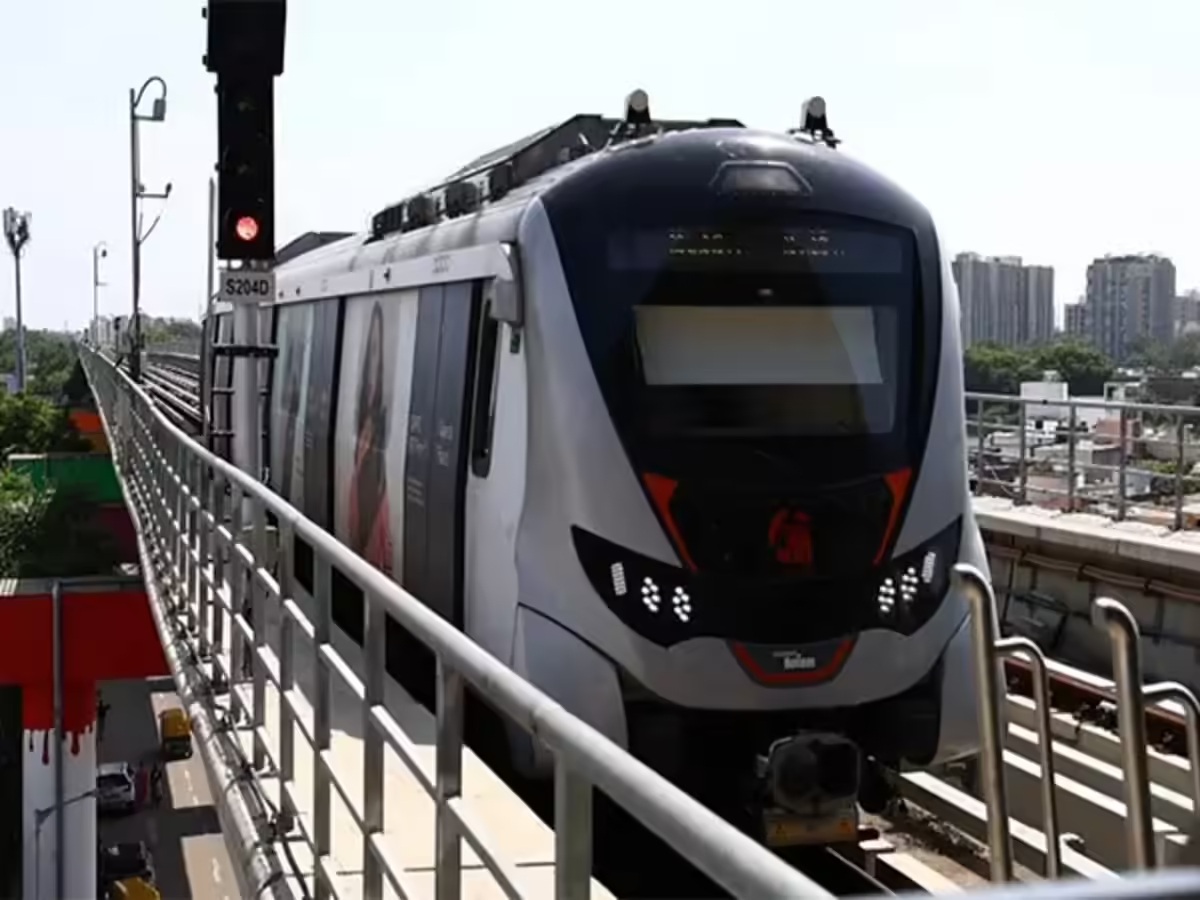
Ahmedabad’s expanding metro network has entered a new operational phase, with the Gujarat Metro Rail Corporation (GMRC) restructuring routes, terminal stations and service frequencies across key corridors linking the city with Gandhinagar. The recalibration places Koteshwar Road as a major northern terminal, signalling a shift in how the region’s fast-growing urban spine is being planned and used.
The most consequential change affects the north–south corridor, which now runs between APMC and Koteshwar Road. By extending services beyond the earlier northern endpoint, GMRC has lengthened the corridor to just over 20 kilometres while compressing end-to-end travel time to about 35 minutes. Urban transport planners say this adjustment reflects rising residential density and employment activity in northern Ahmedabad, as well as the need to better distribute passenger loads away from event-centric zones. Ahmedabad Gandhinagar Metro connectivity has also been streamlined through modifications to the intercity corridor linking the state capital. The route connecting Koteshwar Road with Mahatma Mandir has been shortened compared to earlier alignments, trimming both distance and journey time. Officials familiar with the planning process indicate that the revision is intended to improve operational efficiency while maintaining dependable links between administrative hubs, residential clusters and transit-oriented development zones.
On the east–west axis, the Vastral Gam to Thaltej Gam corridor continues to function as the city’s most frequent service, with peak-hour trains running at shorter intervals during weekdays. Reduced frequencies during off-peak hours and weekends are designed to balance ridership demand with energy efficiency, an increasingly important consideration as cities aim to lower the carbon intensity of public transport systems. The Ahmedabad Gandhinagar Metro remains a critical connector for daily commuters, students and office workers travelling between the two cities. However, service frequency on this corridor is notably lower than within Ahmedabad’s urban limits, highlighting the challenge of sustaining high-capacity transit across lower-density stretches. Urban mobility experts note that improving last-mile access and encouraging mixed-use development around stations will be key to unlocking higher ridership and long-term viability.
Meanwhile, limited-hour operations on the GNLU–GIFT City corridor underscore the experimental nature of transit planning in emerging business districts. With metro services supplemented by buses during mid-day hours, authorities appear to be testing demand patterns before committing to full-day operations. The short travel time on this stretch positions rail as a potential catalyst for reducing car dependency in one of Gujarat’s most ambitious commercial zones. Taken together, the network changes point to a more adaptive approach to metro planning one that responds to land use, commuter behaviour and sustainability goals rather than fixed blueprints. As Ahmedabad continues to grow outward and upward, the effectiveness of the Ahmedabad Gandhinagar Metro will depend not just on track length or frequency, but on how seamlessly it integrates with housing, workplaces and people’s daily lives.