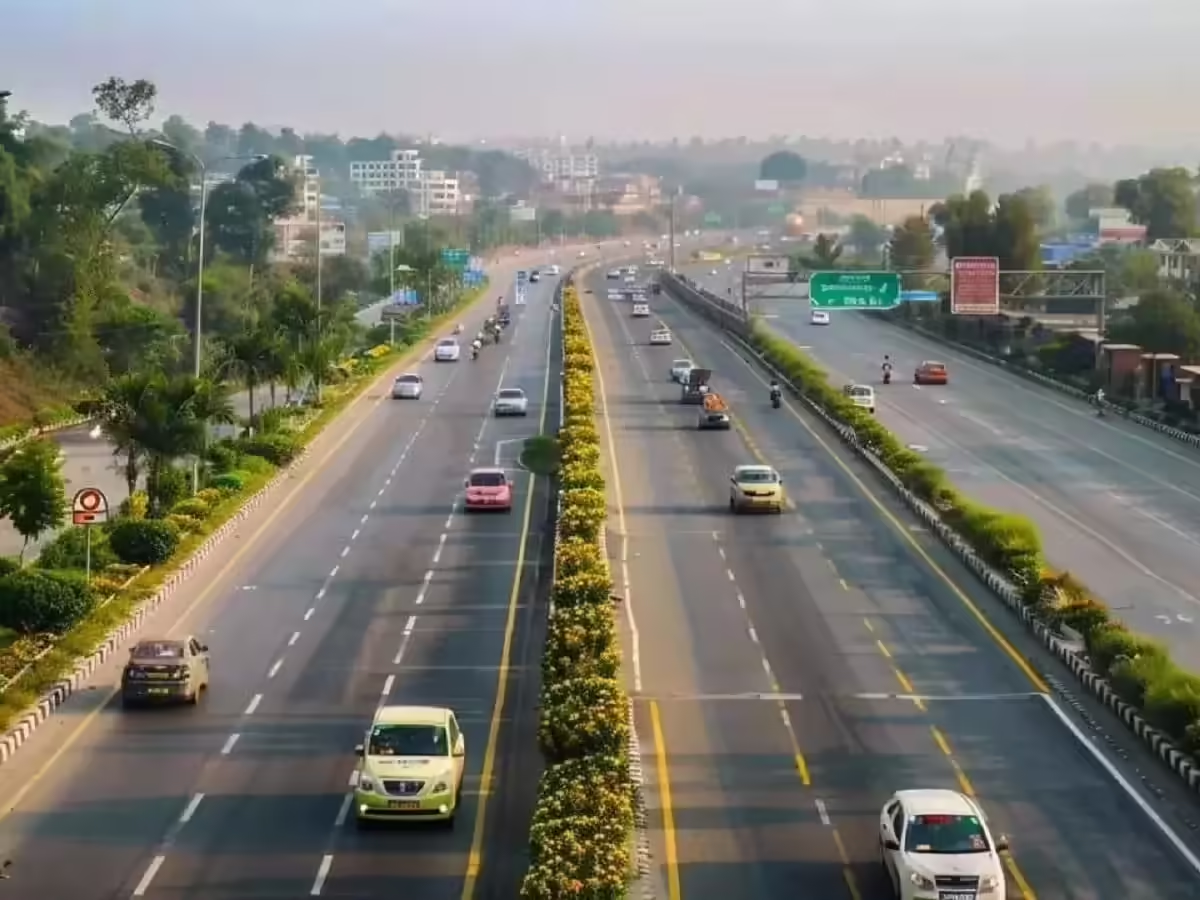
The Gujarat government has cleared a large-scale road expansion that will significantly alter mobility patterns across north and central Gujarat. The Ahmedabad–Mehsana highway, a critical intercity connector, is set to be transformed into an eight-lane corridor, marking one of the state’s most consequential transport investments in recent years. The decision carries implications well beyond faster commutes, shaping logistics efficiency, land use, and regional economic integration.Stretching roughly 51 kilometres, the upgraded corridor is expected to compress travel time between Ahmedabad and Mehsana to under an hour once completed. Officials involved in the planning say the project has been designed to respond to sustained traffic growth from industrial freight, commuter movement, and expanding residential zones along the route. Tendering is expected shortly, with construction timelines estimated at around two years.
Unlike earlier highway widenings that focused mainly on capacity, the Ahmedabad–Mehsana highway project adopts a more layered approach to traffic management. Dedicated service roads on both sides are intended to separate local movement from through traffic, a design feature urban planners say is essential for reducing conflict points, improving safety, and supporting adjacent settlements without choking the main carriageway. The inclusion of an elevated stretch through Kalol is being positioned as a congestion-mitigation measure in one of the corridor’s busiest urban nodes. Multiple flyovers and underpasses are also planned to streamline junctions that currently slow freight vehicles and public transport. Existing overbridges will be expanded to match the new eight-lane configuration, ensuring continuity across the corridor rather than isolated upgrades.
From an economic standpoint, the Ahmedabad–Mehsana highway functions as a spine connecting manufacturing clusters, agro-processing centres, and emerging logistics parks in Mehsana, Patan, and Banaskantha districts. Industry observers note that improved road reliability could reduce transport costs, enhance supply-chain predictability, and make peripheral districts more attractive for decentralised industrial growth. Urban development specialists also point to the project’s potential influence on real estate patterns. Faster, safer connectivity typically encourages housing demand in satellite towns, while service roads can support mixed-use development if managed carefully by local authorities. However, they caution that unplanned ribbon development could strain water resources and local infrastructure if zoning controls are not enforced alongside road expansion.
Environmental and safety considerations will remain under scrutiny as execution begins. Transport experts stress the importance of integrating drainage, pedestrian crossings, and service road access to prevent highways from becoming barriers within growing towns. As Gujarat continues to invest heavily in transport infrastructure, the Ahmedabad–Mehsana highway expansion reflects a broader shift toward high-capacity corridors that serve both economic growth and daily mobility. The project’s long-term success will depend not just on speed gains, but on how well it balances regional development, safety, and sustainable urban expansion.