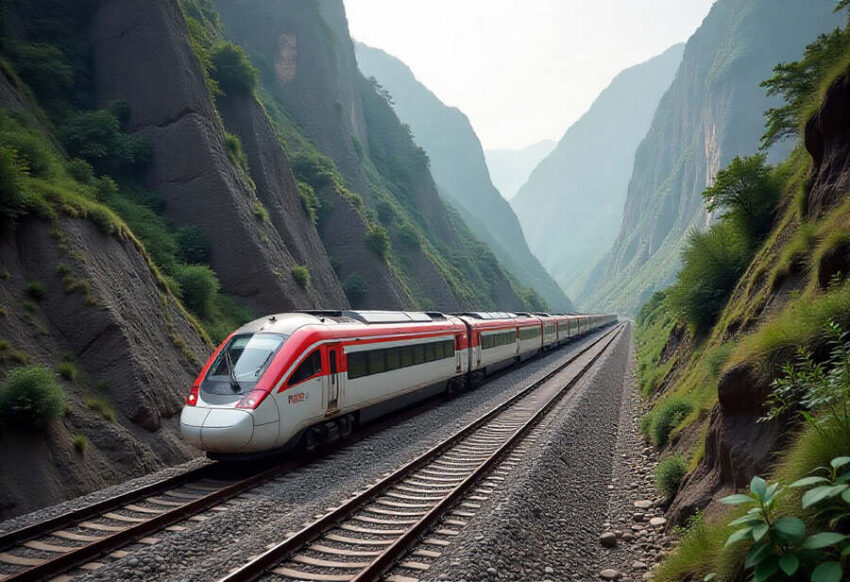
A crucial underground engineering milestone has been reached in Maharashtra’s Palghar district, strengthening momentum on the Mumbai–Ahmedabad bullet train corridor and signalling steady progress on India’s most ambitious rail infrastructure project. The latest tunnel breakthrough near Saphale marks a significant step in building continuous high-speed connectivity between the country’s financial and industrial centres.
The newly completed tunnel, part of a cluster of underground structures along the coastal and semi-rocky stretch north of Mumbai, is designed to carry bi-directional high-speed rail traffic. Engineers involved in the project say the breakthrough reflects growing confidence in managing complex geological conditions that have historically slowed large infrastructure works in the region. For urban planners and mobility experts, this milestone reinforces the feasibility of dense, climate-resilient transport systems in geographies once considered technically restrictive. The tunnel was constructed using adaptive excavation techniques that allow design and reinforcement to respond in real time to ground behaviour. Such methods are increasingly favoured in urbanising regions where groundwater, fractured rock, and nearby settlements require careful risk management. According to infrastructure specialists, completing excavation within a year highlights improved coordination between design teams, contractors, and safety monitoring systems.
The Mumbai–Ahmedabad bullet train spans more than 500 kilometres across Maharashtra, Gujarat, and the Union Territory of Dadra and Nagar Haveli. Once operational, trains on the corridor are expected to run at speeds exceeding 300 kilometres per hour, reducing intercity travel time to roughly two hours. Beyond speed, the project is positioned as a structural shift in how long-distance commuting, business travel, and regional labour mobility are organised in western India. Several tunnels are currently under construction in Palghar district, while parallel work is underway on elevated viaducts, river crossings, and station infrastructure. In the Mumbai metropolitan region, a long underground section linking key commercial districts is progressing alongside surface-level works such as highway crossings and rail overbridges. Project authorities indicate that substantial portions of viaduct construction and bridge works are already complete, particularly along the Gujarat stretch, where track laying and electrification have gathered pace.
Urban economists note that the Mumbai Ahmedabad bullet train is likely to reshape real estate demand, logistics planning, and industrial clustering along its route. Faster, predictable travel between cities could ease pressure on megacity housing markets while supporting secondary urban centres. From a sustainability perspective, high-speed electric rail offers a lower-emission alternative to short-haul aviation and road transport, aligning with long-term goals for cleaner mobility. As construction advances from structural breakthroughs to systems integration, attention will increasingly shift to safety certification, station-area planning, and last-mile connectivity. How effectively these elements are integrated will determine whether the corridor delivers not just speed, but inclusive and resilient urban growth across western India.