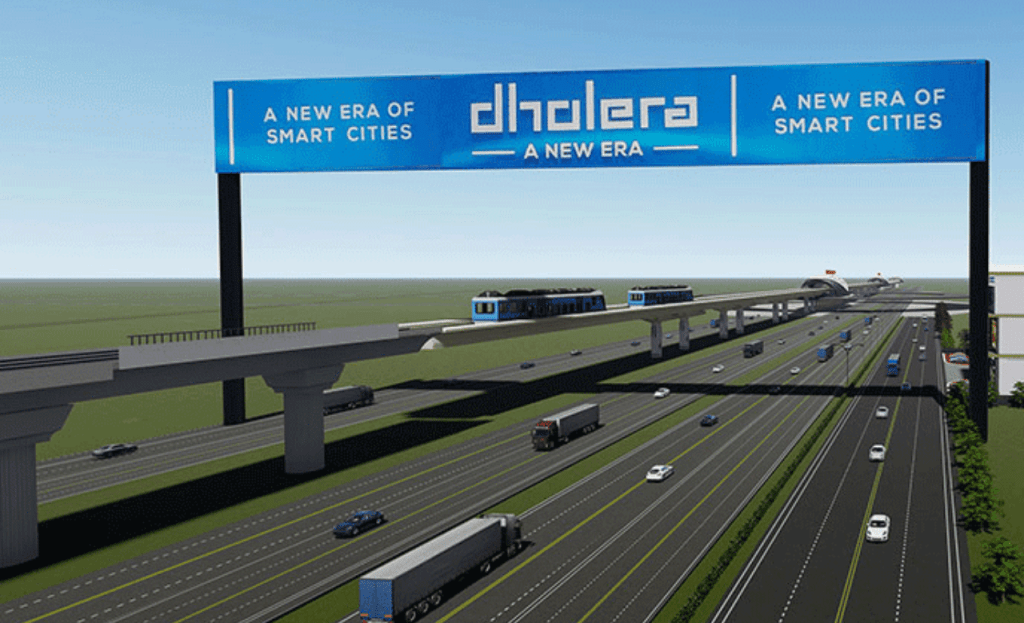
Investor attention is increasingly consolidating around Dholera, positioning the emerging industrial city as a key anchor in western India’s next phase of urban and economic development. Stretching towards Lothal and Ahmedabad, the evolving Dholera–Ahmedabad belt is being viewed by market participants as a long-horizon growth corridor shaped by infrastructure readiness, employment creation and global connectivity. Industry observers note that recent investor interactions have underlined a preference for clearly sequenced urban development rather than fragmented real estate expansion. Dholera’s planned city framework, integrated utilities and logistics-led design are being cited as reasons it is gaining traction as a starting point for long-term capital deployment, rather than a peripheral bet on future appreciation.
Urban planners point out that Ahmedabad’s expanding national profile is reinforcing this shift. Over the past decade, the city has invested heavily in transport networks, sports infrastructure and public realm upgrades, raising its visibility among international institutions and event organisers. While India’s ambitions to host future global sporting events remain at a proposal stage, the associated planning has already influenced thinking around tourism capacity, accommodation supply and regional mobility across the Ahmedabad–Dholera axis. A critical enabler in this equation is the upcoming international airport near Dholera. Aviation experts suggest that once operational, the facility could redistribute passenger flows away from saturated metro hubs and support business travel, cargo movement and longer-stay visitors. This has implications for hotel development, serviced housing and mixed-use districts designed to accommodate transient as well as permanent populations.
Hospitality consultants say early tie-ups between developers and established hotel operators are being interpreted by investors as signals of demand forecasting rather than speculative construction. Such associations, they argue, help impose operating discipline and lifecycle planning, which is increasingly important as regulators and financiers scrutinise environmental performance and land-use efficiency. Beyond tourism, the Dholera growth corridor is also being shaped by industrial employment. The semiconductor and advanced manufacturing ecosystem proposed for the region is expected to draw engineers, technicians and global consultants, creating demand for rental housing, social infrastructure and expat-oriented neighbourhoods. Urban economists caution that the success of this transition will depend on whether housing supply remains affordable and public services keep pace with workforce inflows.
Experts also emphasise the environmental stakes. As greenfield cities expand, the integration of renewable energy, water recycling and low-carbon mobility will determine whether growth aligns with climate-resilient urban models or replicates legacy inefficiencies seen elsewhere. As capital continues to search for regions combining infrastructure depth with governance clarity, Dholera’s role within the wider Ahmedabad region is likely to sharpen. The next phase will test whether coordinated planning across industry, housing and transport can deliver inclusive, resilient urbanisation rather than isolated real estate outcomes.