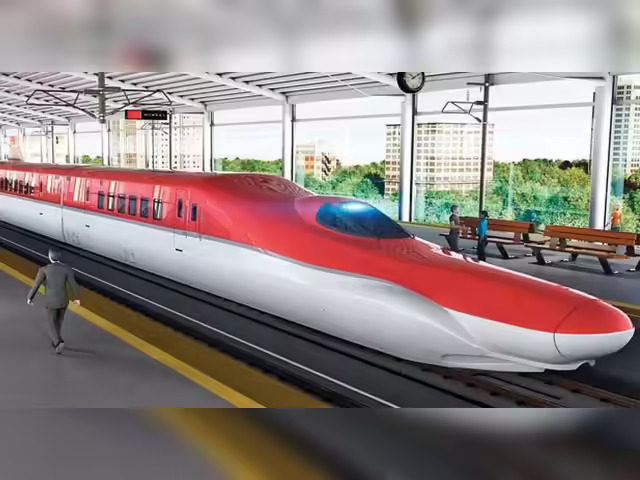
Ahmedabad is set to emerge as a pivotal node in India’s next phase of intercity mobility, as the Union government advances plans to extend the country’s high-speed rail network beyond the western corridor and deeper into central and southern India. The proposed expansion would dramatically compress travel times between Ahmedabad and major economic centres such as Pune and Hyderabad, altering long-distance commuting, business travel, and regional integration. According to officials familiar with the planning framework, the existing Ahmedabad–Mumbai high-speed rail corridor is proposed to continue southwards, connecting Pune and Hyderabad through dedicated bullet train alignments. Once operational, journeys that currently require overnight travel or full-day commitments could be completed within a few hours, reshaping how professionals, students, and enterprises move between cities.
For Ahmedabad, the implications extend beyond convenience. Urban economists note that high speed rail connectivity typically strengthens secondary business hubs by reducing the friction of distance. Faster access to technology, manufacturing, and services clusters in Maharashtra and Telangana is expected to enhance Ahmedabad’s role as a commercial gateway between western and southern India. The expansion is part of a broader national blueprint outlined in the Union Budget for 2026–27, which proposes close to 4,000 kilometres of new high-speed rail routes, with a longer-term ambition of nearly 7,000 kilometres. Transport planners see this as a shift from city-centric infrastructure to corridor-led development, where mobility investment is aligned with economic geography rather than administrative boundaries.
Urban planners point out that high speed rail projects also carry significant land-use implications. Stations along the extended corridor are expected to catalyse transit-oriented development, encouraging higher-density, mixed-use growth around rail nodes. If executed with strong zoning controls and affordable housing mandates, such development could support more compact, energy-efficient cities while reducing reliance on carbon-intensive road and air travel. Environmental analysts add that high speed rail, when powered by cleaner electricity sources, offers a lower-emissions alternative for medium-distance travel. This is particularly relevant as Indian cities grapple with congestion, air pollution, and rising transport-related emissions. Shifting a portion of intercity trips from flights and highways to electrified rail could contribute to broader climate resilience goals.
However, experts caution that the success of the expansion will depend on execution. Land acquisition, last-mile connectivity, ticket affordability, and integration with local transit systems will determine whether the benefits are broadly shared or limited to premium travellers. Transparent project phasing and coordination with state governments will also be critical to maintaining timelines and public trust. As detailed project reports move forward, the proposed high speed rail extensions signal a rethinking of how India’s cities connect not as isolated metros, but as part of a faster, more integrated urban network where time, distance, and opportunity are fundamentally rebalanced.