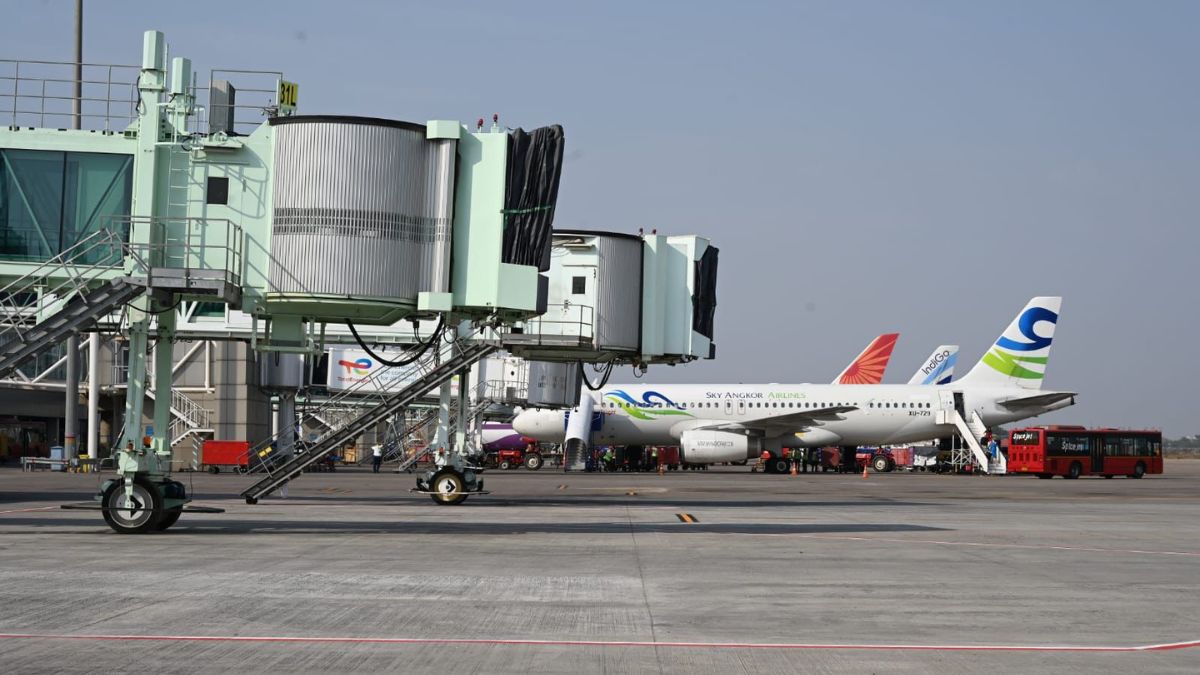
Ahmedabad’s principal aviation gateway has expanded vehicular access at its domestic terminal, adding three new traffic lanes to the arrivals forecourt in a bid to ease persistent congestion and improve passenger movement. The intervention at the Sardar Vallabhbhai Patel International Airport comes amid rising private vehicle dependence and growing domestic passenger volumes, signalling how air mobility infrastructure must adapt to evolving urban travel patterns.
The latest changes increase the total number of lanes outside Terminal 1 to nine. Airport officials said the reconfiguration includes a dedicated corridor for app-based taxis and commercial cabs, alongside adjustments within the parking circulation zone. The aim is to separate vehicle types and reduce overlapping movements that frequently led to bottlenecks during peak hours. Domestic travel now accounts for a majority of the airport’s vehicular load. Authorities estimate that thousands of cars enter and exit the campus daily, with a significant proportion linked to Terminal 1 operations. During holiday seasons and evening peak windows, vehicles often queue beyond the kerbside area, affecting approach roads and increasing idle time an operational challenge with both economic and environmental implications.
Urban mobility planners note that such congestion at airport forecourts reflects a broader metropolitan trend: rising reliance on private cars and aggregator taxis for first- and last-mile connectivity. While additional lanes may ease immediate pressure, they also highlight the absence of stronger public transport integration within airport precincts. Surface access to major airports across India remains heavily road-dependent, contributing to carbon emissions and localised traffic stress. At Ahmedabad airport, travellers have long reported delays in pick-up coordination, especially when vehicles struggle to access the arrivals kerb. The newly designated cab-only lane is expected to streamline flow and improve kerbside discipline. Officials indicated that traffic patterns will be closely monitored over the coming weeks to assess whether the expanded configuration delivers measurable reductions in wait times.
However, some urban design observers argue that improving road capacity alone may not fully resolve accessibility concerns. Auto-rickshaw facilities, commonly used by cost-sensitive passengers, are located at a distance from the main exit, requiring longer walking routes. For elderly passengers, families with children, and those carrying luggage, this remains a usability issue that touches on inclusive infrastructure design. As Ahmedabad continues to grow as a commercial and logistics hub, passenger throughput at its airport is expected to rise further. The recent upgrade underscores the need for airports to function not only as transit nodes but as integrated mobility systems. Balancing efficiency, safety, and sustainability will be critical if the Ahmedabad airport is to manage rising demand without exacerbating congestion or environmental strain. For now, the expanded lane network represents an incremental but necessary step in modernising landside operations with longer-term solutions likely to depend on multimodal planning and climate-conscious mobility investments.