


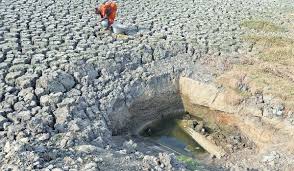
Tamil Nadu is entering a new phase of water stress, with official assessments indicating that several districts are extracting groundwater faster than it can be replenished — a trend that raises serious concerns for urban growth, agriculture and industrial expansion across the state.
A recent joint evaluation by central and state water authorities shows that nine districts fall in the “over-exploited” category, meaning annual extraction exceeds natural recharge. Two districts are classified as “critical”, where usage ranges between 90% and 100% of available replenishable reserves. More than ten others fall in the “semi-critical” band.According to data placed before Parliament by the Union water resources ministry, Tamil Nadu’s annual groundwater recharge stands at 22.61 billion cubic metres (BCM), while the extractable resource is estimated at 20.46 BCM. Annual groundwater extraction is pegged at 15.04 BCM, or roughly 73.5% of available replenishable reserves.
Hydrologists point out that the concern lies not only in the state-wide average but in district-level imbalances. When extraction crosses 100%, it begins to tap into static reserves — deeper aquifers that function as long-term buffers rather than annual sources. Once these reserves decline, recovery becomes significantly harder and costlier.Districts such as Salem, Vellore, Chennai, Dindigul, Namakkal and Thanjavur are among those flagged as over-exploited. Krishnagiri and Coimbatore fall under the critical category, while districts including Tiruvannamalai, Villupuram, Madurai and Erode are categorised as semi-critical.
For rapidly urbanising regions like Chennai and its industrial corridors, the Tamil Nadu groundwater crisis carries implications beyond water availability. Real estate growth, manufacturing investments and peri-urban housing expansion often rely on borewells in areas where piped supply remains uneven. Without regulatory oversight, this can accelerate aquifer depletion.Officials note that the state has invested heavily in artificial recharge, rainwater harvesting, watershed development and desalination infrastructure over the past five years. Dashboard data under the national water campaign suggests thousands of crores have been spent on recharge structures and conservation measures. Authorities also state that a majority of monitored wells show rising levels. However, depletion remains pronounced in districts such as Dindigul, Namakkal, Tiruppur and Thoothukudi.
Water policy experts argue that regulation remains the missing link. The earlier groundwater legislation was repealed over a decade ago, and a new comprehensive water resources law passed this year is still awaiting final assent. Until a monitoring and licensing framework becomes operational, enforcement challenges persist.Urban planners warn that climate variability — alternating droughts and extreme rainfall — makes reliance on groundwater increasingly risky. While desalination and tertiary treated water offer supply buffers for cities, rural and semi-urban communities remain heavily dependent on aquifers.The Tamil Nadu groundwater crisis underscores a broader transition challenge: balancing economic expansion with ecological limits. As the state pursues industrial growth and housing development, the sustainability of its water base will determine how inclusive and climate-resilient that growth can ultimately be.
Also Read:Nashik Pune Highway To Be Widened Before Kumbh
Tamil Nadu groundwater crisis deepens statewide
