


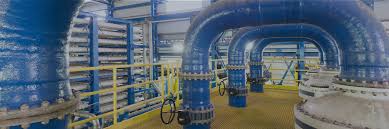
Chennai’s long-term water security strategy received a significant push this week as senior state officials reviewed progress at the 400 MLD Perur desalination plant, a project expected to expand the city’s potable supply capacity by nearly one-third when commissioned in 2027. Located along the coast and executed by the metropolitan water utility, the facility is designed to serve both core urban zones and fast-growing suburban clusters.
With close to 60% of construction reported complete, the Perur desalination plant represents one of the largest single water infrastructure investments currently under execution in the region, with an outlay exceeding ₹6,000 crore. The project is being supported through international development financing, underscoring its strategic importance within Chennai’s climate adaptation roadmap.The Perur desalination plant is being built with advanced treatment systems including seawater intake structures, pre-treatment units such as lamella clarifiers and dissolved air flotation systems, followed by reverse osmosis membranes that remove dissolved salts. Associated facilities for sludge handling, neutralisation and mineral balancing are also under development to ensure treated water meets potable standards.
Offshore engineering works — often the most technically complex component of coastal desalination — have crossed key milestones. Large-diameter intake and outfall pipelines have been laid beneath the seabed to draw in raw seawater and safely discharge brine after treatment. Officials indicate that final offshore connections will be integrated with the main plant infrastructure in the coming months.Equally critical is the distribution backbone. A nearly 60-kilometre transmission pipeline is being laid to connect Perur with the city’s western distribution node, enabling integration into existing pumping stations and storage reservoirs. Partial pipe deliveries have been completed, and on-ground laying is progressing in phases.
Once operational, the Perur desalination plant will add 400 million litres per day to a system that currently supplies around 1,230 MLD from a mix of reservoirs and an existing desalination facility. The additional capacity is expected to benefit over two million residents across Greater Chennai and adjoining local bodies, including rapidly urbanising suburban panchayats.Urban planners view desalination as both an opportunity and a constraint. While it reduces dependence on monsoon-fed lakes — increasingly vulnerable to climate variability — it is energy intensive and demands careful environmental management of marine ecosystems. Experts note that future resilience will depend on integrating desalination with demand management, wastewater recycling and aquifer recharge.
For Chennai’s real estate and industrial corridors, predictable bulk water availability could reduce tanker dependence and stabilise development planning. However, as population and built-up area expand, policymakers will need to balance large-scale supply augmentation with conservation and efficiency.The commissioning of the Perur desalination plant in 2027 will mark a structural shift in Chennai’s urban water mix — but sustaining equitable and affordable distribution will define its long-term impact.
Also Read:Maharashtra Cabinet Clears 1000 Acres For Industrial Park
Chennai Perur desalination plant nears completion
