Ahmedabad has cleared a ₹18,518 crore municipal outlay for 2026–27, placing renewable energy, riverfront recreation and civic welfare at the centre of its urban agenda. The scale and direction of the Ahmedabad Budget 2026 signal an attempt to balance infrastructure expansion with climate-conscious investments in one of India’s fastest-growing urban economies. The approved budget increases overall spending compared to the previous year and prioritises traffic decongestion through new grade separators, including one overbridge and three underpasses in high-pressure corridors. City planners say such interventions are aimed at easing bottlenecks along arterial routes and peri-urban stretches that have seen rapid real estate growth.
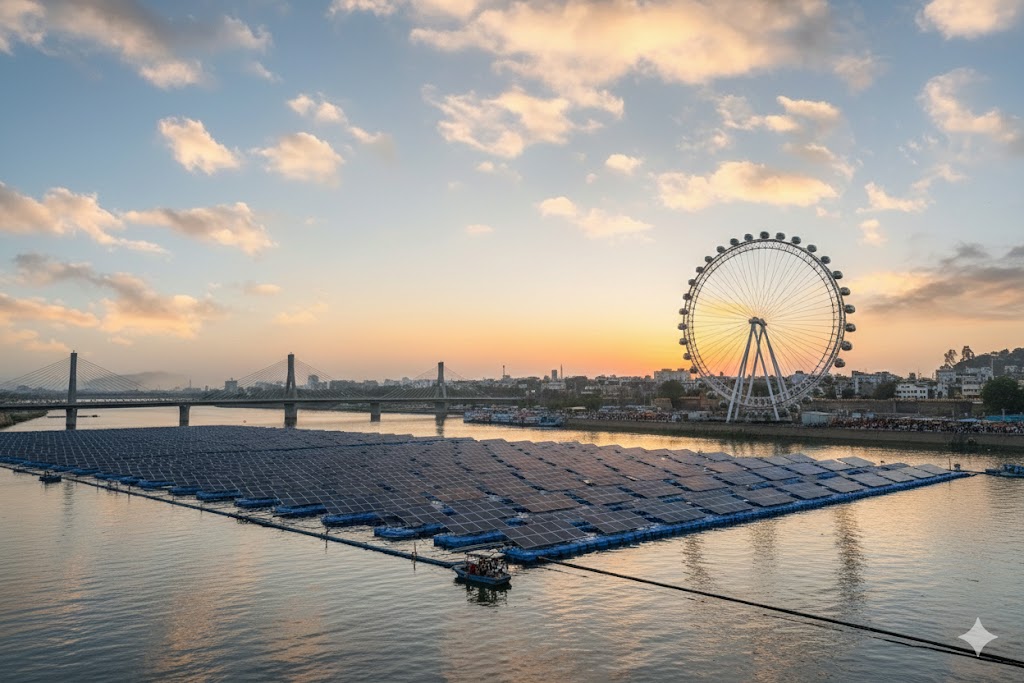
However, the more consequential shift lies in energy and environmental infrastructure. For the first time, the civic body has earmarked ₹50 crore for floating solar installations across lakes and sections of the Sabarmati. A 10 MW plant is proposed at Lamba Lake, marking Ahmedabad’s entry into water-based solar generation. Urban energy experts note that floating systems reduce evaporation losses and help limit algae growth while freeing up scarce land parcels for housing or public amenities. The Ahmedabad Budget 2026 also sets aside funds for vertical wind turbines, an emerging technology suited to dense urban settings. Unlike conventional windmills, these compact systems can harness wind from multiple directions and may power street lighting and public facilities. While the allocation is modest, sustainability analysts view it as a pilot step towards decentralised renewable generation within city limits.
Recreation and placemaking feature prominently. A large observation wheel is proposed along the Sabarmati Riverfront, alongside new themed gardens including a bonsai park. Civic officials describe these projects as efforts to enhance public spaces and tourism appeal. Yet urban designers caution that such capital-intensive attractions must be matched by maintenance planning and inclusive access to avoid becoming underutilised assets. On the social front, allocations include funding for cancer screening and treatment support, sanitation upgrades, expanded public toilet facilities and rain shelters for the homeless. The administration has also indicated plans to make the city “beggar-free”, alongside creating structured grievance redressal mechanisms. Gender-sensitive measures such as distribution of sanitary products in municipal schools are part of the welfare framework.
Environmental remediation has been budgeted through surveys and technical studies to address industrial discharge into the Sabarmati, as well as investments in lake aeration and green cover along railway corridors. Opposition voices within the civic body have questioned fiscal transparency and execution capacity, pointing to gaps between budget announcements and on-ground delivery in previous years. Urban finance specialists argue that the true test of the Ahmedabad Budget 2026 will lie in implementation timelines, private sector participation and measurable sustainability outcomes. As India’s cities compete for investment and liveability rankings, Ahmedabad’s strategy reflects a broader shift: infrastructure growth is no longer judged solely by roads and flyovers, but by resilience, clean energy integration and the quality of shared public spaces. The coming fiscal year will reveal whether intent translates into durable urban transformation.