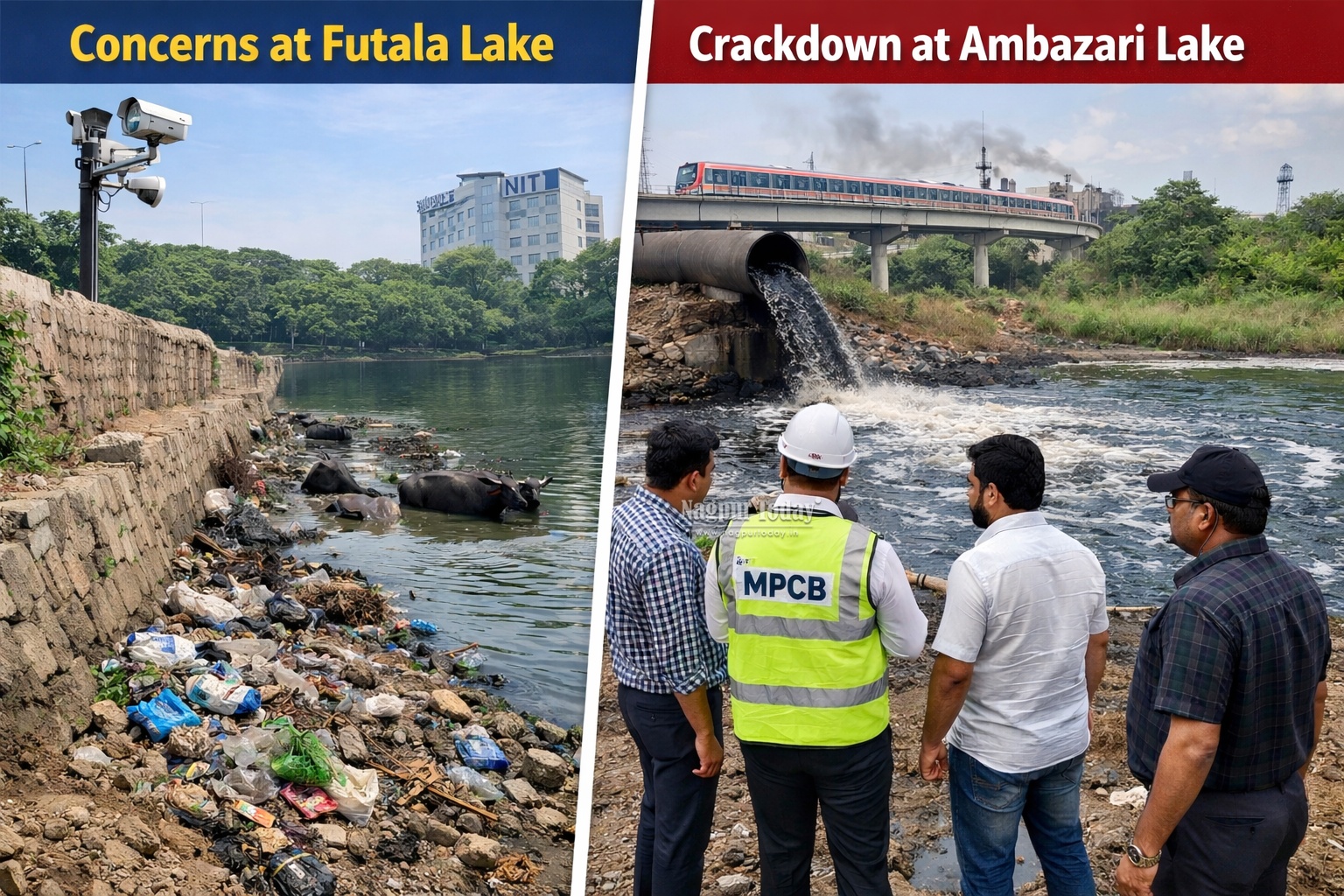
Nagpur NGT Action Targets Futala and Ambazari Lake Pollution
The National Green Tribunal (NGT) has stepped up judicial scrutiny over the deteriorating environmental conditions of Futala Lake, directing municipal authorities to prepare a time-bound plan for sewage infrastructure after finding longstanding neglect of pollution controls in the city’s iconic water body.
Simultaneously, the Maharashtra Pollution Control Board (MPCB) has initiated enforcement actions against industrial polluters affecting Ambazari Lake, highlighting the compounded challenge of water quality management in Nagpur’s urban ecosystem. The NGT’s February orders require the Nagpur Municipal Corporation (NMC) to submit detailed proposals within weeks for constructing a new sewage line — estimated at ₹23.6 lakh — aimed at preventing untreated waste from entering Futala Lake. In issuing the directive, the tribunal noted that outdated sewage infrastructure has been unable to cope with increased loads, allowing contaminants to degrade water quality. Futala Lake, historically a recreational hub in the city, has suffered from nutrient-driven pollution, with frequent algal and water hyacinth growth documented in recent years as untreated sewage inflows have continued.
The NGT has expanded its scrutiny to include other agencies, including the Nagpur Improvement Trust (NIT) and Maha Metro, on compliance with environment management plans and lake wall reconstruction. Experts argue that credible environmental governance must go beyond surface-level removals of water hyacinth and stray waste. “Unless primary sewage interception and treatment systems are modernised, operational gains from mechanical weed removal or anti-littering squads will remain temporary,” said a senior environmental planner familiar with inland water restoration. This aligns with broader national emphasis on protecting urban waterways as key climate adaptation assets.
In parallel, the MPCB has reportedly taken action against industrial units discharging effluents into Ambazari Lake, Nagpur’s largest water body. Continuous pollutant influx from adjacent municipal council areas and industrial zones has accelerated eutrophication — a process where excess nutrients fuel invasive plant growth and oxygen depletion — necessitating regulatory intervention. Ambazari’s plight has been well-documented: routine clean-up efforts struggle to counter persistent water hyacinth growth driven by nutrient-rich sewage inflows, underscoring the limits of reactive responses in absence of source control.
For residents and recreational users, these water bodies are more than ecological assets — they influence public health, urban microclimates, and quality of life. The NGT’s insistence on actionable sewage plans reflects a judicial acknowledgement that urban lakes are integral to sustainable city buffers, flood mitigation and biodiversity in rapidly densifying regions. Local civic advocacy groups have welcomed the regulatory attention, while urging NMC to couple compliance with robust community engagement and transparent monitoring. “Restoration must be participatory and data-driven,” one planner said, noting that water quality indices should be publicly shared and tied to clear milestones.
As Nagpur’s lakes face renewed legal and regulatory pressure, the coming weeks will test whether enforcement can translate into durable restoration, equitable access to urban nature, and climate-resilient water infrastructure — key pillars of sustainable urban futures.