


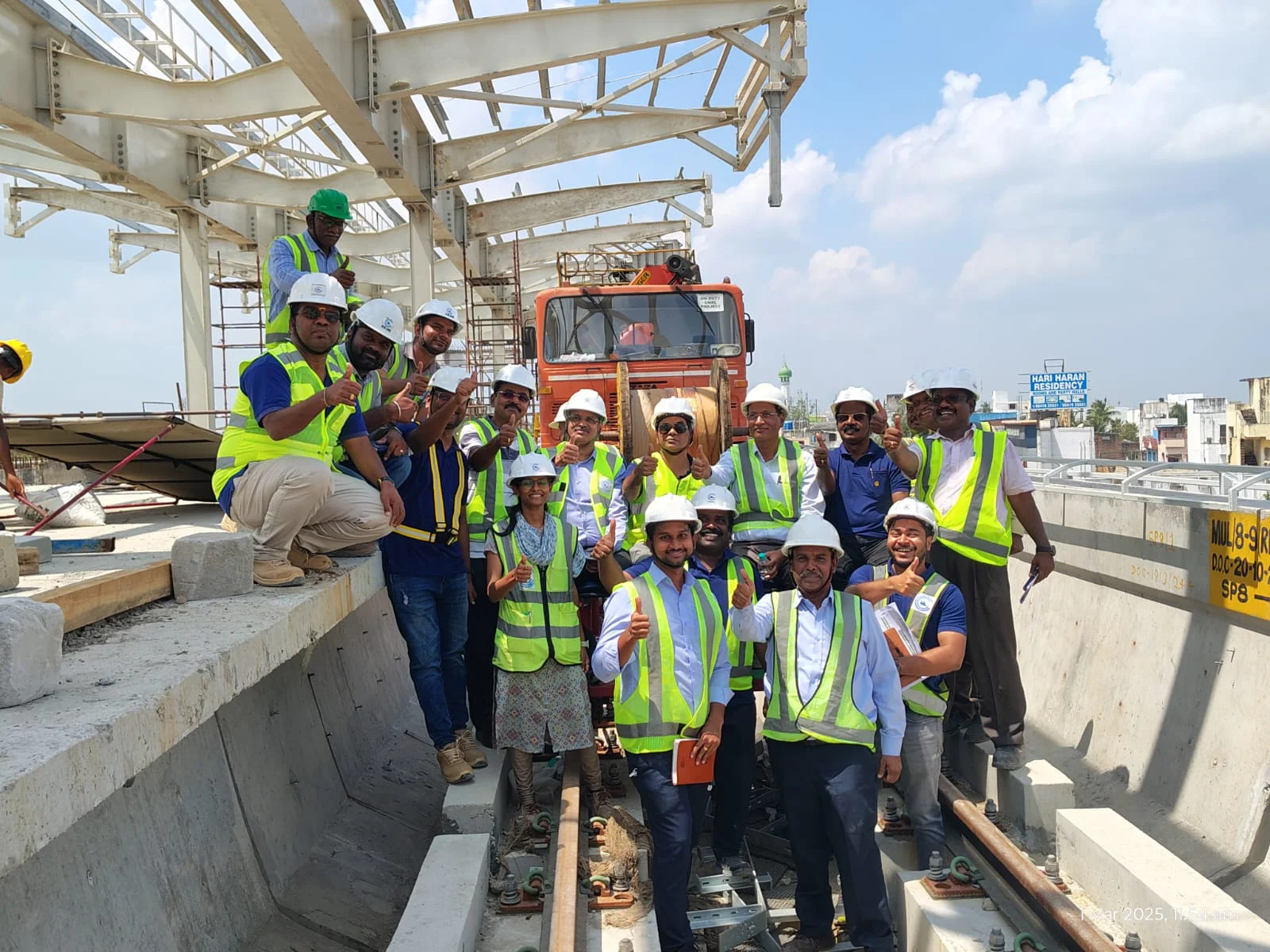
Chennai’s expanding metro network reached a significant construction milestone this week as underground tunnelling on one of its most complex corridors moved closer to completion. A tunnel boring machine completed a critical underground drive on Line 4 of Chennai Metro Phase II, marking steady progress on a section designed to ease congestion along the city’s densely built central spine.
The breakthrough occurred at a shaft location in the southern part of the city, completing a nearly two-kilometre underground stretch beneath some of Chennai’s most established neighbourhoods and institutional zones. For planners and mobility experts, the development signals growing momentum in a project that is central to the city’s long-term shift towards low-carbon, mass public transport.Line 4 is a 26-kilometre corridor connecting the coastal Light House area with the Poonamallee Bypass, integrating residential, commercial and employment clusters across the metropolitan region. A substantial portion of this alignment runs underground between the city’s eastern seafront and western arterial corridors, reflecting the constraints of building new transport infrastructure in a fully urbanised environment.
The completed tunnel section was constructed beneath more than a hundred existing structures, including heritage buildings, public institutions and active residential zones. Engineers involved in the project describe the work as technically demanding, requiring continuous ground monitoring and vibration control to avoid surface disruption. Urban infrastructure specialists note that such subterranean construction allows cities to add transport capacity without large-scale land acquisition or displacement, a growing priority in inclusive urban development.Chennai Metro Phase II includes multiple underground packages on Line 4, together accounting for several kilometres of twin tunnels built using multiple tunnel boring machines. This approach enables parallel construction, reducing overall project timelines while maintaining safety standards in sensitive zones. Officials overseeing the project say tunnelling progress is now aligning with station box construction and systems planning, an important step towards integrated commissioning.
From a wider economic perspective, the corridor is expected to strengthen connectivity between employment hubs, education centres and residential districts, reducing reliance on private vehicles. Transport economists point out that metro-led development can lower commute times, improve labour mobility and support more compact urban growth patterns. For real estate markets, improved mass transit access often reshapes housing demand, encouraging higher-density, transit-oriented developments along metro corridors.Environmental analysts also highlight the climate implications. As Chennai faces rising emissions and heat stress linked to traffic congestion, underground metro corridors offer a scalable alternative that cuts per-capita transport emissions while improving air quality. However, they caution that timely completion, last-mile connectivity and integration with buses and non-motorised transport will determine the project’s real impact.
With tunnelling milestones now being achieved across multiple Phase II corridors, attention is gradually shifting to systems installation, safety certification and operational readiness. For Chennai, the progress on Line 4 underscores how complex underground engineering is becoming a cornerstone of building resilient, people-first and sustainable urban transport systems in India’s large cities.
Also Read:Kolkata Municipal Climate Training Advances Urban Resilience
Chennai Metro Line 4 Tunnelling Milestone Reached
