


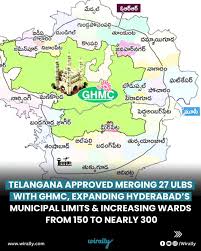
Hyderabad’s urban governance structure is once again under scrutiny as discussions emerge around a possible reorganisation of the Greater Hyderabad Municipal Corporation, reflecting the pressures created by rapid spatial expansion and population growth. With its jurisdiction now spanning over 2,000 sq km and covering hundreds of wards, the civic body has become one of the largest municipal entities in the country, raising questions about administrative efficiency, service delivery and long-term urban resilience.
The city’s municipal journey dates back to the late 19th century, when a formal civic system was first introduced to manage sanitation, roads and public order in the historic core. Over successive decades, Hyderabad’s municipal boundaries were repeatedly redefined to accommodate suburban growth, industrial expansion and new residential areas. Each restructuring responded to changing urban realities, from colonial-era neighbourhoods to post-Independence integration of twin cities and, later, satellite settlements.The most transformative shift came in the mid-2000s, when multiple municipalities and rural local bodies were consolidated into a single metropolitan civic authority. This move aimed to enable integrated planning for infrastructure, water supply, transport and land use across the urban region. More recently, the inclusion of additional urban local bodies nearly doubled the number of wards and tripled the geographical footprint of the corporation, turning it into a mega-governance unit overseeing diverse urban, peri-urban and semi-rural zones.
Urban planners and governance experts note that while scale can bring coordination benefits, it also stretches administrative capacity. Managing local roads, drains, solid waste systems and neighbourhood services across such a vast area requires decentralised decision-making and strong institutional frameworks. In the absence of these, citizen access to civic services can become uneven, particularly in newly added peripheral areas that lack mature infrastructure.Against this backdrop, policymakers are examining whether dividing the existing civic body into smaller municipal corporations could improve responsiveness and accountability. Preliminary discussions envision separate civic entities broadly aligned with the city’s central-southern areas, its north-western technology and residential belt, and the eastern and north-eastern growth corridors. Each zone has distinct development patterns, land values and infrastructure needs, suggesting that tailored governance models may be more effective than a one-size-fits-all approach.
From a real estate and infrastructure perspective, any reorganisation would have implications for project approvals, property taxation and local planning regulations. Developers and investors typically track such changes closely, as municipal boundaries influence development charges, service provision timelines and future growth potential. Equally, residents are likely to assess proposals based on whether they lead to cleaner neighbourhoods, better mobility and more transparent civic engagement.At present, no formal decision has been announced, and officials indicate that any structural change would require extensive consultation, legislative backing and transition planning. As Hyderabad continues to expand as a technology, logistics and residential hub, the debate highlights a central challenge for Indian cities: balancing metropolitan scale with people-first governance. How the city resolves this question could shape its capacity to deliver inclusive, climate-resilient urban growth over the coming decades.
Also Read:Kolkata Municipal Climate Training Advances Urban Resilience
Hyderabad Civic Governance Faces Possible Municipal Reorganisation
