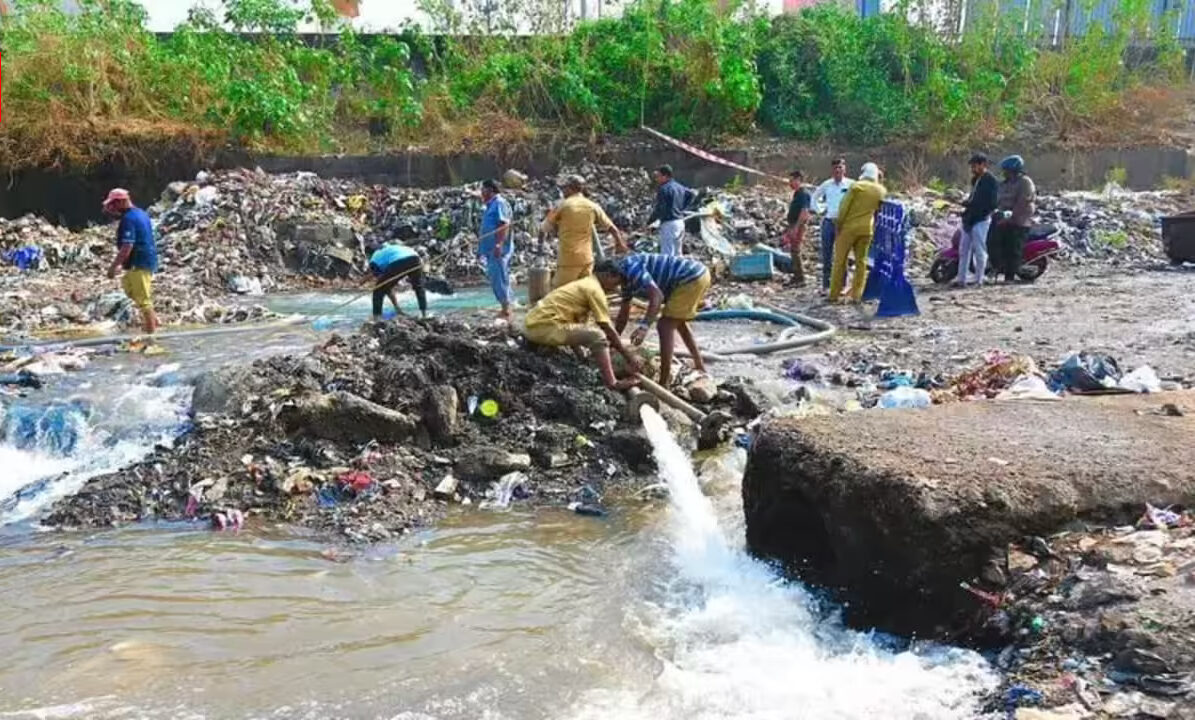
Mumbai’s ageing water infrastructure came under strain on Monday after a major underground pipeline failure disrupted supply across parts of the western suburbs, underscoring the vulnerability of essential services in one of the country’s most densely populated urban corridors. The incident occurred along the Mahim Causeway, a critical north–south connector, triggering water shortages in residential and commercial pockets of Khar West and Bandra West.
Civic records indicate that the disruption was caused by damage to a large-diameter water main during excavation activity on the causeway’s northbound stretch. The pipeline forms part of the city’s primary distribution network, carrying high-volume water flows to neighbourhoods that rely almost entirely on municipal supply. The sudden leakage led to a rapid drop in pressure, forcing authorities to temporarily isolate sections of the network to prevent further loss. Municipal engineers and water supply teams were deployed to the site shortly after the leakage was detected. Emergency repair work began immediately, involving dewatering, excavation and inspection of the damaged section. A senior civic official said restoring supply safely was prioritised over speed, given the pressure levels involved and the risk of secondary failures in adjoining lines.
For residents and businesses in the affected areas, the disruption translated into reduced or irregular water availability during peak daytime hours. Housing societies and small commercial establishments were advised to manage consumption until repairs were completed. Urban infrastructure experts note that such incidents, while operationally routine for city agencies, have disproportionate impacts in high-density neighbourhoods where storage capacity is limited and dependence on tanker supply can escalate costs. The Mahim Causeway episode has also revived concerns around infrastructure coordination in Mumbai. Large-scale excavation for road, utility and redevelopment projects often takes place in close proximity to legacy pipelines, some of which are several decades old. Without comprehensive underground mapping and real-time monitoring, the risk of accidental damage remains high. Urban planners argue that integrating utility upgrades with surface-level infrastructure works is essential for reducing repeated disruptions.
From a climate resilience perspective, water loss from major leaks represents a growing challenge. Mumbai already faces increasing stress on its water sources due to erratic rainfall patterns and rising demand. Preventable leakage not only disrupts supply but also undermines efficiency in a system that must adapt to future climate variability. Traffic movement along the causeway was partially affected as repair work continued, with motorists advised to exercise caution around the site. Civic officials indicated that permanent restoration and surface reinstatement would follow once structural integrity checks were completed.
As Mumbai continues to invest heavily in roads, coastal projects and urban redevelopment, incidents like this highlight the need for parallel investment in subterranean infrastructure. Strengthening pipelines, improving coordination between agencies, and adopting predictive maintenance systems could help ensure that critical services keep pace with the city’s growth. For residents of Khar and Bandra, the immediate focus remains on the restoration of normal water supply—but the broader lesson lies in building a more resilient and reliable urban utility network.
Mumbai Water Main Failure Disrupts Supply Across Khar Bandra Pockets