


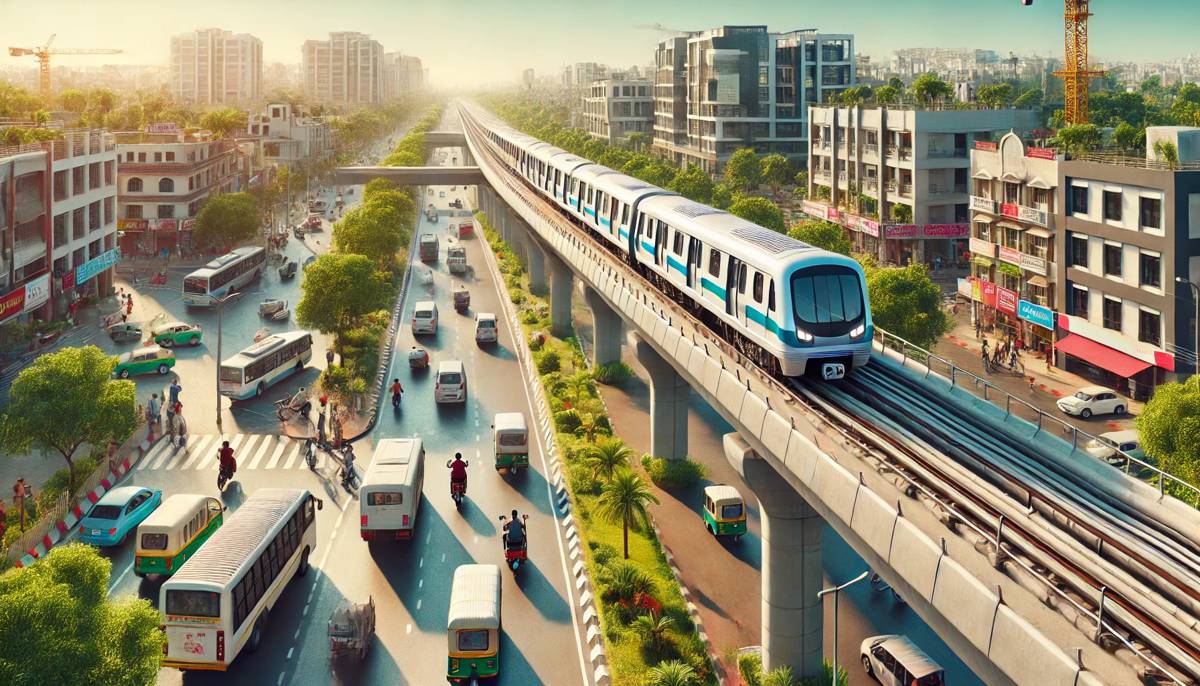
Nagpur’s metro rail authority has unveiled a comprehensive land-use framework aimed at reshaping urban development within a 500-metre radius of its metro corridors. The action plans seek to align transport investment with spatial planning, marking a shift towards transit-oriented development in one of central India’s fastest-growing cities. The move is significant as cities increasingly look to metro systems not just for mobility, but as anchors for compact, low-carbon and economically productive urban growth.
The newly outlined framework identifies station influence zones along operational and upcoming metro stretches, where land use, building regulations and infrastructure provision will be recalibrated. Urban planners involved in the process indicate that the objective is to encourage higher-density, mixed-use development near stations, reducing reliance on private vehicles while improving access to jobs, housing and civic amenities. Nagpur’s urban footprint has expanded rapidly over the past decade, often characterised by low-density sprawl and rising travel distances. Transport experts note that without coordinated land-use planning, metro systems risk underperforming their potential ridership and climate benefits. By synchronising zoning norms with metro accessibility, the city aims to capture the full economic and social value of its rail investment. According to officials associated with the metro authority, the action plans focus on rationalising floor space index norms, improving pedestrian and cycling infrastructure, and enabling commercial and residential uses to coexist around stations. Such measures are intended to create walkable neighbourhoods that support daily needs within short travel distances, a key principle of people-first urban design.
Real estate analysts view the strategy as a signal of greater regulatory clarity for developers and investors. Transit-linked zones often attract interest for offices, rental housing and retail formats that benefit from predictable footfall. However, experts caution that safeguards will be required to prevent speculative land price escalation that could displace lower-income residents or undermine affordability goals. There is also an environmental dimension to the approach. Concentrating growth around mass transit corridors can reduce per-capita energy use and emissions by shortening commute lengths and promoting public transport usage. In a city facing rising temperatures and water stress, compact urban form is increasingly seen as a resilience tool rather than a planning preference. Social infrastructure has been embedded into the planning logic, with provisions for public spaces, healthcare access and community facilities within station areas. Urban development specialists argue that such integration is essential to ensure that transit-oriented development remains inclusive and gender-neutral, serving diverse age groups and income segments rather than becoming enclaves of premium real estate.
Implementation, however, will be the real test. Coordinating municipal agencies, revising development control regulations and ensuring last-mile connectivity will require sustained governance capacity. Past experiences in Indian cities suggest that transit-oriented policies often falter without clear enforcement mechanisms and community engagement. Looking ahead, Nagpur’s land-use action plans could offer a template for other mid-sized cities seeking to align metro expansion with sustainable urban form. If executed effectively, the initiative has the potential to reshape how residents live, work and move—transforming metro corridors into engines of equitable, climate-conscious urban growth rather than mere transport lines.
Also Read: Kochi Metro Expands Research Ties To Innovate Mobility
Nagpur Urban Land Plans Reshape Metro Neighbourhoods
