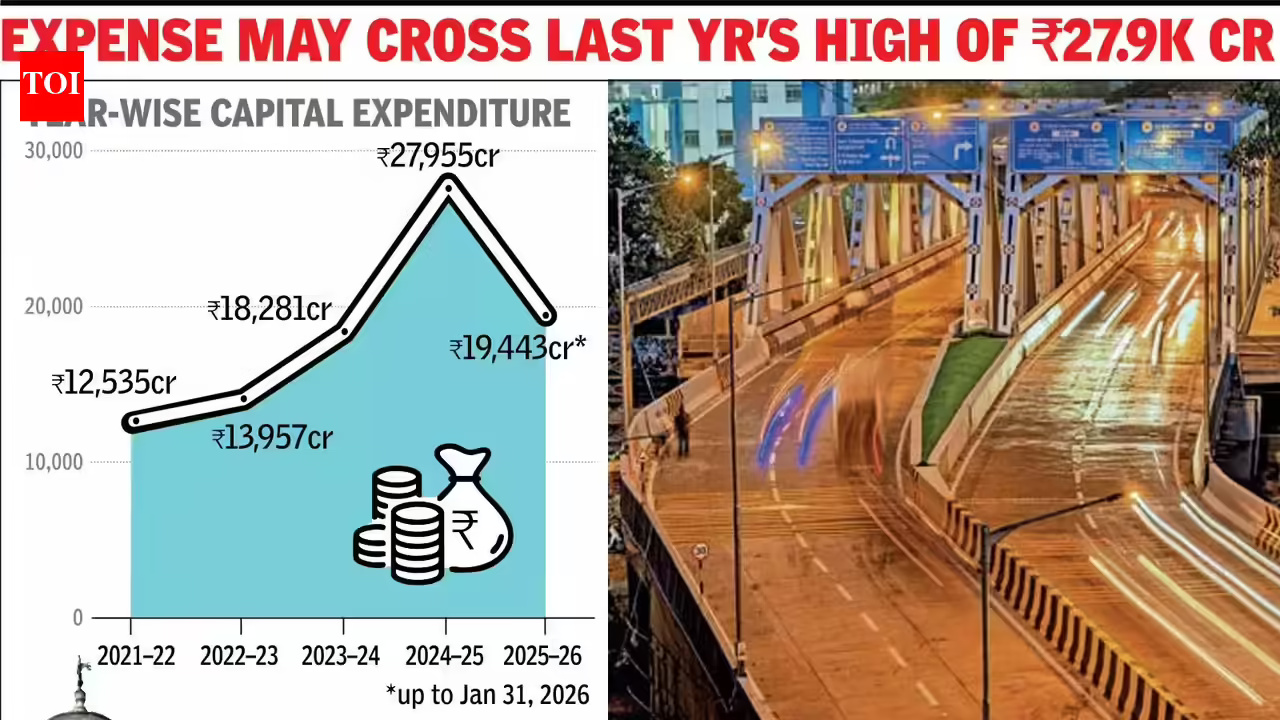
Mumbai’s civic administration has already deployed nearly ₹19,400 crore towards infrastructure works in the current financial year, underscoring the scale and intensity of capital investment shaping the city’s physical transformation. As the municipal authority prepares to present its 2026–27 budget, spending data obtained through statutory disclosures offers a window into how road networks, bridges, and sanitation systems continue to dominate urban priorities.
Of the total capital expenditure provisioned for 2025–26—estimated at over ₹43,000 crore—close to 45 per cent has been utilised so far. Roads, traffic management, bridge construction, and sewerage upgrades together account for the largest share of this outlay, reflecting an ongoing attempt to address long-standing bottlenecks in mobility, drainage, and public health infrastructure across India’s financial capital. Civic engineers involved in budget planning say road works remain the single biggest focus area, driven largely by the citywide concretisation programme aimed at improving durability and reducing recurring maintenance costs. Transport planners argue that while such works are disruptive in the short term, they are intended to create more resilient streets capable of withstanding monsoon stress and heavy traffic loads, a recurring challenge in Mumbai’s climate-sensitive geography.
Bridge infrastructure has also seen accelerated spending as several long-pending projects move closer to completion. New flyovers and rail overbridges are expected to ease congestion at key junctions and improve east–west connectivity, particularly in older neighbourhoods where rail lines and narrow corridors have historically constrained movement. Urban mobility experts note that timely completion will be critical to ensuring these investments translate into tangible travel-time savings. Equally significant is the renewed push on sewerage and wastewater management. Multiple sewage treatment plants are currently under construction across the city, part of a broader effort to improve water quality, reduce pollution of creeks and coastal waters, and comply with evolving environmental norms. Specialists in urban sanitation say this investment is essential not only for public health but also for safeguarding Mumbai’s coastal ecosystems amid rising climate risks.
While the scale of spending signals strong execution capacity, it has also led to a sharp rise in civic liabilities, now estimated to exceed ₹2 lakh crore. This growing financial burden is prompting internal discussions on alternative funding mechanisms, including market-linked instruments commonly used in large infrastructure sectors. Financial analysts point out that structured models such as infrastructure trusts could help recycle capital tied up in completed assets, reducing pressure on annual budgets. With contractor payments typically peaking towards the end of the financial year, total capital expenditure is expected to surpass last year’s record levels. For residents, the coming months will likely bring continued construction-related disruption alongside gradual improvements in mobility and sanitation.
As Mumbai balances aggressive infrastructure expansion with fiscal sustainability, the next budget will be closely watched for signals on how the city plans to fund growth while advancing towards a more resilient, equitable, and future-ready urban framework.
BMC Channels Big Funds Into Core City Infrastructure