


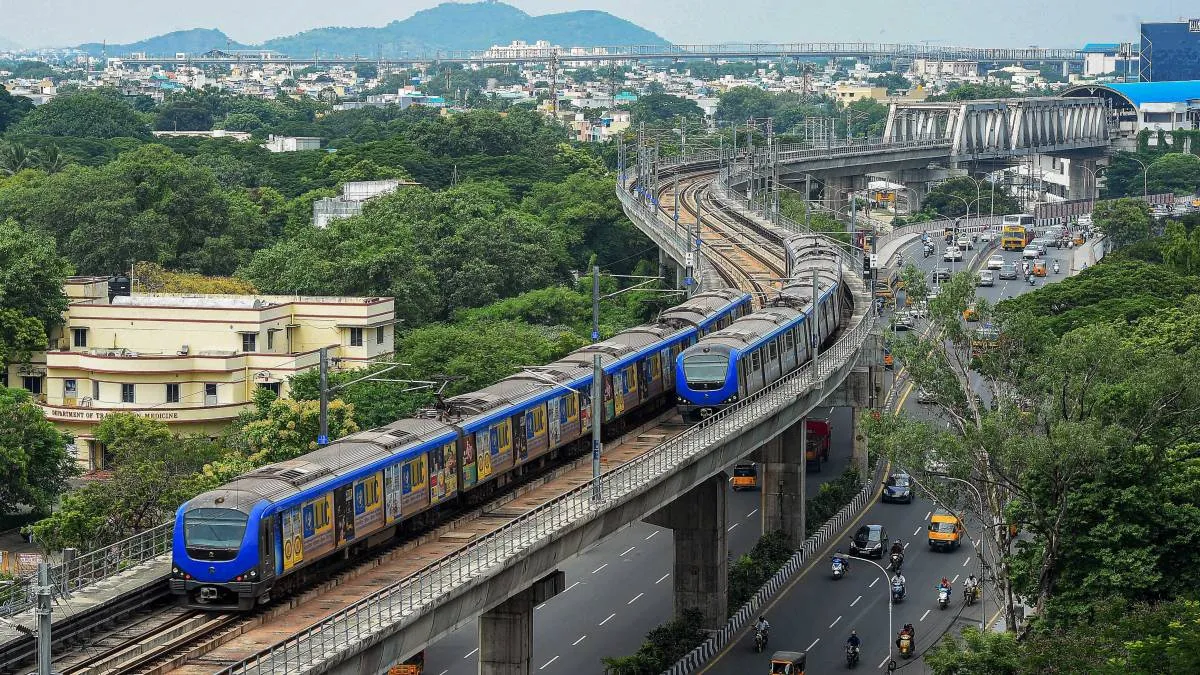
Chennai’s long-delayed relief from construction congestion may be approaching, as the city’s metro rail authority advances towards completing a substantial share of elevated corridors under Phase Two of the network. Transport planners indicate that close to 40 kilometres of viaducts are targeted for completion by early 2027, a milestone that could reshape daily commuting patterns and ease pressure on several overburdened arterial roads.
Phase Two of the metro expansion spans over 116 kilometres, making it one of the largest rapid transit projects currently under execution in India. Elevated alignments account for nearly two-thirds of the network, reflecting a strategic decision to reduce land acquisition, avoid dense utility corridors, and accelerate construction in fast-growing urban zones.Officials involved in the project say that a phased commissioning strategy is being followed. Several elevated sections are expected to become operational incrementally, allowing road barricades occupying central medians to be removed in stages. This is particularly significant for high-traffic corridors that have experienced prolonged lane reductions, affecting logistics movement, office commutes, and access to commercial districts.
One of the most advanced stretches lies along the southern IT and residential spine of the city, connecting major employment hubs with emerging housing clusters. Urban planners note that this corridor has seen sustained real estate absorption despite construction disruptions, driven by the expectation of high-capacity public transport connectivity.Parallel progress is being reported on another major corridor linking the city’s northern neighbourhoods with the southern industrial and technology zones. Construction activity along this route has been prioritised due to its role in connecting peripheral growth areas with the metropolitan core, a factor that directly influences labour mobility and housing demand.
While elevated structures are nearing readiness across multiple corridors, underground sections present a more complex challenge. Dense neighbourhoods with heritage structures, narrow rights-of-way, and layered utilities are expected to remain under construction for longer periods. Officials acknowledge that these areas will continue to face traffic restrictions, though sequencing has been planned to limit overlap between surface and subsurface works.From a sustainability perspective, transport analysts argue that the timely delivery of elevated metro corridors is critical to reducing vehicular dependence. Chennai’s road network has struggled to keep pace with population growth, leading to rising emissions, longer travel times, and uneven access to jobs. High-frequency metro services offer a lower-carbon alternative that supports compact, transit-oriented development.
In the near term, the opening of initial Phase Two segments is expected to provide an early test of ridership response and operational integration with existing lines. For city planners and investors alike, the focus will now be on whether construction timelines hold — and whether the promised transition from disruption to connectivity materialises on the ground.
Also Read:Hyderabad Set To Anchor National Bullet Rail Hub
Chennai Metro Phase Two Elevated Sections Nearing Completion
