


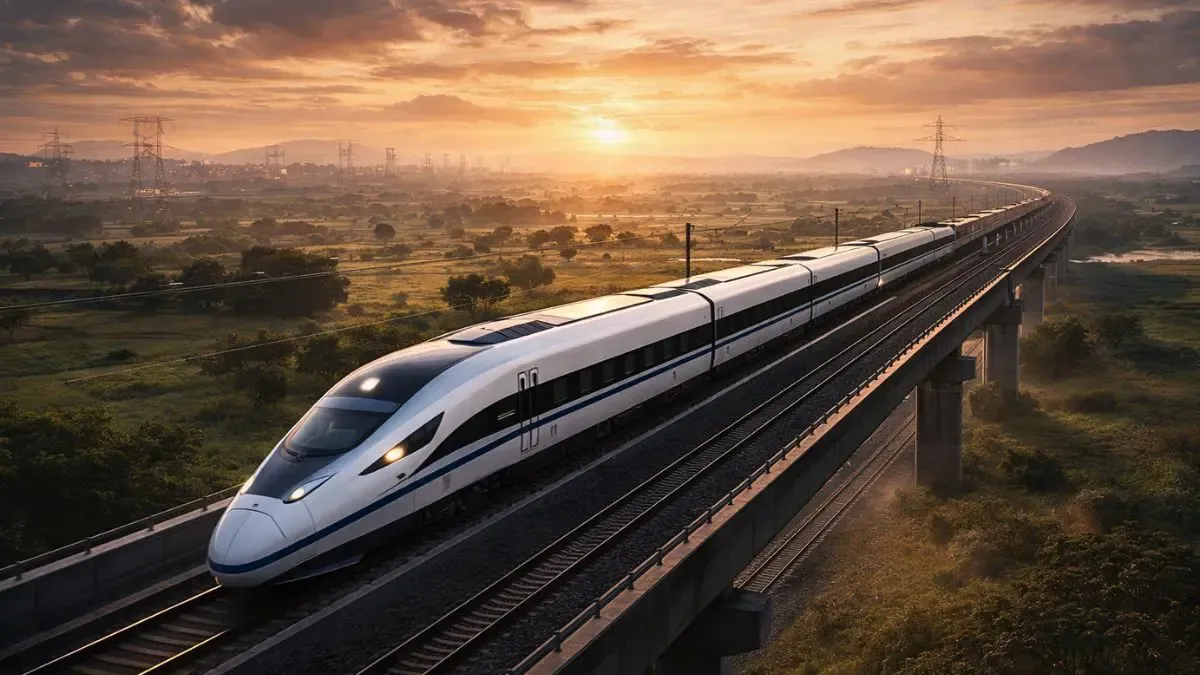
India’s transport and infrastructure strategy is entering a new phase, with the Union Budget 2026–27 outlining a significant expansion of high-speed passenger rail and freight connectivity across key economic regions. The proposed plan introduces seven high-speed rail corridors alongside a new east–west freight route, signalling a shift towards faster, cleaner and more integrated movement of people and goods.
According to budget documents and railway planning notes, the high-speed rail corridors are intended to function as national growth connectors linking major urban and industrial centres. The proposed routes span western, southern and eastern India, strengthening ties between financial hubs, technology clusters and emerging regional cities. While final technology choices have not been confirmed, the corridors are designed to support substantially higher speeds than conventional rail, reducing intercity travel times and easing pressure on aviation and highways.
Urban transport specialists say the initiative reflects lessons from the country’s first high-speed rail project, currently under construction in western India. That corridor has established new benchmarks in land acquisition, station-area development and safety standards. Policymakers appear keen to replicate these frameworks while adapting them to varied regional contexts, including denser urban corridors and environmentally sensitive zones.
Parallel to passenger rail expansion, the budget places renewed emphasis on freight logistics. A proposed dedicated east–west freight corridor linking eastern industrial zones with western ports is expected to rebalance cargo flows and reduce congestion on existing passenger-heavy rail lines. Logistics experts note that freight trains operating on exclusive corridors can move longer, heavier loads more efficiently, cutting transit time, fuel consumption and emissions.
The rail proposals are complemented by a broader multimodal transport agenda. Over the next five years, additional national waterways are slated for operationalisation, allowing bulk cargo to shift towards lower-carbon inland water transport. The budget also earmarks funding to strengthen domestic container manufacturing, addressing supply bottlenecks that have disrupted trade and logistics in recent years.
From an urban development perspective, planners see high-speed rail as a catalyst for more distributed growth. By shrinking travel times between metros and Tier-II or Tier-III cities, the network could encourage firms to locate operations beyond saturated urban cores. However, experts caution that without coordinated land-use planning, station-area development risks fuelling speculative real estate rather than inclusive economic activity.
Environmental analysts underline the importance of execution. High-speed rail has the potential to reduce per-capita transport emissions if powered by cleaner electricity and integrated with public transit at city ends. Freight corridors, similarly, can cut road congestion and air pollution if last-mile connectivity is efficiently managed.
Financing and risk mitigation also feature prominently in the budget framework. New instruments aimed at de-risking long-term infrastructure investment are intended to attract institutional capital while recycling public-sector land and assets for redevelopment.
As India accelerates its infrastructure build-out, the success of the high-speed rail and freight corridors will depend on sequencing, governance and coordination across states. If aligned with climate resilience and people-first urban planning, the rail expansion could redefine how India’s cities and regions connect, compete and grow over the coming decades.
Also Read:Mumbai Real Estate Revenue Rises on Premium Shift
