


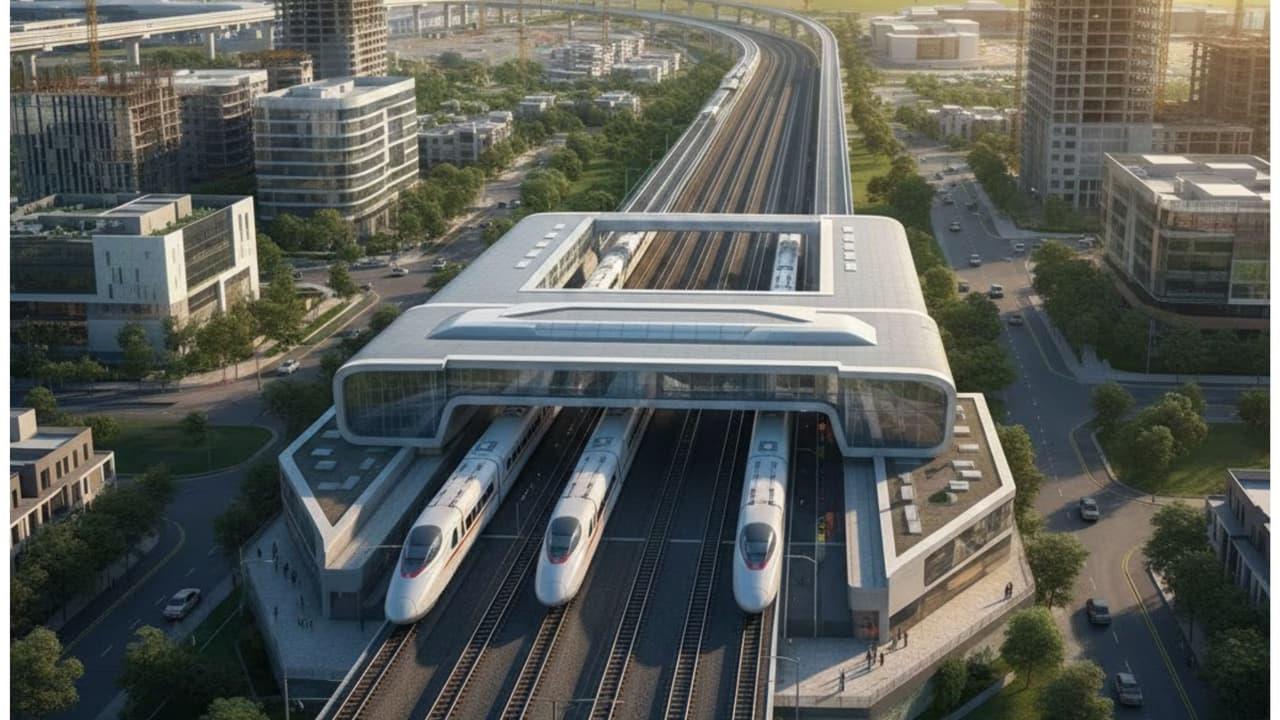
Hyderabad is poised to assume a central role in India’s emerging high-speed rail network, with railway planners advancing proposals to establish a multi-directional bullet train terminal near the city’s international airport. The planned hub, located in the Shamshabad growth corridor, would place Hyderabad at the intersection of several proposed high-speed rail routes, reshaping long-distance mobility across southern and western India.
Railway planning documents indicate that the airport zone has been identified for a three-arm high-speed rail terminal, enabling direct bullet train connectivity from Hyderabad to Bengaluru, Chennai and Pune, with onward integration toward the Mumbai metropolitan region. If executed as envisioned, this configuration would make Hyderabad the only Indian city positioned to link four major metro economies through dedicated high-speed rail infrastructure.Transport planners cite strategic and spatial considerations behind the selection of the airport corridor. The area offers comparatively unconstrained land parcels suitable for large-scale rail terminals, depots and maintenance yards—assets that are difficult to accommodate within dense urban cores. Its proximity to the international airport also allows for integrated air–rail transfers, an increasingly important feature in global transport hubs seeking to reduce overall travel time and emissions.
From a mobility standpoint, proposed travel times would significantly compress intercity journeys that currently rely on aviation or long-haul road travel. Industry experts note that high-speed rail could offer predictable, lower-carbon alternatives for business and leisure travel once end-to-end time savings are considered, including airport access and security procedures. This shift aligns with national decarbonisation objectives for the transport sector, which remains one of India’s fastest-growing sources of emissions.Urban economists point to wider spatial impacts beyond mobility. The Hyderabad Musi River basin and airport-led development zones have already attracted logistics parks, data centres and large residential townships. A high-speed rail hub is expected to accelerate this trend, potentially redistributing economic activity away from the traditional city centre while raising land values along the corridor. Planners caution, however, that such growth must be matched with affordable housing, public transport links and resilient water and energy systems to avoid exclusionary development.
The proposal also intersects with broader national infrastructure planning outlined in recent Union budget documents, which emphasise multi-corridor high-speed rail expansion rather than isolated point-to-point routes. By anchoring multiple corridors at a single node, authorities aim to improve network efficiency while reducing duplication of assets.Despite the promise, several steps remain before implementation. Detailed alignment studies, environmental assessments and intergovernmental coordination will be required, particularly as routes cross multiple states. Land acquisition and community consultation in peri-urban zones will also shape timelines and public acceptance.
As Hyderabad continues its transition into a multi-nodal metropolis, the high-speed rail hub proposal highlights how transport infrastructure is increasingly being used to guide urban form. Whether the project delivers equitable and climate-resilient outcomes will depend less on headline speeds and more on how seamlessly it integrates with the city’s everyday mobility and regional development priorities.
Also Read:India Real Estate Accelerates Green Certification Drive
