


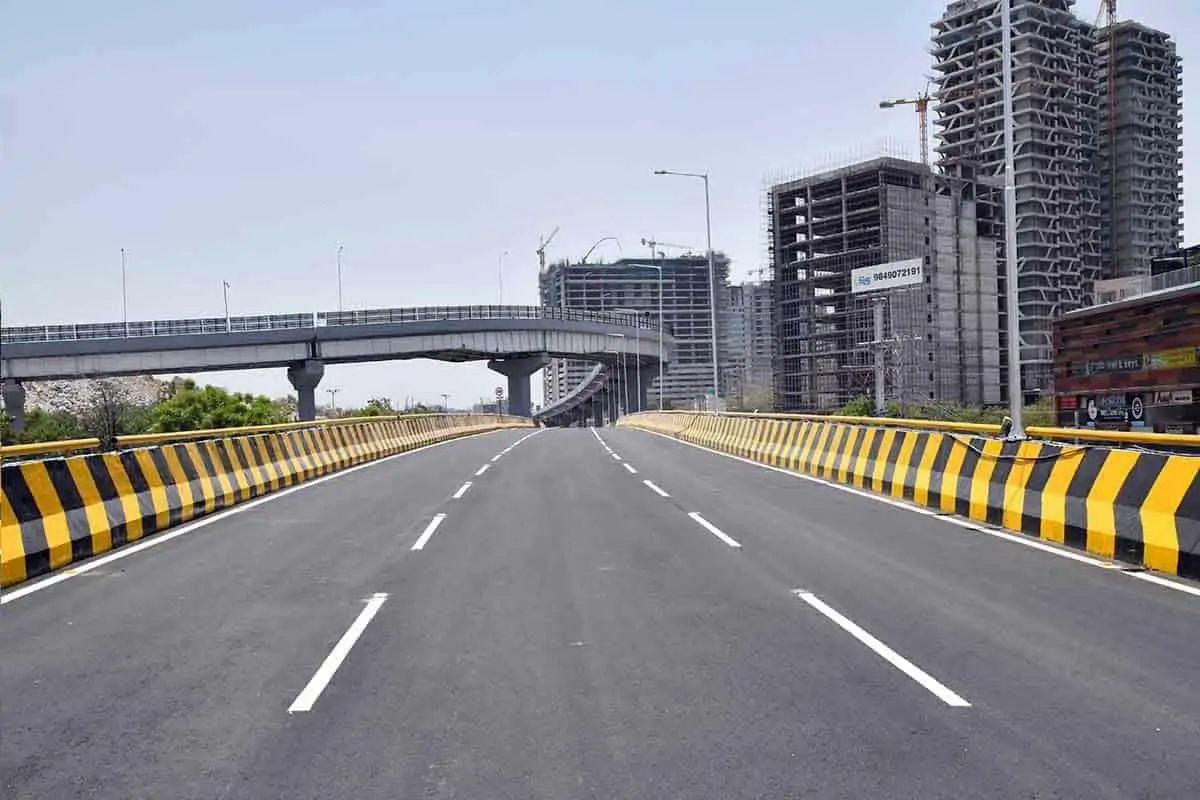
Construction activity has intensified at one of Hyderabad’s most congested technology corridors, with civic authorities accelerating work on a multi-flyover system designed to unclog daily bottlenecks near major employment hubs. The project, spread across three junctions in the western IT belt, marks a critical intervention in a zone where traffic pressure has consistently outpaced road capacity.
The infrastructure package includes elevated structures and grade separation at intersections that currently experience long queues during peak commuting hours. Urban transport planners involved in the project say the objective is to convert a signal-heavy stretch into a continuous flow corridor, reducing idle time for vehicles and improving travel reliability for thousands of daily commuters.The junction near major academic and technology campuses has emerged as the focal point of construction, with deep excavation and foundation work now well underway. Following earlier geotechnical surveys, pillar construction has begun, indicating that the project has moved beyond preparatory stages into full-scale execution. Similar progress is planned at two adjoining junctions that together form a critical spine of the IT corridor.
This stretch of the city has seen intense commercial and residential growth over the past decade, driven by the clustering of offices, co-working spaces and high-density housing. However, road infrastructure has struggled to adapt, leaving commuters vulnerable to prolonged delays. During the previous monsoon season, even moderate rainfall exposed the fragility of the network, leading to hours-long standstills and spillover congestion across neighbouring arterial roads.Municipal officials estimate the total investment at around ₹800 crore, covering three flyovers and an underpass. While the headline benefit is faster travel, transport economists note that signal-free corridors also reduce fuel wastage and tailpipe emissions by cutting stop-start driving, aligning incremental road projects with broader climate goals when paired with efficient design.
Urban planners caution, however, that flyovers are not a standalone solution. Their effectiveness depends on integration with surface-level pedestrian crossings, bus movement and last-mile access. Without this balance, elevated roads risk shifting congestion rather than resolving it. Officials involved in planning say provisions are being evaluated to ensure smoother transitions at entry and exit points, especially for public transport and emergency vehicles.The completion target has been set for mid-2028, reflecting the complexity of building large structures while maintaining traffic flow in a live urban environment. For businesses in the IT belt, improved connectivity is expected to enhance workforce productivity and reinforce Hyderabad’s competitiveness as a technology destination. For residents, the promise lies in reclaiming predictable commute times in a city where travel uncertainty increasingly shapes daily life.
As construction progresses, the project will test Hyderabad’s ability to deliver large-scale road infrastructure while responding to environmental stress, rapid urbanisation and evolving mobility needs. The coming phases will determine whether this intervention becomes a template for people-centred, climate-aware transport upgrades across the metropolitan region.
Also Read:India Home Loans Face Hidden Inflation Pressure
Hyderabad IT Corridor Flyovers Advance Construction
