


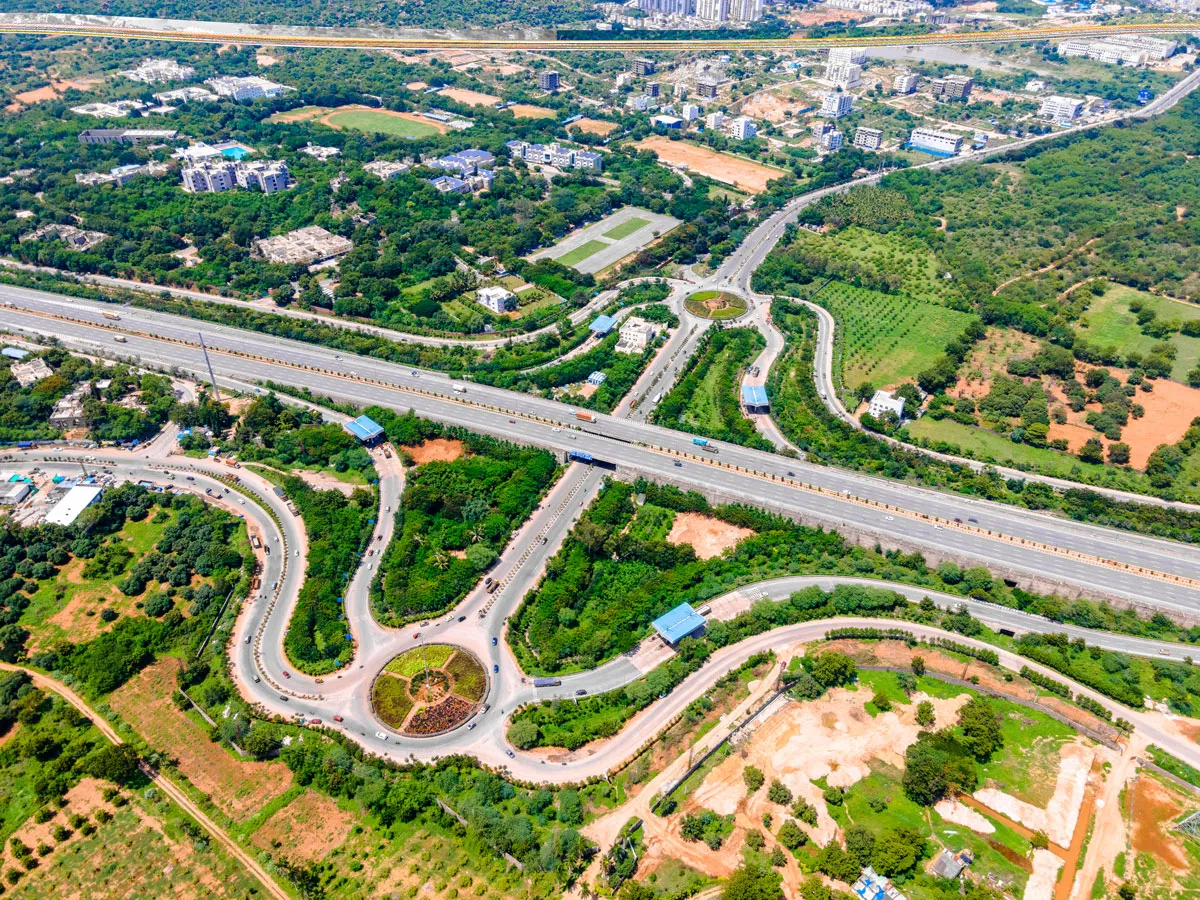
Hyderabad’s metropolitan planning authority has initiated a fresh round of statutory planning to expand and realign road infrastructure across the city’s western growth belt, signalling a renewed push to address congestion in one of India’s fastest-developing urban corridors. Draft notifications have been issued to formally incorporate multiple new roads and widening projects into approved development plans, a procedural step that precedes land acquisition and detailed execution.
The proposals focus on strengthening east–west and radial connectivity in areas that have witnessed intense residential and commercial growth over the past decade. Western Hyderabad, home to major employment hubs and high-density housing clusters, has increasingly faced traffic bottlenecks due to gaps in secondary road networks and delayed upgrades of older village roads now functioning as urban arterials.Among the key proposals is a new connector designed to bridge missing links between existing arterial roads near Narsingi, Manchirevula and surrounding peri-urban settlements. Urban planners involved in the process say the objective is to create continuous corridors that reduce dependency on a few overloaded routes leading to the IT and financial districts. By closing these gaps, travel times between outer residential zones and employment centres are expected to stabilise despite rising vehicle volumes.
In parallel, several existing roads are proposed for widening in phases to accommodate higher traffic loads and future public transport integration. These corridors cut across rapidly transforming villages that have shifted from agrarian land use to mixed residential and commercial development. Planning officials note that formal inclusion of these roads into statutory master plans is essential to ensure uniform right-of-way protection and coordinated utility planning.The draft notifications align the proposed roads with long-term metropolitan development frameworks, including earlier master plans and the region’s 2031 growth strategy. Infrastructure experts point out that such alignment is critical to avoid piecemeal expansion, which often leads to drainage disruptions, loss of green buffers and inefficient land use. Integrating road planning with zoning and environmental layers allows authorities to better manage flood-prone zones, lakes and natural drainage channels.
Public consultation now forms a crucial phase of the process. Property owners and residents within affected survey boundaries have been invited to review the proposals and submit feedback. Urban policy specialists emphasise that transparent engagement is particularly important in peripheral areas, where land acquisition can directly impact livelihoods and settlement patterns.If implemented with coordination and safeguards, the proposed network could rebalance traffic flows across western Hyderabad and ease pressure on legacy highways. However, planners caution that road expansion alone cannot resolve congestion unless paired with public transport upgrades, non-motorised infrastructure and demand management strategies. The coming months will determine whether the planning exercise translates into a more resilient and accessible urban mobility framework for the region.
Also Read:Hyderabad Municipal Governance Set for Three Way Split
