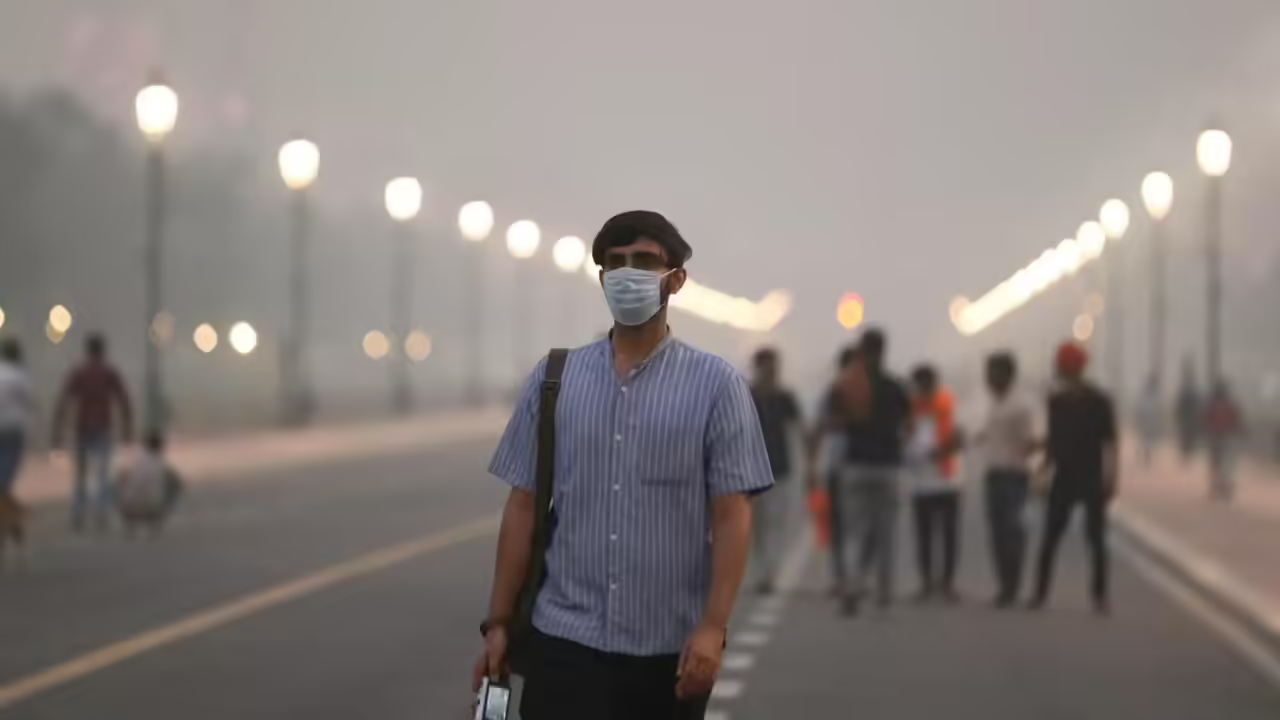
Air quality across the National Capital Region remained critically stressed through January, with multiple NCR cities consistently recording particulate pollution levels far above health thresholds, highlighting the region’s deepening urban and infrastructure challenge. Data compiled from national monitoring networks and analysed by independent clean-air researchers shows that Delhi, Ghaziabad, Noida and Gurgaon repeatedly featured among India’s most polluted urban centres during the month.
Fine particulate matter (PM2.5), the pollutant most closely linked to respiratory and cardiovascular illness, remained largely in the “very poor” to “severe” category across the region, leaving millions exposed to air that exceeded global safety benchmarks by a wide margin.Gurgaon emerged as one of the worst-affected large cities, with average PM2.5 concentrations nearly three times India’s daily ambient standard and several multiples higher than international health guidelines. Air quality failed to reach even “satisfactory” levels on any day in January, reflecting the structural nature of winter pollution in the NCR rather than short-term weather anomalies.
Ghaziabad recorded the highest pollution levels nationally, while Delhi and Noida also remained near the top of daily pollution rankings for much of the month. Urban planners note that the clustering of NCR cities at the top of national charts underlines the interconnected nature of air quality across the region, where emissions, meteorology and land-use patterns cut across municipal boundaries.
Within Haryana, monitoring data showed Gurgaon leading a wider belt of polluted urban and industrial settlements extending through Faridabad, Manesar, Dharuhera and parts of western and central districts. Most monitored locations in the state exceeded national PM2.5 limits, reinforcing concerns that pollution is no longer confined to major metros but is spreading along industrial corridors and high-growth real estate zones.
Urban economists point out that prolonged poor air quality carries tangible economic costs. Reduced labour productivity, rising healthcare expenditure and declining urban liveability can weaken NCR’s competitiveness as a destination for global investment and skilled talent. The real estate sector is also increasingly sensitive to environmental performance, with air quality emerging as a factor in residential demand and corporate location decisions. Across India, winter pollution affected cities beyond the NCR, though the region’s dominance in national rankings underscores its outsized contribution to the problem.
Analysts say this strengthens the case for treating air pollution as a regional infrastructure issue rather than a city-level compliance exercise.
As policymakers prepare revisions to national clean-air strategies, experts argue that sharper focus on fine particulates, stricter industrial controls and coordinated airshed-based planning will be critical. For the NCR, where growth pressures remain intense, the coming years will test whether urban expansion can be aligned with cleaner mobility, energy and construction practices or whether seasonal smog will continue to define life in India’s largest urban region.
NCR Cities Dominate India Pollution Rankings