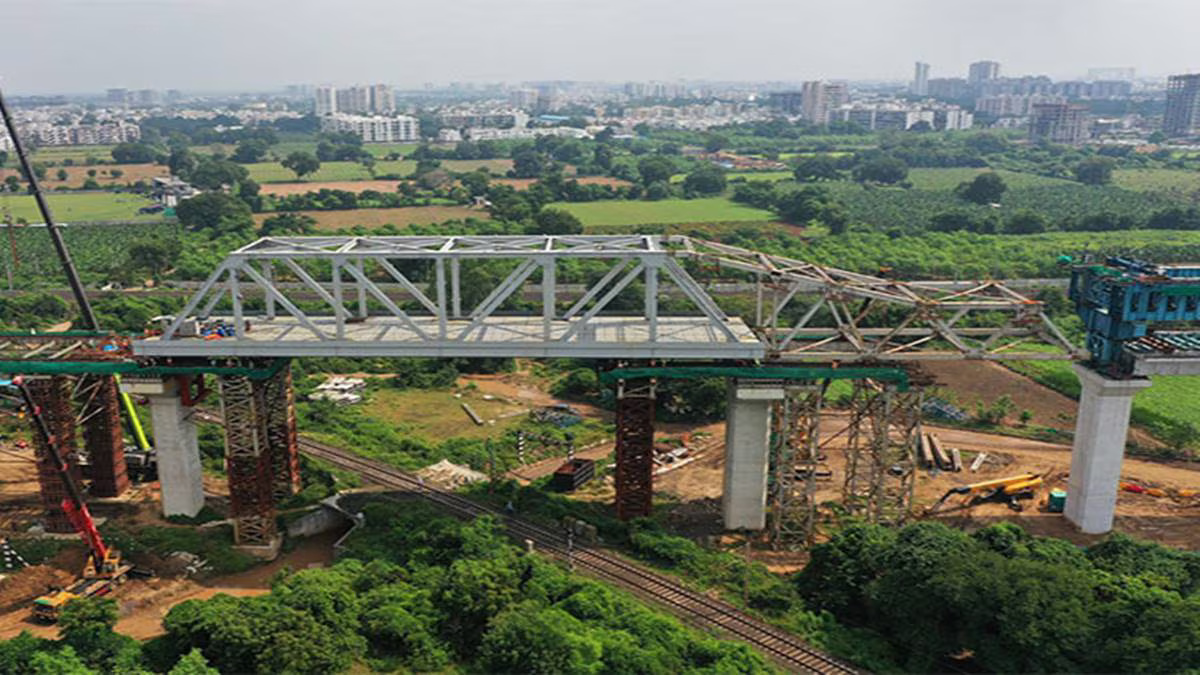
Construction on India’s first high-speed rail corridor has achieved another critical milestone in Ahmedabad, underscoring steady progress on a project that is reshaping long-distance mobility and urban infrastructure planning. A major steel bridge has now been completed on the Kalupur–Shahpur stretch of the Mumbai–Ahmedabad bullet train corridor, addressing one of the more complex engineering challenges along the route.
The newly completed structure spans 100 metres and forms part of a series of steel bridges being built across Gujarat to navigate dense urban conditions. Officials overseeing the project indicate that this bridge was specifically designed to cross above an operational underground metro tunnel without transferring structural load onto it. Such constraints required a departure from conventional concrete viaduct construction typically used along the corridor. Engineers opted for a steel truss configuration, allowing for longer spans and precise load distribution while maintaining the safety envelope around the existing metro infrastructure. The bridge, weighing over 1,000 tonnes, was first assembled at height on temporary supports before being gradually lowered onto its permanent bearings. Infrastructure specialists say this method reduces construction risk in built-up areas and limits prolonged disruption at ground level.
This bridge marks the 13th steel span completed in Gujarat, with several others already in service over highways, rail lines and rivers. The broader Mumbai–Ahmedabad high speed rail project stretches across 508 kilometres and cuts through some of the country’s most densely populated and industrialised regions. Its progress is closely watched not only for transport outcomes but also for its influence on regional development patterns. Urban planners note that high-speed rail infrastructure has the potential to rebalance economic activity by shrinking travel times between cities, encouraging business decentralisation and reducing dependence on short-haul air travel. From a climate perspective, shifting long-distance trips from road and air to electric rail systems is seen as a critical lever for lowering transport-related emissions over the long term.
Across the corridor, work continues simultaneously on viaducts, tunnels, stations and river crossings. Several major river bridges in Gujarat are already complete, while tunnel excavation in geologically challenging sections has advanced steadily. Officials associated with the project say that adopting context-specific engineering solutions—such as steel superstructures in constrained urban zones—is key to maintaining construction timelines without compromising safety. However, experts caution that the success of such mega projects will ultimately depend on integration with local transport networks and station-area planning. High-speed rail stations, particularly in urban cores, must be supported by efficient public transport, pedestrian access and mixed-use development to fully realise economic and social benefits.
As structural milestones continue to be achieved, attention will increasingly shift toward systems installation, testing and operational readiness. For cities like Ahmedabad, the completion of complex urban crossings signals not just construction progress, but a gradual reconfiguration of how large-scale infrastructure can coexist with existing transit systems in a growing, climate-conscious metropolis.
Ahmedabad Bullet Train Project Advances With Steel Bridge