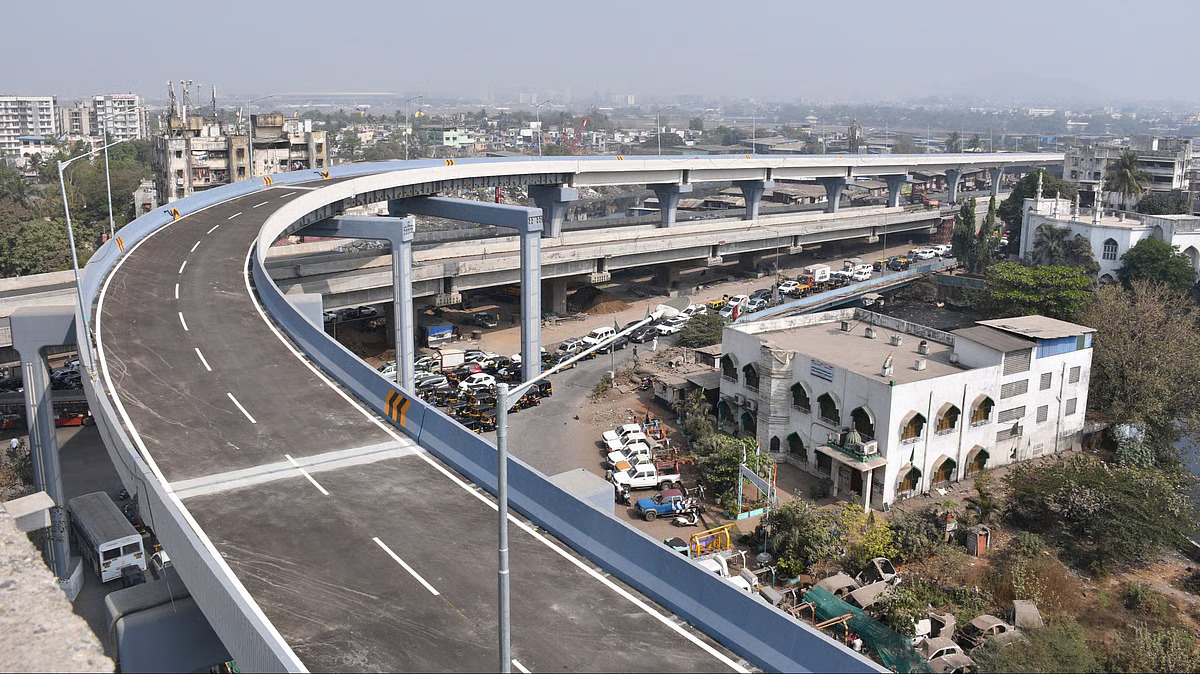
Mumbai is set to see a significant shift in daily commuting patterns as the long-awaited Western Express Highway–Bandra Kurla Complex connector under the Santacruz–Chembur Link Road (SCLR) extension approaches operational readiness. The elevated link, now in its final construction and safety certification phase, is expected to open by the end of March, offering a faster and more predictable route between the city’s primary commercial district and its busiest north–south highway.
The 1.4-km elevated corridor directly links the Western Express Highway (WEH) with Bandra Kurla Complex (BKC), bypassing some of the city’s most congested junctions. For thousands of office commuters, airport-bound travellers, and freight vehicles, the connector is projected to reduce peak-hour travel time by up to 35 minutes. Urban mobility planners say this is a rare instance where a short stretch of road could have citywide ripple effects by unclogging multiple downstream bottlenecks. Designed and executed by the metropolitan planning authority, the connector forms a crucial missing piece of the larger SCLR network, which aims to strengthen east–west connectivity across Mumbai. Until now, vehicles travelling between BKC, Kurla, the Eastern Express Highway and the western suburbs were forced through choke points such as Vakola junction and adjoining arterial roads. The new link allows traffic to merge directly onto the WEH near the domestic airport precinct, removing pressure from residential and institutional neighbourhoods along the old route.
A defining element of the project is its cable-stayed bridge segment, the first in South Asia to accommodate a sharp horizontal curve of around 100 metres. Rising nearly 25 metres above ground level, the structure uses an orthotropic steel deck and a Y-shaped pylon to avoid mid-span supports. Engineers involved in the project indicate that the design was shaped by tight urban constraints, including the need to navigate around underground metro infrastructure while maintaining safety and load efficiency. Beyond time savings, transport experts point to environmental and economic implications. Reduced idling at junctions is expected to lower vehicular emissions along one of Mumbai’s most polluted corridors, while faster access to BKC strengthens its role as a high-density employment hub without adding new surface-level congestion. The connector also improves access between Navi Mumbai, the eastern suburbs and the airport, supporting regional business mobility.
With structural work largely complete, current efforts are focused on finishing activities such as waterproofing, barrier installation and systems checks. Officials involved in the project say the final phase prioritises safety audits and traffic integration rather than speed. As Mumbai continues to invest in elevated corridors and public transport simultaneously, the SCLR connector offers a case study in how targeted road infrastructure—when carefully aligned with existing networks—can improve urban efficiency while minimising additional land and carbon costs. The real test will lie in traffic management once the link opens and how effectively it redistributes, rather than merely shifts, congestion across the city.
Mumbai Western Highway BKC Link Enters Final Stage