


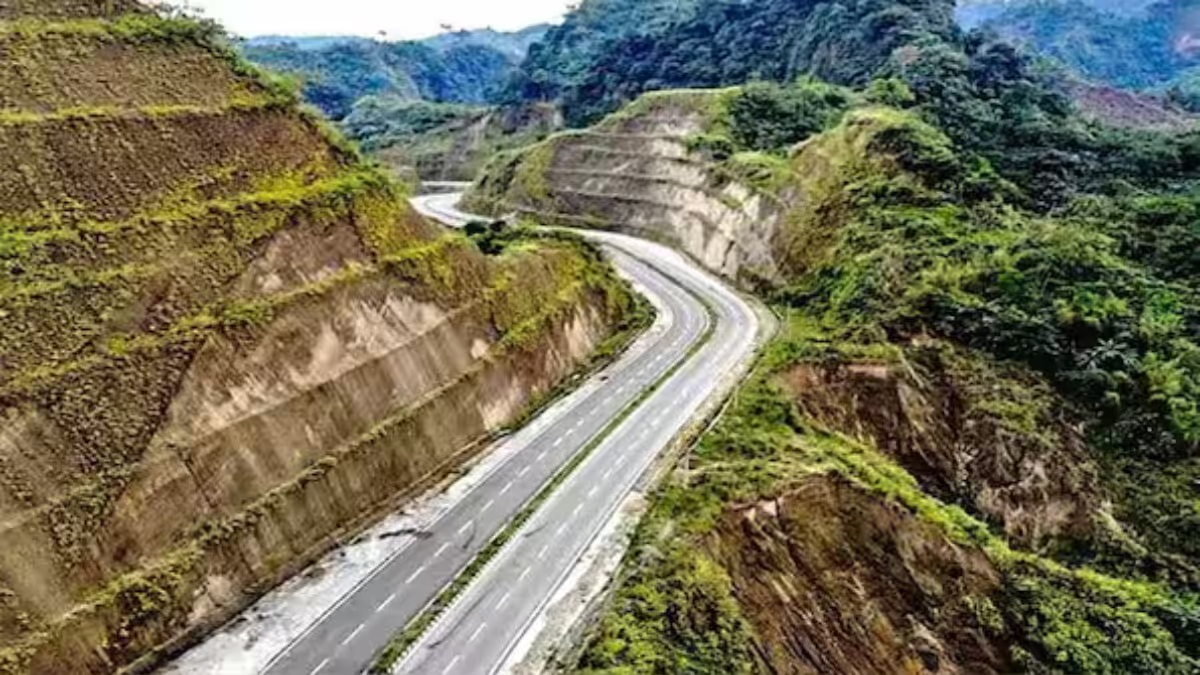
ITANAGAR — A federal financial investigation into alleged irregularities linked to compensation payouts for a strategic highway project in Arunachal Pradesh has brought renewed attention to governance risks in large-scale infrastructure delivery. Enforcement agencies recently conducted searches across multiple locations, recovering significant unaccounted cash connected to payments made during land acquisition for the Trans Arunachal Highway.
The probe centres on suspected manipulation of compensation claims tied to land parcels acquired for the highway, a flagship road corridor designed to improve connectivity across the northeastern state. Officials familiar with the investigation said the case involves inflated valuations, fabricated ownership claims and intermediary networks that allegedly diverted public funds meant for affected landholders. The Trans Arunachal Highway is a critical infrastructure project, intended to integrate remote districts with economic centres, improve access to healthcare and education, and support disaster response in a region prone to landslides and extreme weather. Any misuse of funds linked to such projects has broader implications beyond financial loss, undermining public trust and delaying essential development in ecologically sensitive areas. According to officials overseeing the investigation, compensation disbursements were processed over several years, during which inconsistencies in land records and beneficiary lists went unchecked. Urban governance experts note that land acquisition remains one of the most vulnerable stages of infrastructure execution, particularly in regions where cadastral mapping is outdated and administrative capacity is stretched.
The case also highlights the intersection between infrastructure expansion and real estate dynamics. Improved road connectivity typically increases land values along corridors, creating incentives for speculative claims and informal transactions. Without transparent digital land records and independent valuation mechanisms, compensation processes can become susceptible to misuse, distorting local property markets and disadvantaging genuine landowners. From a public finance perspective, experts warn that such leakages erode the efficiency of infrastructure spending. Funds diverted at the acquisition stage often lead to cost overruns, delayed construction and compromised project quality. In climate-sensitive regions like Arunachal Pradesh, delays can be particularly damaging, as construction windows are limited by terrain and weather conditions. Officials involved in regional planning stress that stronger institutional safeguards are needed as infrastructure investment in the Northeast accelerates. These include end-to-end digitisation of land records, third-party audits of compensation awards and greater coordination between revenue, urban development and transport agencies. Transparent processes are increasingly seen as essential to ensuring that infrastructure growth translates into equitable economic opportunity rather than concentrated windfalls.
The investigation is ongoing, with authorities indicating that further scrutiny of financial flows and beneficiary networks is underway. While the case remains at an enforcement stage, it has already triggered internal reviews of land acquisition practices linked to other road and urban infrastructure projects in the state. As India expands transport networks in border and remote regions, the Arunachal case serves as a reminder that resilient infrastructure depends as much on governance integrity as on engineering design. Strengthening accountability mechanisms will be crucial to ensuring that public investment delivers inclusive, sustainable outcomes for communities it is meant to serve.
Also Read: Bengaluru NH44 Collapse Disrupts Regional Mobility
Arunachal Highway Probe Flags Compensation Leakages
