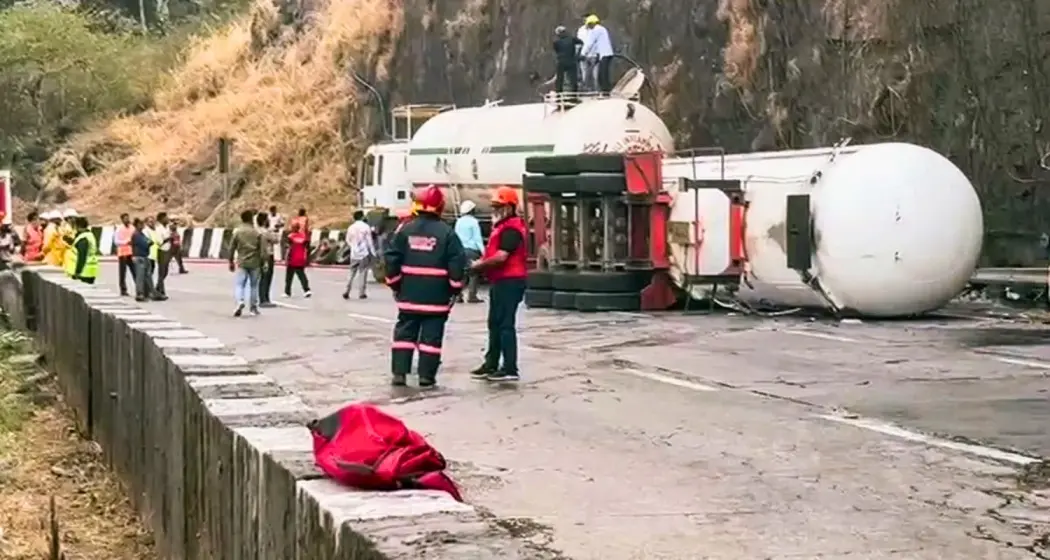
Mumbai Pune Expressway Exposed By Gas Leak Shutdown
Mumbai-Pune Expressway, one of Maharashtra’s most critical road corridors, witnessed an extraordinary breakdown of mobility and emergency response systems this week after a tanker carrying flammable industrial gas overturned near the Adoshi tunnel in the Khandala Ghat. The ensuing leak of propylene — a combustible hydrocarbon — forced authorities to halt expressway traffic for more than 24 hours, exposing weaknesses in disaster management, inter-agency coordination, and resilience planning on a route that ferries tens of thousands of people daily.
What began around 5 pm on Tuesday quickly became a logistical nightmare as the Mumbai-bound carriageway was closed for safety, and both lanes eventually saw severe congestion. Emergency services — including the National Disaster Response Force (NDRF), State Disaster Response Force (SDRF), and specialised teams from Bharat Petroleum Corporation Limited (BPCL) — were mobilised to contain the leak, but recovery proved slow, underscoring the complexity of handling hazardous materials in a high-traffic ghat section.For commuters, the disruption was more than an inconvenience. Vehicles remained stranded in gridlock for more than 12 hours, with families, workers and public transport users left without access to basic necessities such as food, water and toilets. Long queues extended across kilometres, and traffic diversions onto the old Mumbai-Pune highway pushed secondary roads beyond capacity, revealing how fragile alternative routes can be under strain.
Urban transport planners point out that the expressway — operational since 2002 — was not originally designed for the current vehicular volumes, which have soared with urban expansion in both Mumbai and Pune. The Khandala Ghat section, characterised by steep gradients and limited emergency access, regularly experiences bottlenecks; a hazardous materials spill has now sharply amplified the consequences of these inherent design constraints.Beyond physical infrastructure, experts highlight a more systemic issue: fragmented coordination between agencies responsible for traffic management, disaster response and expressway operations. Even with routine drills mandated for high-impact corridors, the absence of pre-positioned hazardous materials response units meant containment efforts were reactive rather than proactive.
Public authorities acknowledged the scale of the disruption and have ordered internal reviews to strengthen emergency protocols. But civil society advocates argue that piecemeal solutions will not suffice for an expressway that functions as a backbone of western India’s logistics and commuting ecosystem. They recommend establishing clearly defined command structures, integrating real-time traffic data with emergency dispatch centres, and investing in specialised HazMat capabilities along key freight and passenger corridors.
The incident also reignites debate over long-pending infrastructure projects — such as the Missing Link bypass intended to reduce pressure on the ghat section — which have faced repeated delays. Strengthening resilience against accidents and climatic stressors remains crucial as urban populations grow, economic activity intensifies, and essential lifelines like the Mumbai-Pune Expressway face increasing operational demands.