


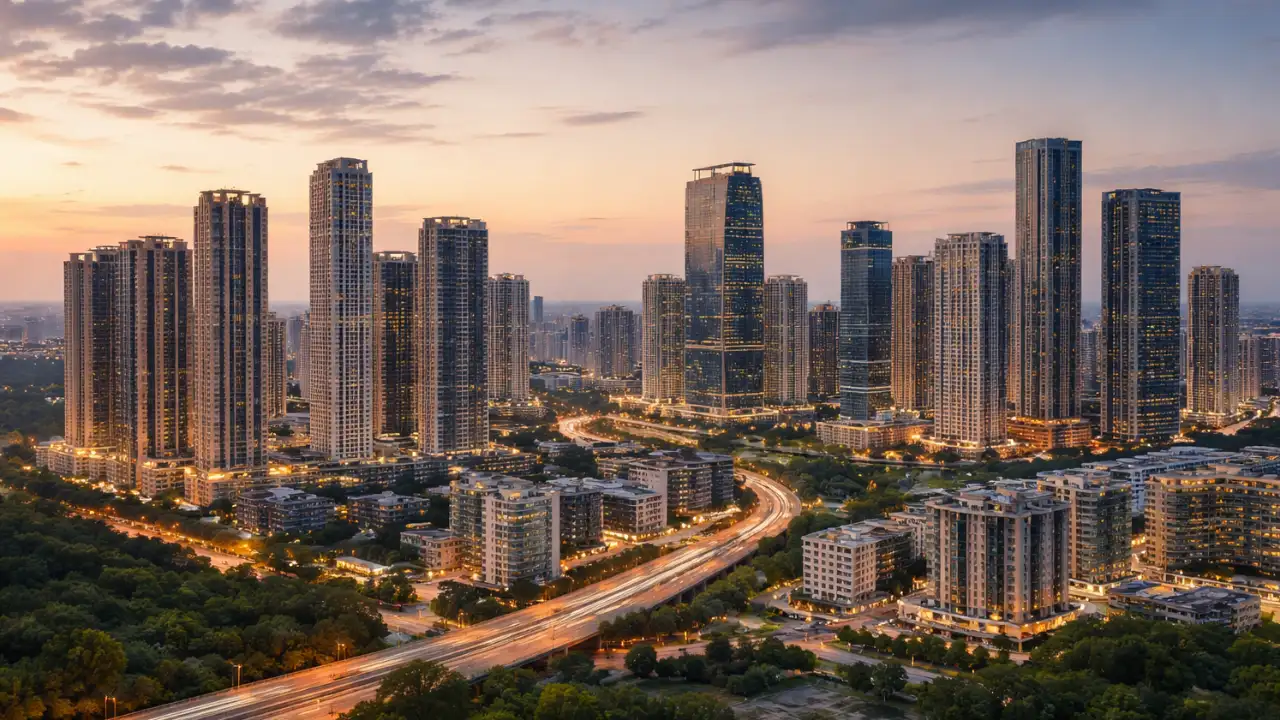
Hyderabad is consolidating its position as one of India’s most resilient and fast-expanding office real estate markets, outperforming larger metros as corporate occupiers and developers deepen their long-term commitments to the city. New research by a domestic ratings agency points to a sustained surge in both supply and absorption, signalling a structural shift rather than a cyclical upswing.
Over the past seven years, Hyderabad’s office market has expanded at nearly double the pace of India’s six largest commercial hubs. While national office stock growth remained moderate, the Telangana capital witnessed a sharp rise in Grade A developments, driven by technology-led employment, institutional investment and supportive urban planning frameworks. This expansion has allowed the city to steadily increase its share of India’s total office inventory, reinforcing its status as a core destination for global occupiers. What sets Hyderabad apart is the balance between new construction and demand. Even as developers delivered millions of square feet of premium office space over the past year, leasing activity kept pace, preventing the build-up of excess vacancy. Industry analysts attribute this equilibrium to sustained demand from technology services, financial institutions and global capability centres, many of which are scaling operations beyond cost arbitrage into higher-value functions. The city’s western growth corridor continues to anchor this momentum. Established employment clusters such as the technology corridor, financial district and adjoining business zones account for nearly two-thirds of Hyderabad’s total office supply. These micro-markets benefit from integrated infrastructure, transit connectivity and relatively predictable development norms, making them attractive for long-term corporate tenancy.
Urban planners note that Hyderabad’s development model has played a role in absorbing growth more efficiently than older metros. Lower density constraints and planned commercial zoning have enabled larger, campus-style developments, reducing fragmentation and allowing companies to consolidate operations. This has helped keep vacancy levels stable even as fresh supply enters the market. Looking ahead, developers are preparing for another wave of office completions over the next two years. Analysts expect leasing to remain robust, with a high proportion of new space likely to be occupied within the initial quarters of completion. The market’s fundamentals suggest that Hyderabad is entering a phase where scale, rather than speculation, will define growth. Concentration among large developers is also shaping the city’s commercial landscape. A small group of established players controls a majority of premium office stock, enabling standardisation in building quality, sustainability benchmarks and operational efficiency. This concentration has helped attract institutional capital seeking predictable yields and long-term asset performance.
For the city, the implications extend beyond real estate. Office-led growth continues to support employment generation, transit-oriented development and demand for housing and urban services. As cities across India compete for global investment, Hyderabad’s ability to align supply, demand and infrastructure may offer a blueprint for commercially driven yet relatively stable urban expansion.
Also Read: Stellar Innovations Reshapes Real Estate Operations
Hyderabad Office Growth Redefines City Scale
