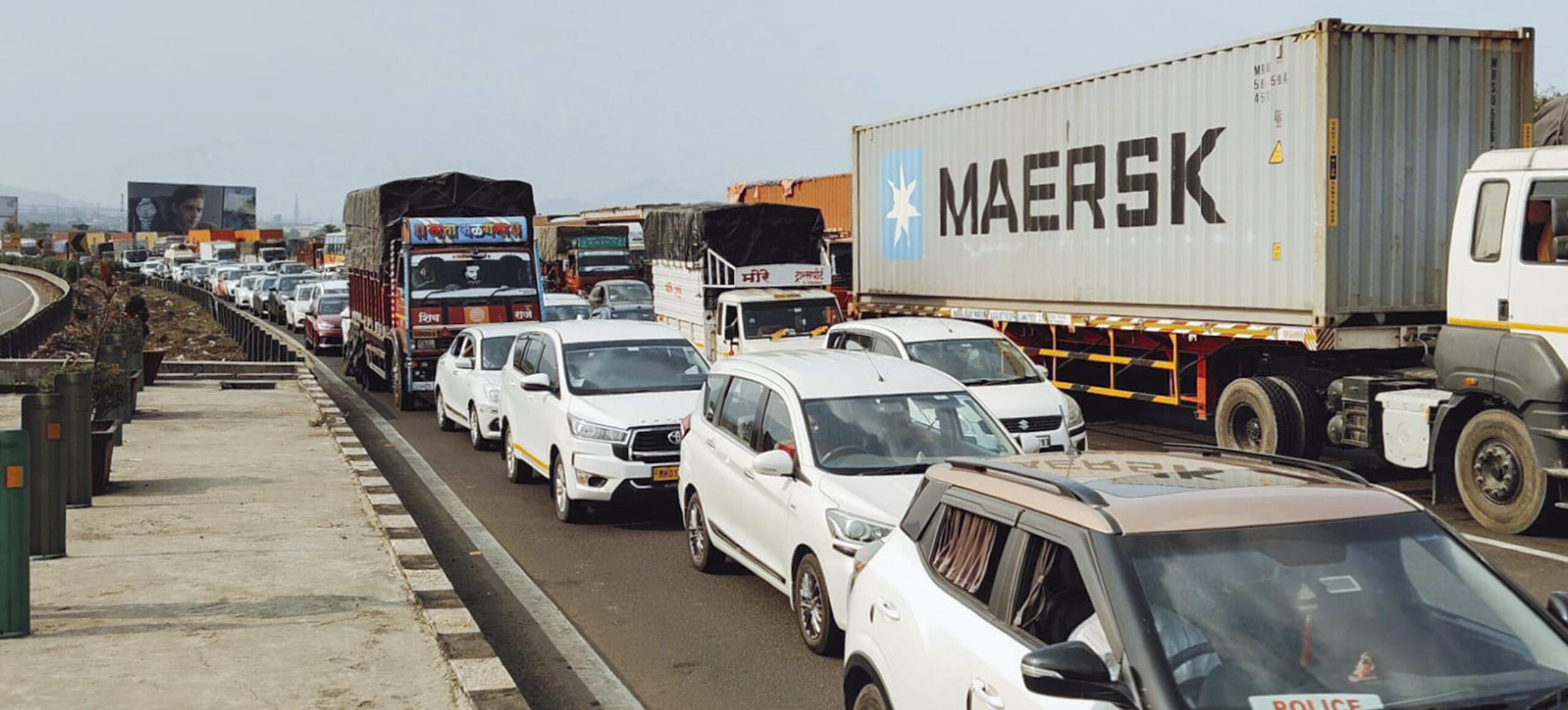
Pune Mumbai Expressway Disruption Paralyzes Regional Mobility
A prolonged shutdown on the Pune–Mumbai Expressway this week left thousands of motorists stranded for more than 32 hours, exposing critical vulnerabilities in one of western India’s most important economic corridors. The disruption followed an accident involving a hazardous material carrier near the ghat section close to a tunnel, forcing authorities to halt traffic on the Mumbai-bound carriageway for safety reasons. Beyond commuter distress, the episode has renewed scrutiny of infrastructure resilience, emergency response systems, and the risks embedded in high-density freight corridors.
The expressway, designed as a high-speed, access-controlled link between Maharashtra’s financial capital and its industrial heartland, effectively turned into a stationary parking lot. Traffic congestion extended well beyond the immediate accident zone, spilling across multiple districts and paralysing regional mobility. Families with children, senior citizens, and patients travelling for medical care were among those caught overnight in vehicles without access to food, sanitation, or reliable information. Urban planners point out that the incident highlights how a single-point failure on a critical artery can cascade across an entire metropolitan system. With limited redundancy and few safe diversion routes capable of absorbing sudden surges, the Pune Mumbai Expressway has become both indispensable and increasingly brittle. While alternate ghat roads exist, they are neither designed nor regulated to safely handle large volumes of diverted expressway traffic, especially for heavy vehicles.
Emergency response teams, including disaster management units and industry specialists, worked through the night to neutralise the hazard. Authorities opted to transfer the volatile cargo to secure containers before clearing the damaged vehicle, a process that took several hours due to safety protocols. Officials said traffic restrictions were unavoidable given the risk of ignition in a densely trafficked mountain stretch. However, transport analysts argue that the lack of nearby specialised recovery infrastructure prolonged the shutdown. The economic ripple effects were immediate. Intercity bus services were curtailed, logistics schedules disrupted, and passenger rail services experienced unusually high crowding as stranded travellers sought alternatives. For businesses dependent on just-in-time movement between Pune’s manufacturing clusters and Mumbai’s ports and commercial hubs, the stoppage translated into delayed deliveries and operational uncertainty.
From a sustainability and urban governance perspective, the episode raises deeper questions. As freight volumes rise and hazardous cargo movements increase, cities and regions must reassess how expressways intersect with climate resilience, public safety, and emergency preparedness. Experts suggest decentralised response hubs, stricter routing protocols for dangerous goods, and better real-time communication with commuters as immediate priorities. As traffic has now resumed, the focus shifts to lessons learned. Strengthening corridor resilience on the Pune Mumbai Expressway will be essential not only for commuter confidence, but also for the long-term economic stability of the Mumbai Metropolitan Region and its satellite cities.