


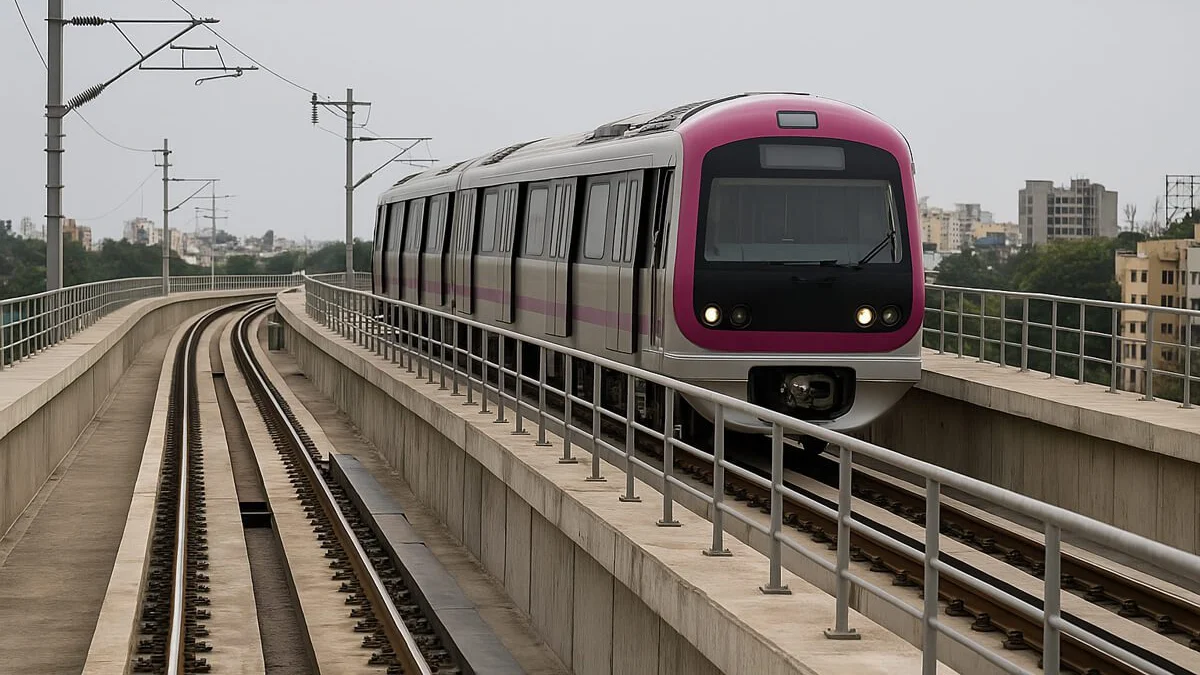
Bengaluru — The arrival of an additional trainset at the Kothanur depot marks a steady step forward in operational preparedness for Bengaluru Metro’s Pink Line, a critical east–west corridor designed to ease congestion across some of the city’s most densely populated and economically active zones. While construction progress often dominates public attention, the gradual build-up of rolling stock signals a transition from civil works to systems readiness, with implications for urban mobility, land use, and climate-conscious transport planning.
Metro officials confirmed that the Pink Line’s train fleet is being inducted in phases, aligned with depot readiness and systems integration. The line, once operational, is expected to connect residential clusters, commercial hubs, and institutional zones that currently rely heavily on road-based transport. Urban transport planners note that this corridor could significantly reduce travel times and vehicular pressure on arterial roads that experience daily congestion. Beyond mobility, the timing of fleet induction matters for the city’s broader development trajectory. Bengaluru’s growth has increasingly pushed eastward and northward, where real estate expansion has outpaced public transport availability. The Pink Line is seen as a backbone for transit-oriented development, encouraging higher-density, mixed-use projects around stations while reducing dependence on private vehicles. Industry experts point out that expanding the train fleet well ahead of full corridor commissioning allows for extended testing, staff training, and operational calibration. This reduces the risk of service disruptions during launch and supports safer, more reliable operations. For commuters, it translates into better frequency planning and capacity management from day one.
From an environmental perspective, the Pink Line’s progress reinforces the role of metro rail as a low-emission alternative in a city grappling with deteriorating air quality and rising transport emissions. Each fully operational metro corridor has the potential to remove thousands of daily car and two-wheeler trips from the road network, contributing to incremental but meaningful reductions in carbon output. Economically, improved metro connectivity often reshapes local markets. Property analysts observe that areas along under-construction metro corridors typically see speculative interest, but sustained value appreciation depends on timely commissioning and service reliability. The visible addition of rolling stock sends a signal of execution momentum, which can stabilise investor confidence and guide more responsible development decisions. However, urban planners caution that rail infrastructure alone cannot resolve congestion unless supported by pedestrian access, feeder bus services, and last-mile connectivity. The effectiveness of the Pink Line will depend on how seamlessly stations integrate with surrounding neighbourhoods, particularly for women, elderly commuters, and informal workers who rely on affordable, accessible transport.
As Bengaluru Metro continues to induct trainsets and advance system trials, attention will increasingly shift from construction milestones to operational readiness. For a city searching for scalable, people-first mobility solutions, the Pink Line represents more than a new route — it is a test of whether infrastructure expansion can keep pace with urban growth while steering Bengaluru towards a more resilient and sustainable transport future.
Also Read: Indian Railways Boosts Long Distance Rail Capacity
Bengaluru Metro Pink Line Fleet Expansion Advances
