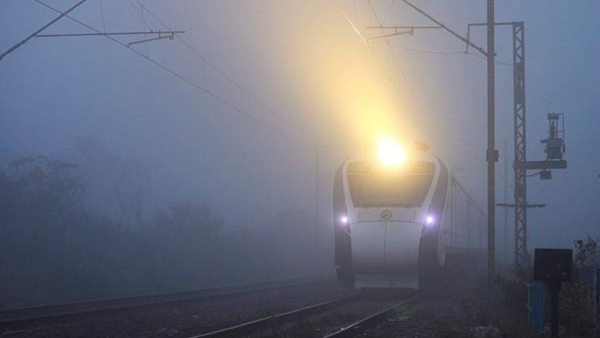
Dense winter fog across Delhi–NCR and the Indo-Gangetic plain disrupted premium rail operations early Wednesday, delaying multiple Vande Bharat Express services on routes connecting the capital with eastern Uttar Pradesh. While seasonal in nature, the episode once again exposed the growing vulnerability of India’s intercity mobility systems to climate-linked weather volatility, with cascading effects on productivity, commuter confidence, and urban connectivity.
Visibility levels dropped sharply across key rail corridors after midnight, forcing speed restrictions on semi-high-speed trains approaching Delhi from Lucknow and Varanasi. Rail operations managers indicated that even advanced rolling stock such as Vande Bharat must comply with conservative safety protocols when signal sighting becomes unreliable. As a result, inbound services reached the capital significantly behind schedule, contributing to platform congestion and missed onward connections at major terminals including New Delhi and Anand Vihar.
For daily commuters, business travellers, and inter-state professionals, the delays carried real economic costs. Morning disruptions on high-demand corridors affect office attendance, supply chain timing, and airport-rail transfers, particularly in a region where rail remains the backbone of long-distance, low-carbon mobility. Transport economists note that repeated winter fog delays are increasingly shaping travel behaviour, with passengers building larger buffers or shifting to more carbon-intensive road options when reliability is uncertain. The India Meteorological Department has flagged dense to very dense fog conditions across northern India, attributing the phenomenon to stagnant cold air, high moisture content, and reduced wind circulation. Urban climate researchers warn that such episodes are becoming more frequent and persistent due to changing atmospheric patterns and urban heat retention, especially across densely built plains where pollution particles further reduce visibility.
From an infrastructure planning perspective, the disruption underscores the need to integrate climate resilience into transport operations. While Indian Railways has invested heavily in modern signalling, collision avoidance systems, and fleet upgrades, experts argue that operational resilience must now extend beyond engineering to include predictive weather integration, staggered scheduling, and improved passenger communication during extreme conditions. Railway authorities have advised passengers to rely on real-time digital platforms for updated running information and to anticipate knock-on delays through the morning peak.
However, passenger rights groups highlight that weather-related delays currently fall outside compensation frameworks, raising questions around consumer protection as climate risks intensify. As cities across northern India pursue sustainable mobility transitions, ensuring reliability under adverse weather will be as critical as expanding capacity. Fog-related disruptions may be seasonal, but their impact on trust in public transport is cumulative making resilience planning not just an operational necessity, but a core pillar of people-first urban infrastructure.
Delhi NCR Fog Slows Vande Bharat Operations