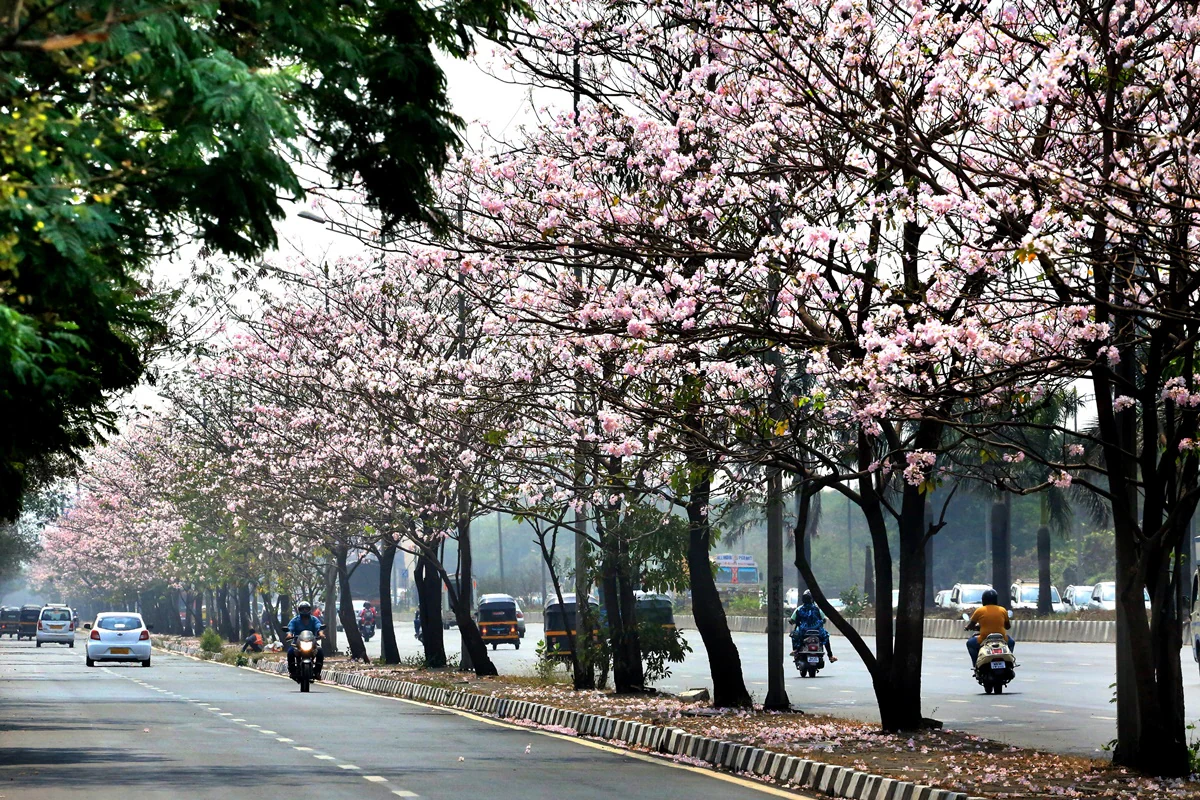
A seasonal transformation along several of Mumbai’s major roads has drawn widespread public attention, with stretches of the city briefly taking on a soft pink canopy as flowering trees enter peak bloom. The visual shift, most visible along the Eastern Express Highway near Vikhroli, has sparked interest far beyond aesthetics, highlighting the growing role of urban greenery in shaping climate resilience, public space, and liveability in dense metropolitan regions.
The flowering trees, commonly known as pink trumpet trees, have lined traffic corridors, residential neighbourhoods, and transit hubs across Mumbai and Navi Mumbai. Urban planners say such moments reveal how thoughtfully planned green infrastructure can humanise large transport corridors, offering residents visual relief in an otherwise high-stress urban environment dominated by concrete and traffic. Municipal horticulture officials explain that these fast-growing, drought-tolerant trees are increasingly favoured in city landscaping programmes due to their low water requirements and limited maintenance needs. Typically reaching heights of 25 to 30 feet, the trees shed leaves before flowering, allowing clusters of trumpet-shaped pink blooms to dominate the canopy for a short period. This flowering cycle generally occurs between late winter and early spring, although variations in temperature and rainfall patterns can shift bloom timing.
Beyond the Eastern Express Highway, the trees are distributed across multiple urban zones, including western suburbs, central neighbourhoods, heritage precincts in South Mumbai, and planned townships in Navi Mumbai. Urban forestry experts note that dispersing flowering species across different land-use zones ensures broader environmental benefits while avoiding over-concentration in ornamental districts alone. Mumbai’s urban tree inventory runs into several million trees, with pink trumpet varieties accounting for a small but visually prominent share. Originally native to parts of Central and South America, these species have adapted well to Mumbai’s coastal climate. Their success reflects a broader municipal strategy of selecting non-invasive, climate-resilient species capable of withstanding heat stress, pollution, and limited soil volumes along roadsides.
The public response, amplified through social media, has also reopened discussion around the economic and social value of urban green cover. Environmental economists point out that tree-lined roads can improve mental well-being, encourage walking, and marginally reduce surface temperatures, contributing to long-term public health outcomes. For cities facing rising heat risks, such nature-based solutions are increasingly viewed as essential urban infrastructure rather than aesthetic additions. However, experts caution that flowering visibility should not overshadow deeper challenges, including uneven tree cover distribution, survival rates of saplings, and conflicts between road widening projects and green assets. Ensuring continuity of green corridors alongside transport expansion remains a key governance challenge.
As Mumbai prepares for another summer marked by heat stress and climate volatility, the seasonal bloom serves as a reminder that resilient urban design depends as much on ecological planning as it does on built infrastructure. Strengthening urban forestry strategies, particularly along transport networks, may prove central to building a more inclusive and climate-adaptive city.
Mumbai Roads Turn Pink With Seasonal Blooms