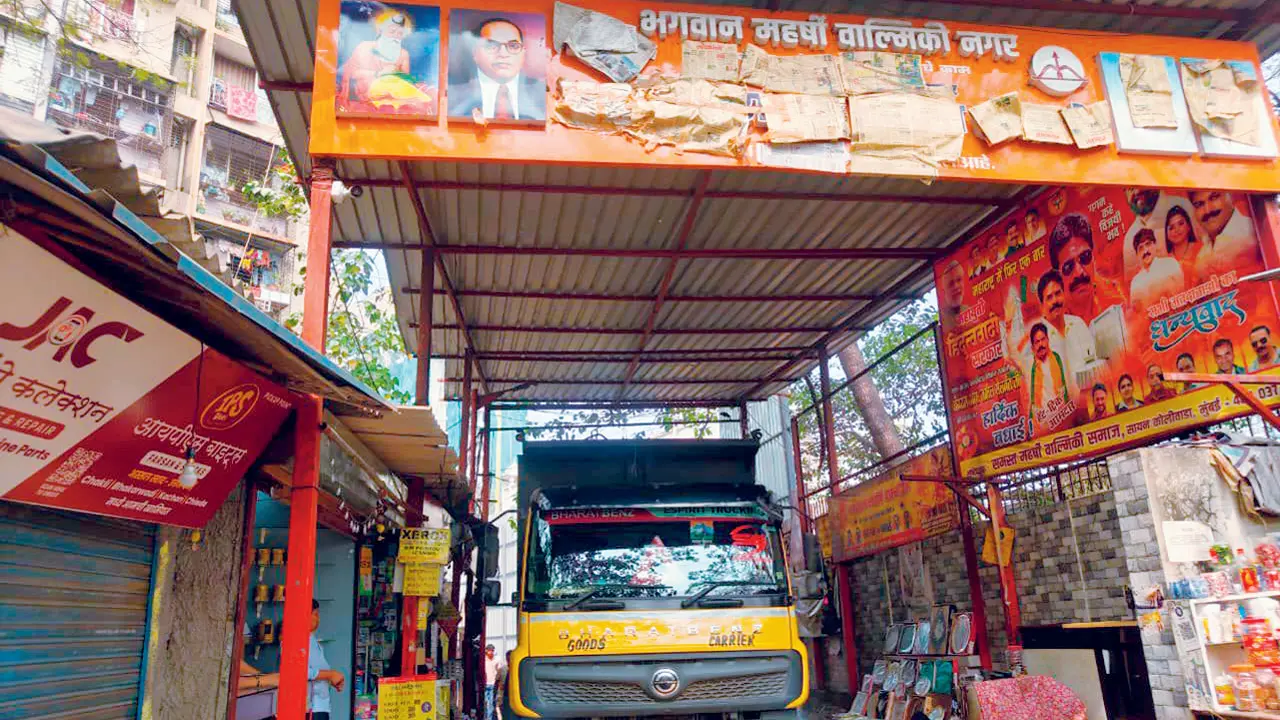
A neighbourhood road in Mumbai’s Sion area has become the centre of a growing civic dispute after residents flagged safety risks linked to redevelopment activity at a nearby housing colony. The issue has reignited questions around construction oversight, pedestrian safety, and how urban redevelopment is managed within already constrained city spaces.
Residents of the GTB Nagar precinct allege that a narrow Development Plan (DP) road connecting residential buildings to the local railway station has deteriorated rapidly due to sustained movement of heavy construction vehicles serving two redevelopment plots within a government housing colony. The road is a daily thoroughfare for senior citizens, commuters, and schoolchildren, making its condition a matter of public safety rather than a local inconvenience. According to residents, repeated use by trucks and heavy machinery has resulted in uneven surfaces, damaged paving, and persistent dust. More critically, underground utility lines were reportedly affected during construction activity, leading to continuous water leakage and waterlogging. Urban planners note that such damage not only increases accident risk but also undermines municipal infrastructure already under stress, particularly in older neighbourhoods where services were not designed for intensive construction traffic.
The issue has taken on a regulatory dimension after residents sought clarity from the municipal corporation regarding whether formal permission had been granted to use the DP road as a construction access route. In written correspondence shared with residents, civic officials stated that no approval had been issued for access or exit through the road. Despite this, residents claim construction traffic continues, raising concerns about enforcement gaps at the ward level. Parents of students attending a nearby school say the situation has altered daily routines, with children now requiring adult supervision due to constant vehicle movement along the narrow stretch. Urban safety experts point out that school access roads require stricter controls under city mobility guidelines, especially in high-density neighbourhoods where pedestrian movement dominates.
Residents have also questioned discrepancies in project documentation, alleging that the road width cited for redevelopment approvals does not match on-ground conditions. Industry observers say such disputes highlight the need for transparent verification of site access, road widths, and impact assessments before redevelopment permissions are finalised, particularly in land-scarce urban areas like Mumbai. Project representatives, however, maintain that the redevelopment has received all statutory approvals and argue that opposition from some residents is driven by internal disputes linked to the project. Municipal officials from the local ward did not provide a response on enforcement measures before publication.
The dispute underscores a larger urban challenge: balancing redevelopment and housing renewal with safety, infrastructure resilience, and everyday mobility. As Mumbai accelerates redevelopment to address ageing housing stock, experts say stronger monitoring of construction logistics and stricter accountability for on-ground impacts will be essential to ensure redevelopment does not come at the cost of liveability or public safety.
Mumbai Sion Redevelopment Triggers Road Safety Alarm