


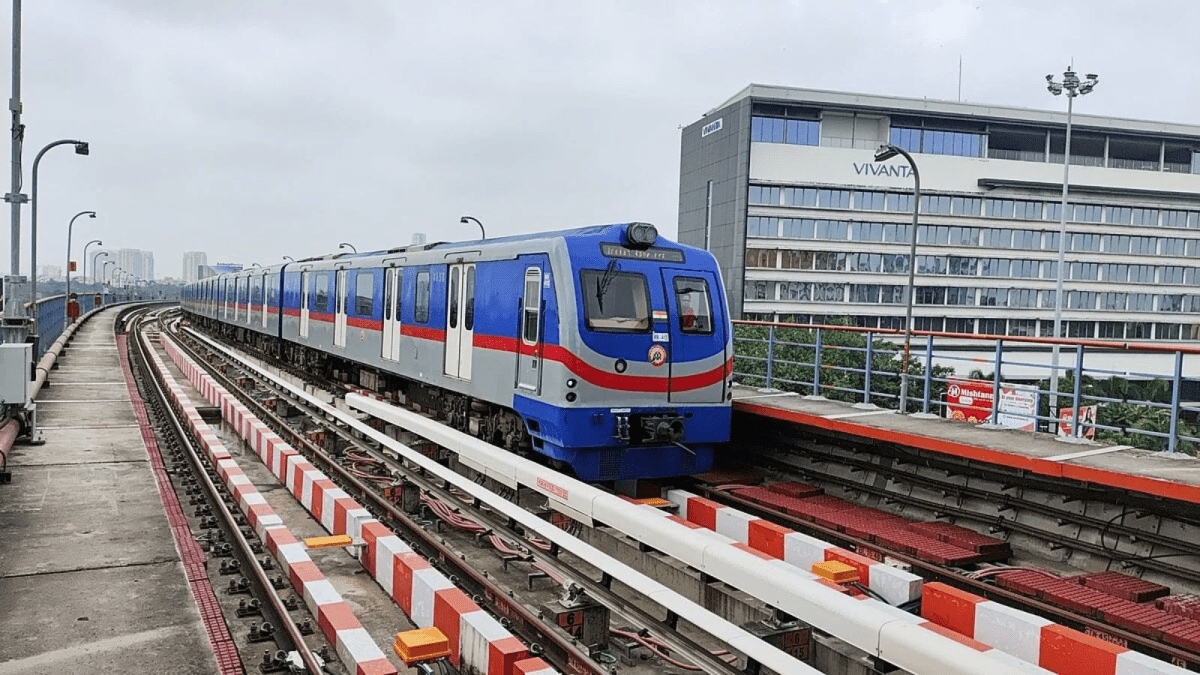
Kolkata’s largest rapid transit artery, the Blue Line of Kolkata Metro, has seen a marked uptick in service punctuality following a temporary operational clearance from the Commission of Railway Safety (CRS) to permit track switching at the southern end of the corridor.
This adjustment, in place while structural concerns are addressed at the primary terminal, is helping restore commuter confidence on a line that carries tens of millions of annual passengers and is central to urban mobility in the city’s congested transport network. The Blue Line, which runs from the city’s northern districts through central business zones to the southern suburbs, had suffered persistent delays since a key station was closed due to structural issues. In response, CRS — the statutory body responsible for rail safety oversight — granted a temporary exemption allowing trains to use a crossover at the main terminus, thereby smoothing turnaround and increasing schedule adherence to around 98 per cent. The disruption stemmed from the closure of the southernmost station of the line after engineers detected cracks in its platform supports last year. With that terminal partly inaccessible, operations shifted to the preceding station, which lacks essential infrastructure such as a crossover point to switch train direction. Under normal safety rules, a train cannot depart without a cleared crossover movement, leading to bottlenecks that rippled across the entire corridor.
Urban planners and transport analysts point out that uninterrupted metro service is more than a scheduling metric; frequent, reliable mass transit directly supports equitable access to jobs, education and city services, particularly for women, students and lower-income commuters who depend on it daily. Delays on high-capacity corridors like the Blue Line can push passengers back toward road-based alternatives, increasing congestion and emissions in a city already grappling with air quality challenges. Railway officials indicate that the temporary CRS concession means all scheduled 172 daily train movements can now utilise the crossover for return journeys, improving rhythm and predictability. For months, the operator had been deploying operational workarounds including sending empty trains southward to the original terminal for technical manoeuvres, a practice that strained resources and did little to reassure commuters. Industry experts note that while this regulatory latitude stabilises service in the short term, it underscores a deeper infrastructure gap. Permanent resolution will require reconstructing the affected platform supports and establishing full crossover facilities at the interim terminal — projects that must be coordinated with signalling upgrades, such as the Communication-Based Train Control (CBTC) system planned for the Blue Line to enhance capacity and enable closer train spacing.
Real-estate stakeholders also watch metro reliability closely: transport performance influences property values, walkable transit-oriented development and business location decisions. Improvements in punctuality could reinforce investment interest in commercial and residential nodes anchored by the Blue Line, while unresolved delays risk dampening growth prospects in fringe catchments. As the metro operator leverages this interim approval, the focus now shifts to balancing immediate commuter needs with long-term infrastructure upgrades. Ensuring sustained reliability, integrating advanced control systems, and securing transparent communication with the public will be critical if Kolkata’s busiest metro corridor is to support equitable and low-carbon urban mobility into the next decade.
Also Read: Ahmedabad Mumbai Rail Sees Palghar Progress
Kolkata Metro Blue Line Sees Operational Improvement
