Delhi’s long-stalled institutional focus on neighbourhood infrastructure east of the Yamuna is set for a reset, with the Trans Yamuna Development Board preparing to roll out more than 1,100 small-scale civic projects across East Delhi during the current financial year. The move follows fresh budgetary backing from the city government and signals a shift toward clearing chronic service gaps in one of the capital’s most densely populated urban zones.
Officials familiar with the planning process said the initial project pipeline is designed to address everyday deficits rather than marquee construction. Road repairs, stormwater drainage, sewer modernisation and local water supply upgrades together account for the overwhelming majority of approved works. Execution responsibility will largely rest with municipal and water utility agencies, aligning funding with existing delivery structures to speed up implementation.
Urban infrastructure specialists see the approach as pragmatic. East Delhi’s development constraints are less about land availability and more about ageing networks that have struggled to keep pace with population growth. Improving drainage and sewer capacity is particularly significant in flood-prone pockets along major roads and low-lying residential areas, where climate variability has intensified seasonal disruptions.
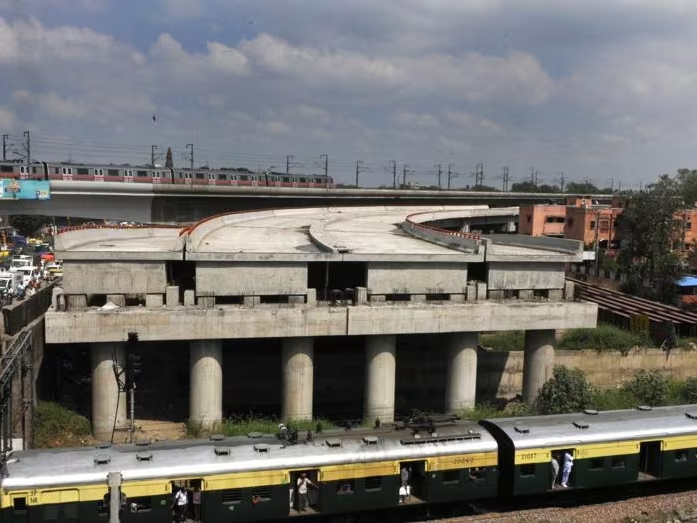
Among the larger proposals under early evaluation is an elevated road connection along a congested drainage corridor linking educational and industrial clusters. Transport planners say such interventions, if carefully designed, could ease traffic pressure without large-scale land acquisition, a persistent challenge in built-up neighbourhoods. However, they caution that flyovers must be accompanied by pedestrian safety and last-mile connectivity improvements to deliver lasting benefits. Beyond mobility and utilities, the approved framework allows investment in public schools, community facilities, green spaces and healthcare equipment, signalling a broader interpretation of infrastructure that includes social assets. Notably, the guidelines also permit the creation of hostels for working women, reflecting a growing policy emphasis on inclusive urban participation and workforce mobility.
To tighten governance, the board has adopted a detailed operating framework that standardises project selection, costing and fund release. Proposals must adhere to national construction and financial norms, include clear timelines and be supported by site documentation. Officials said geo-tagged project records and inter-agency clearances are intended to reduce execution delays that have historically plagued area development schemes. Importantly, the funding framework explicitly excludes unauthorised colonies, directing such works to separate regularisation programmes.
While this may limit immediate reach, urban policy analysts argue that clarity of mandate is essential to avoid overlaps and stalled projects.
For residents and local markets, the near-term impact lies in improved reliability of basic services rather than visible transformation. Yet planners suggest that stabilising core infrastructure is a prerequisite for more ambitious redevelopment, including public spaces and commercial revitalisation. As funding levels potentially rise in the next fiscal cycle, the board’s ability to convert incremental upgrades into long-term urban resilience will be closely watched.
Delhi East Sees Large Civic Upgrade Drive