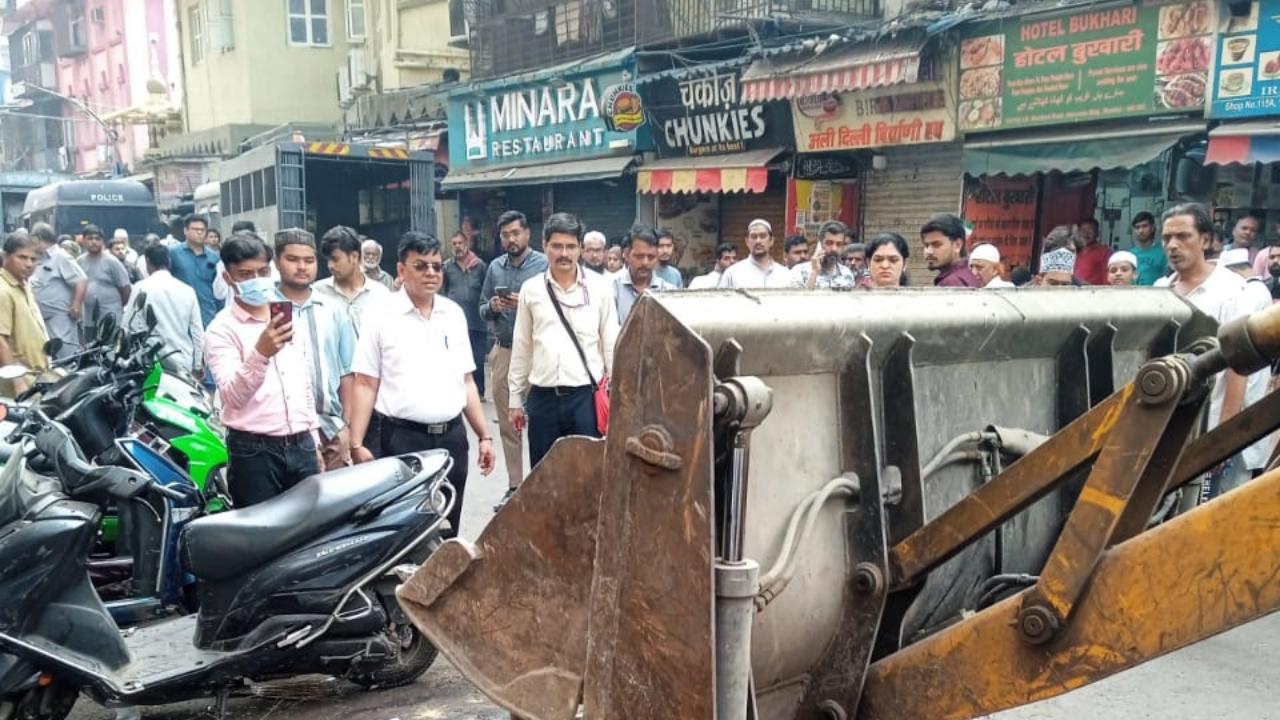
Mumbai’s civic administration has stepped up efforts to reclaim public space in the city’s historic core, carrying out a coordinated clearance operation along two of South Mumbai’s busiest commercial corridors. The exercise focused on restoring footpath access and easing traffic flow in areas that serve as vital links between wholesale markets, retail clusters, and residential neighbourhoods, underlining the growing urgency of pedestrian-first street management in older parts of the city.
The operation was undertaken on Mohammed Ali Road and Ibrahim Merchant Road, both long-established trading streets that experience heavy daily footfall and vehicular movement. Over time, these corridors have become increasingly constrained due to unauthorised extensions, informal vending, and abandoned vehicles, reducing effective road width and forcing pedestrians onto carriageways. Urban mobility experts note that such conditions significantly raise accident risk while slowing goods movement across key market districts. Civic officials overseeing the drive said multiple forms of encroachment had been identified along the footpaths, including extended shop fronts, temporary sheds, raised platforms, and fixed street furniture that did not have statutory approvals. These structures had gradually narrowed pedestrian space and disrupted traffic circulation, particularly during peak business hours. The clearance also addressed non-functional vehicles occupying curbside space, further contributing to congestion.
From an infrastructure and planning perspective, the action reflects a broader push by Mumbai’s municipal authorities to improve street efficiency in dense commercial zones without expanding road footprints. In land-scarce inner-city areas, reclaiming footpaths is increasingly seen as one of the most cost-effective interventions to improve safety, accessibility, and economic productivity. Transport planners point out that clear walkways are essential not only for pedestrians but also for last-mile freight movement, emergency access, and public transport reliability. The operation required a coordinated deployment of civic staff, heavy equipment, and police support, highlighting the scale of enforcement needed to address entrenched encroachment in older market precincts. While such drives often generate short-term disruption, municipal officials argue that consistent enforcement is necessary to prevent reoccupation and ensure that public infrastructure functions as intended.
The Mumbai anti-encroachment drive also has implications for urban equity and climate resilience. Clear footpaths enable safer movement for women, senior citizens, and people with disabilities, while reducing pedestrian spillover onto roads helps lower accident-related emissions from stop-start traffic. Urban economists add that better-managed streets can improve business turnover by making markets more accessible and predictable for both traders and customers. Looking ahead, planners suggest that sustained monitoring, redesigned vending zones, and clearer enforcement frameworks will be essential to prevent recurring encroachment. As Mumbai continues to modernise its transport and public realm, the effectiveness of the Mumbai anti-encroachment drive will be judged not just by immediate clearance, but by whether these critical commercial streets remain accessible, safe, and economically vibrant over the long term.
BMC Launches Clearance Drive On Mohammed Ali Road And Ibrahim Merchant Road