


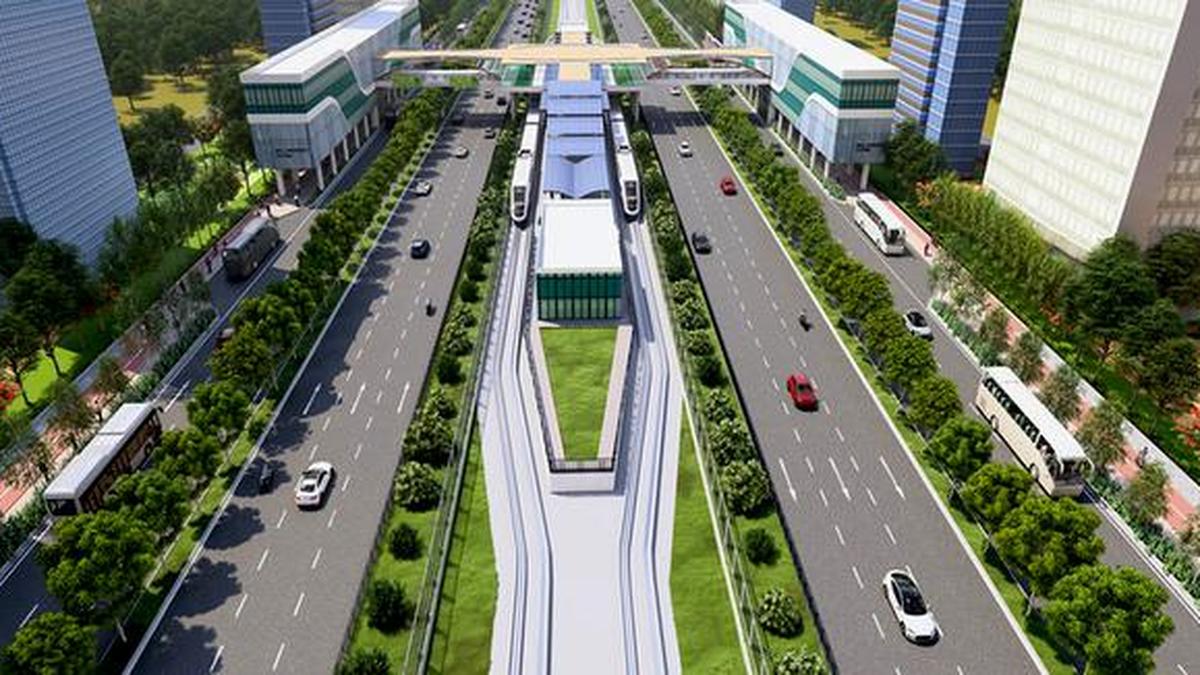
Cyberabad’s civic and policing authorities are advancing plans for a dedicated pedestrian skywalk along one of Hyderabad’s busiest technology corridors, signalling a shift towards people-first mobility solutions in high-density employment zones. The proposed elevated walkway will connect the Raidurgam Metro Station with major office and innovation hubs, addressing long-standing safety and congestion challenges in the area.
Officials overseeing urban traffic management said the initiative is intended to create a continuous, grade-separated pedestrian route through a stretch that experiences intense footfall throughout the day. The corridor, anchored by technology offices, retail spaces, and transit infrastructure, has emerged as a pressure point where pedestrians and vehicles compete for limited road space.Urban planners involved in the assessment said the Cyberabad skywalk project aims to reduce risky road crossings while improving access to public transport. By separating pedestrian movement from vehicular traffic, authorities expect smoother traffic flow and safer walking conditions, particularly during peak office hours. Early projections suggest a meaningful reduction in surface-level congestion once the facility becomes operational.
The first phase of the Cyberabad skywalk project is planned as a 500-metre elevated structure aligned with existing transit and flyover infrastructure. Parallel proposals include a pedestrian underpass to strengthen last-mile connectivity between office campuses and innovation districts. Together, these interventions are designed to function as an integrated mobility network rather than isolated infrastructure elements.Officials said the project is being developed through coordinated planning between law enforcement, industrial area authorities, and infrastructure agencies, with private sector participation expected under a public–private partnership framework. This model, increasingly used in employment hubs, allows faster execution while aligning infrastructure design with user needs.
Experts in sustainable urban transport note that pedestrian infrastructure is often overlooked in Indian cities, despite walking accounting for a significant share of daily trips. In car-oriented business districts, the absence of safe walking routes not only increases accident risk but also discourages public transport use. Elevated walkways, when thoughtfully integrated, can reduce short vehicle trips and associated emissions.Beyond physical infrastructure, the initiative reflects a broader push towards administrative modernisation within Cyberabad’s governance ecosystem. Authorities recently rolled out a digital file management system aimed at reducing paperwork, improving coordination, and accelerating decision-making across departments. Officials said the platform supports real-time tracking and secure collaboration, improving institutional efficiency.
As Hyderabad’s technology corridors continue to densify, urban specialists argue that future competitiveness will depend as much on walkability and safety as on office supply. The proposed skywalk and allied projects will now move through inter-agency approvals, with detailed designs expected to factor in accessibility, lighting, and universal design standards.If implemented effectively, the initiative could set a template for pedestrian-first infrastructure across other high-growth commercial districts, helping cities balance economic intensity with safer, more inclusive public spaces.
Also Read: Mumbai Coastal Road Safety Measures Intensify
