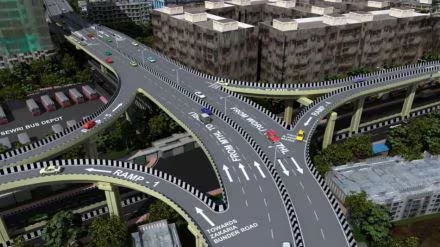
Mumbai’s long-delayed Sewri–Worli elevated road project has regained momentum after authorities cleared a major social and logistical hurdle that had stalled construction for months, marking a renewed push on one of the city’s most consequential transport links. The breakthrough in rehabilitating displaced residents near the Prabhadevi alignment could accelerate progress on the corridor intended to enhance connectivity between South Mumbai and the eastern suburbs, with implications for congestion relief and broader urban mobility.
The Mumbai Metropolitan Region Development Authority (MMRDA) confirmed that disagreements over resettlement arrangements for residents from two key buildings in Prabhadevi — whose demolition was necessary for the road alignment — have largely been resolved. Under the Maharashtra Housing and Area Development Authority (MHADA) framework, most affected residents have either accepted alternative housing or opted for monetary compensation, reducing a critical impediment to construction restart.This elevated link, designed to seamlessly connect South Mumbai to Atal Setu (the Trans-Harbour Link), forms a key component of Mumbai’s strategic transport infrastructure, aimed at reducing persistent gridlock in one of the city’s busiest corridors. Progress on the broader 4.5-km elevated connector has been intermittent, with rehabilitation and land challenges previously slowing pace despite nearly half the structural work already completed.
Urban planners highlight that resolving social consent issues — particularly around project-affected people (PAPs) — is essential for infrastructure projects in densely built environments like Mumbai. Rehabilitation delays on this and other initiatives have been a recurring theme, with scattered housing stock and residents’ preference to remain close to livelihoods adding complexity to relocation planning.For city commuters and businesses, the elevated road holds the promise of significant travel time savings and reduced traffic pressures once operational. It is designed to dovetail with existing links such as the Bandra-Worli Sea Link and Atal Setu, creating a more integrated network that supports both intra-city and regional flows.
However, analysts caution that moving beyond the immediate rehabilitation hurdle does not guarantee timely completion. Large-scale transport infrastructure in megacities often faces iterative challenges — from technical redesigns and land clearances to environmental and traffic management clearances — which can cumulatively extend project timelines.For residents in Prabhadevi and surrounding districts, the road’s progress intersects with localized concerns about displacement, accessibility and quality of life during construction phases. Experts stress the importance of transparent engagement and clear compensation frameworks to maintain trust and minimise disruptions, particularly where infrastructure intersects with residential precincts.
The renewed impetus on the Sewri–Worli elevated road also underscores broader lessons for Mumbai’s urban development: that physical connectivity projects must be synchronised with social planning and sustainable urban design, ensuring equitable outcomes even as the city pursues mobility gains and economic expansion. Looking ahead, coordinated efforts between state agencies, local authorities and residents will be critical to transform this infrastructure milestone into a functional artery that eases congestion and supports equitable urban growth in India’s largest metropolis.