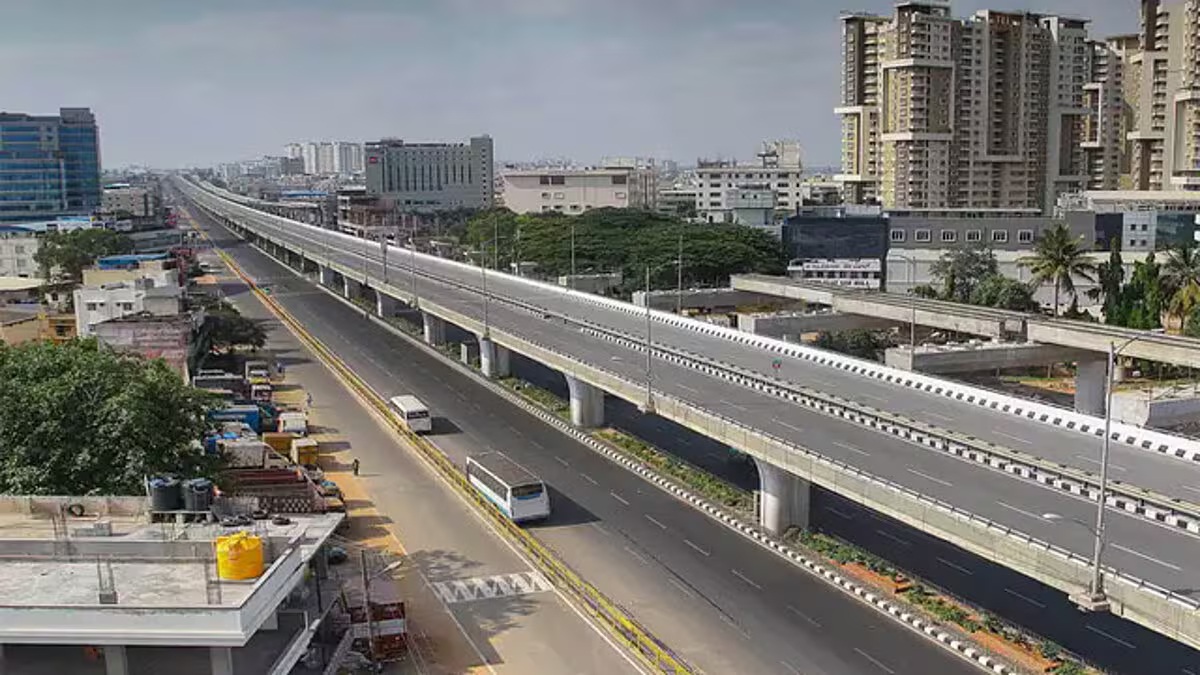
A major transport bottleneck in north Bengaluru is set for relief as civic authorities push to complete the long-pending Yelahanka flyover project by late September 2026. The elevated corridor on Doddaballapur Main Road, a key commuter artery linking residential neighbourhoods, industrial clusters and the airport-bound corridor, is now entering its final construction phase with significant implications for daily mobility, land values and emissions reduction.
During a recent field review across the Bengaluru North municipal zone, the city’s top administrative leadership assessed progress on the 2-kilometre structure and instructed engineering teams to adhere strictly to the revised delivery timeline. Officials confirmed that roughly 70 per cent of the Yelahanka flyover project has been executed, with most structural components already in place. The remaining work involves completing a small number of supporting pillars and installing the balance of precast deck segments. Construction activity is being restricted largely to night hours to avoid paralysing daytime traffic, highlighting the complexity of retrofitting large infrastructure into dense urban corridors. Urban planners note that such constraints often stretch timelines but are necessary to maintain economic activity in fast-growing districts like Yelahanka, where residential expansion has outpaced road capacity over the past decade.
Beyond the flyover, authorities also reviewed progress on complementary road upgrades intended to improve last-mile connectivity. White-topping a concrete surfacing technique designed to extend road life and reduce maintenance cycles has been substantially completed along one side of the Hennur–Bagalur Road, with the remainder scheduled in the coming weeks. Transport experts say durable surfaces can lower long-term public spending while improving fuel efficiency by reducing stop-start congestion. Attention has also turned to a partially completed railway underbridge in the same zone. While one carriageway has been operationalised following structural works, the second side remains delayed due to unresolved land coordination with rail authorities. Senior officials have directed departments to expedite clearances and widen the approach roads, recognising that incomplete junctions can negate the benefits of large flyover investments.
For residents and businesses in north Bengaluru, the completion of the Yelahanka flyover project is expected to shorten travel times, improve bus reliability and ease freight movement toward peripheral employment hubs. Real estate analysts observe that predictable infrastructure delivery plays a crucial role in stabilising housing markets and encouraging mixed-use development, particularly when aligned with public transport corridors. As Bengaluru continues to grapple with climate stress, rising vehicle ownership and uneven infrastructure rollout, the coming months will test whether coordinated execution can translate engineering progress into people-first urban outcomes. The focus now shifts from construction milestones to integration ensuring that flyovers, surface roads and underpasses function as a cohesive, safer network once opened to the public.