Nagpur IIM Partners With Govt And Tata Motors For Rural Growth
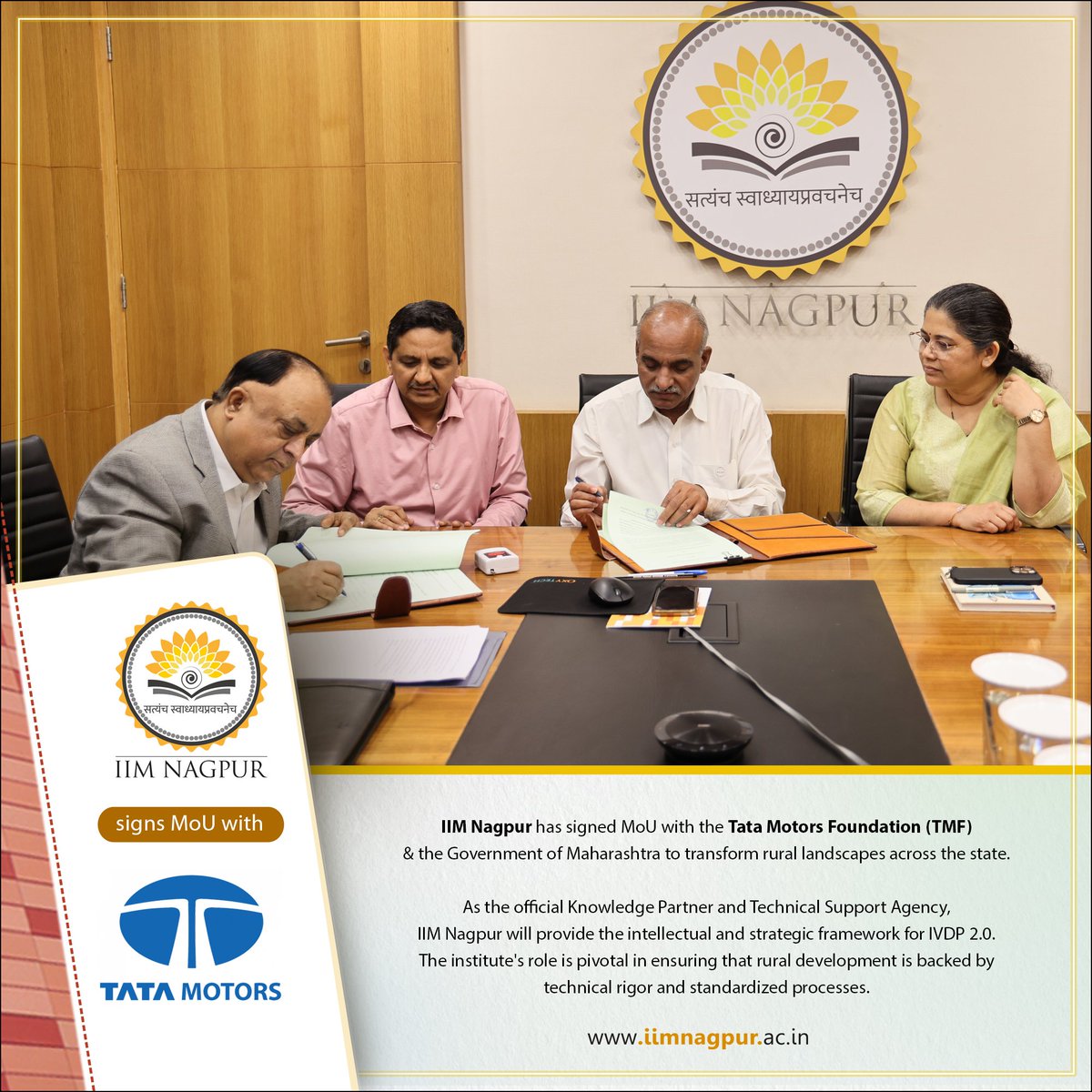
The Government of Maharashtra, Tata Motors Foundation and the Indian Institute of Management (IIM) Nagpur have formalised a strategic partnership to scale rural development across the state, launching Integrated Village Development Programme 2.0 (IVDP 2.0) — a management‑led framework for systematic village transformation. The memorandum of understanding (MoU) signed in Nagpur signifies an effort to rewire traditional rural planning with data‑driven governance and skills development.
Under the tripartite agreement, IIM Nagpur will serve as the principal knowledge partner, providing technical support for planning, execution and impact assessment of village development plans. The Tata Motors Foundation is offering financial backing, while the state government will steer administrative alignment. This model seeks to bridge gaps between policy formulation and last‑mile delivery of public services in sectors such as education, agriculture and local governance.Analysts say rural transformation in India often falters due to fragmented execution and limited integration between local governments and technical expertise. By embedding management principles typically reserved for corporate strategy — such as outcome matrices and rigorous impact validation — the IVDP 2.0 initiative could enhance efficiency in Gram Panchayat Development Plans (GPDPs) and ensure that investment translates into measurable community benefits.
A central feature of the programme involves professional training for field staff and village coordinators, in partnership with YASHADA, Maharashtra’s training institute for public administrators. Improved skills at the grassroots level are expected to enhance governance quality and accelerate the reach of flagship state and central schemes to vulnerable populations. Generationally, this could mean better opportunities for youth and more resilient livelihoods for farming households.Urban planners emphasise that drawing on academic institutions for rural development is not new, but coupling it with robust monitoring frameworks and private‑sector support marks an evolution in how development is operationalised. “If village progress is measured the same way business outcomes are tracked, with clear inputs and outputs, accountability improves,” said a public policy expert.
For Maharashtra, which already hosts experimental “smart village” models using digital tools and sustainable irrigation highlighted in the state’s recent economic survey, the IVDP 2.0 initiative joins a broader mosaic of innovation in rural governance.Critics of rural development reforms caution that success hinges on sustained coordination between state bureaucracies, local leaders and the private partner — a persistent challenge in decentralised governance. They say that community engagement and transparent monitoring are essential to prevent well‑intentioned frameworks from remaining on paper. Review mechanisms and local feedback loops built into the programme could help address this.
As the programme rolls out across Maharashtra’s villages, stakeholders will watch closely for early indicators such as improvements in access to services, enhanced income streams for residents and more efficient implementation of government schemes. These measures will likely define whether the model can be refined for replication in other Indian states