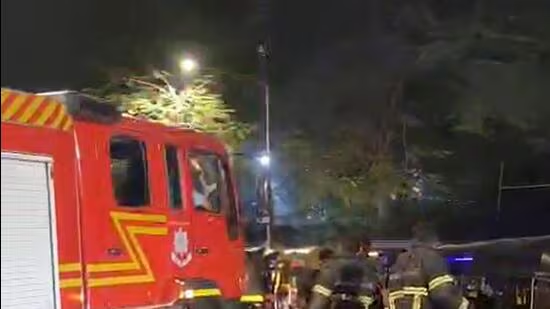
Mumbai Road Obstructions Delay Fire Response Efforts
Emergency responders in Kandivali East faced critical delays entering a residential complex during a late‑night kitchen fire when illegally parked autorickshaws and roadside obstructions blocked access, exposing persistent gaps in urban traffic management and emergency preparedness. The constraint on fire tenders has reignited debate over street encroachments, urban mobility and public safety in one of Mumbai’s rapidly densifying suburbs.
Around 11 pm on Wednesday, fire services arrived within minutes of the distress call to the Lokhandwala Township, a dense housing belt connected to Akurli Road. However, they were unable to drive through the primary access road for nearly 15 minutes because autorickshaws were parked on both sides of the narrow approach, impeding essential clearance for large emergency vehicles. Residents feared the delay could have had far more severe consequences had the blaze spread beyond a single flat.Urban planners point out that emergency access is a fundamental requirement of city infrastructure design, yet enforcement lapses continue to undermine effectiveness on the ground. “Priority lanes for emergency services must be inviolable,” said a senior urban safety consultant. “When public safety intersects with parking and traffic behaviour, the system fails citizens rather than serving them.” Indeed, Mumbai’s road network has long been strained by vehicle proliferation, informal parking and street vendors that inadvertently narrow thoroughfares, particularly in residential pockets off major arteries.
The access road to the Highland society is technically wide enough to allow two‑way large‑vehicle movement, but in practice, encroachments and roadside stalls have shrunk navigable space for years, compounding congestion and risking emergency response times. Locals report that the problem persists despite repeated complaints to civic authorities and traffic police, underscoring enforcement challenges amid competing urban pressures.Emergency response efficiency is an urban resilience indicator and, in rapidly expanding cities like Mumbai, bottlenecks can cost lives if not addressed systematically. Mumbai’s fire departments require unobstructed corridors not just for fires but for medical emergencies and disaster scenarios — particularly in high‑density developments where elevator lobbies, stairwells and internal access depend upon external clearance.
Municipal authorities acknowledge the issue, with local enforcement units issuing daily penalties to errant drivers along Akurli Road. Yet residents say punitive measures alone have not delivered sustained relief, pointing instead to the broader complexities of unregulated urban street use, commercial encroachments and under‑resourced enforcement teams.Authorities have pledged stepped‑up patrols and sweeps to keep primary routes clear of unauthorised parking, and local representatives say they will monitor compliance more closely. Urban mobility experts underscore that sustainable solutions must combine enforcement with better designated parking infrastructure, traffic decongestion strategies and public awareness campaigns to reduce ad‑hoc roadside parking.
As Mumbai’s population continues to grow, integrating emergency access protocols into city planning — from community roads to arterial networks — is essential to safeguard residents. The Kandivali incident highlights that without cohesive urban management frameworks that synchronise land use, mobility and enforcement, gaps in critical services persist — even when frontline responders arrive on time