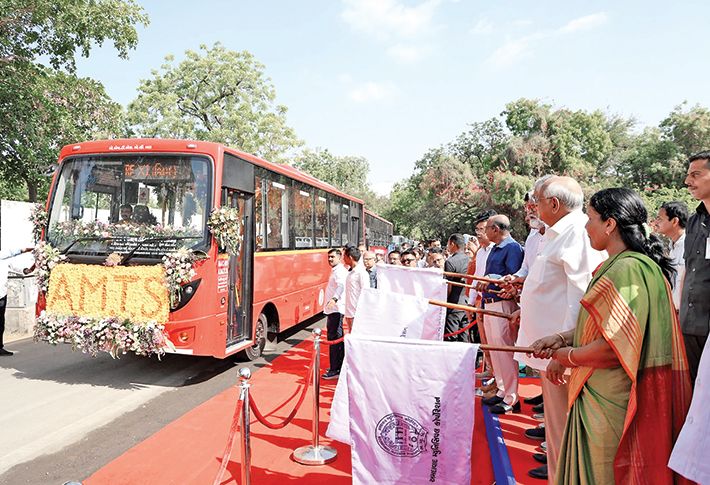
Ahmedabad Public Transport Enters Riverfront Corridor
For the first time since the Sabarmati Riverfront opened to the public over a decade ago, Ahmedabad’s civic transport authority is preparing to introduce city bus services along both banks of the landmark corridor. The move, announced as part of the municipal transport operator’s draft budget for 2026–27, signals a shift in how the riverfront is being integrated into the city’s everyday mobility network rather than treated as a car-oriented recreational zone.
The proposed deployment of electric buses along the nine-kilometre riverfront marks a significant departure from current access rules, which restrict the stretch largely to private vehicles. Urban planners say the change reflects growing recognition that major public spaces must be served by mass transit to remain inclusive, especially as the riverfront increasingly hosts offices, cultural venues, housing clusters and public events. Officials familiar with the plan indicated that the intention is to operate zero-emission buses on both the eastern and western banks, reducing reliance on personal vehicles and lowering local air and noise pollution in one of the city’s most visible public precincts. While a rollout timeline has not yet been disclosed, the inclusion in the draft financial plan suggests preparatory work is underway, including route design, charging infrastructure assessment and traffic integration.
The announcement comes alongside broader measures aimed at improving affordability and access. Workers registered under the state’s labour welfare framework will continue to receive free travel across all routes and services through a dedicated mobility pass. Transport economists note that such schemes, when paired with expanded route coverage, can significantly improve workforce participation by cutting commuting costs for informal and semi-formal workers. From an urban development perspective, extending public transport to the riverfront could influence land use and real estate patterns along the corridor. Improved bus connectivity is expected to support higher footfall for riverfront-facing commercial developments while encouraging denser, mixed-use activity without proportionate increases in private traffic. Sustainability experts also point out that integrating electric public transport into high-profile public spaces helps normalise low-carbon mobility choices across the city.
However, transport planners caution that operational details will be critical. Bus frequency, pedestrian safety, and coordination with cycling and walking infrastructure will determine whether the riverfront remains people-friendly while accommodating public transit. Ensuring that buses complement, rather than dominate, the public realm will be key to maintaining the riverfront’s social and environmental value. As Ahmedabad continues to expand, the decision to introduce AMTS electric buses on the Sabarmati corridor underscores a broader recalibration of urban priorities, one that places public transport, accessibility and climate considerations at the centre of city-building decisions. The coming months will reveal how effectively this vision translates from budget documents to the street.