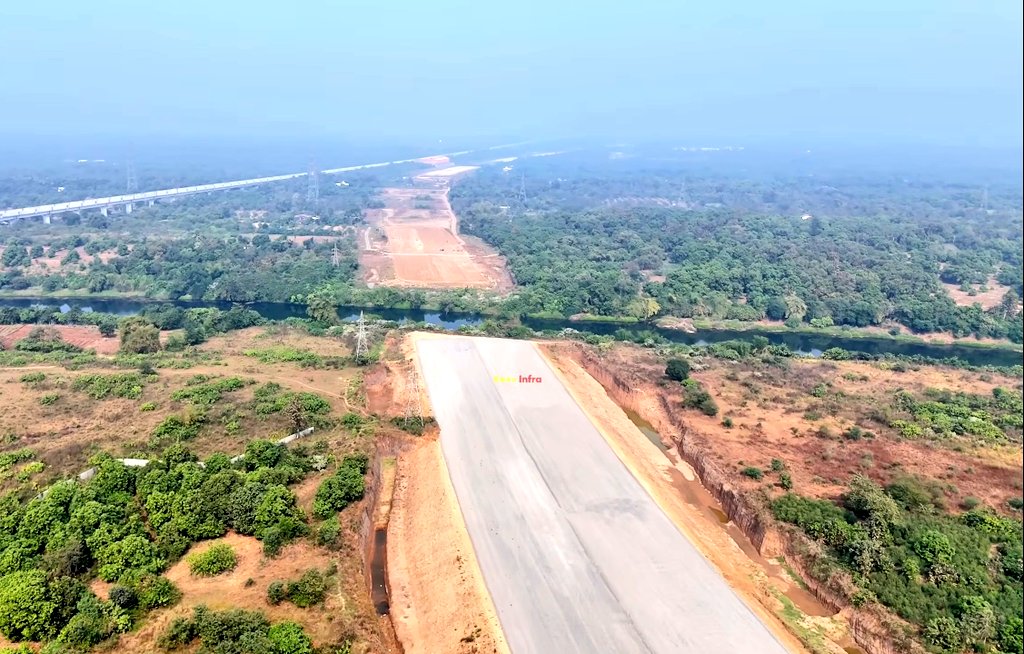
Construction activity has resumed on Package 9 of the Delhi–Mumbai Expressway’s Vadodara–Virar section, signalling renewed progress on one of India’s key national infrastructure corridors. The 26.6 km stretch, connecting Karvad village near NH-56 to Jujwa village at the Valsad interchange, serves as a strategic link between the Vapi and Valsad interchanges and is critical for regional mobility and freight movement.
The National Highways Authority of India (NHAI) initiated the resumption after issuing cure period notices to the contractor responsible for the delayed work, underlining the authority’s proactive oversight in enforcing project timelines. This follows a recent contract termination for Package 8 of the same corridor due to unsatisfactory performance, highlighting accountability measures increasingly being applied across high-priority expressway projects. On-ground updates indicate that foundational activities such as Dry Lean Concrete (DLC) work and earthwork have restarted at multiple points along the corridor. In several sections, the Granular Sub-Base (GSB) layer is now visible, marking initial progress towards pavement construction. Flyover construction at the NH-56 interchange is in early stages, with pillar erection ongoing, while ramp development continues at the earthwork level. Despite the uneven pace, experts suggest that the renewed momentum is likely to accelerate overall project completion.
Urban infrastructure analysts note that Package 9 plays a pivotal role in enhancing intercity connectivity in the western corridor, reducing travel times between Gujarat and Maharashtra, and facilitating logistics efficiency for industrial clusters in Vapi and Valsad. The project also complements India’s broader goals of decongesting older national highways and promoting sustainable transport infrastructure, with design considerations increasingly integrating drainage management and long-term pavement durability. Recent delays have drawn attention to challenges in large-scale expressway projects, including contractor performance, project monitoring, and resource mobilisation. Senior officials emphasise that robust enforcement mechanisms, including cure period notices and potential contract termination, are essential tools to mitigate project stagnation. The case of Package 9 illustrates how oversight interventions can trigger tangible work resumption while signalling the importance of strict adherence to project timelines across multi-package infrastructure projects.
From an economic perspective, timely completion of this expressway segment is expected to enhance regional trade, support supply chains for industrial units, and improve passenger travel safety and reliability. Urban planners highlight that such corridors not only reduce vehicle emissions by easing congestion but also create employment opportunities through ongoing construction and related ancillary activities. While construction progress remains uneven, the resumption of activity on Package 9 offers a positive indicator for the wider Vadodara–Virar section. Officials suggest that with continued monitoring and effective contractor management, the corridor can maintain momentum toward its scheduled operational targets, contributing to a more connected, climate-resilient national transport network.
Delhi Mumbai Expressway Work Resumes Package Nine