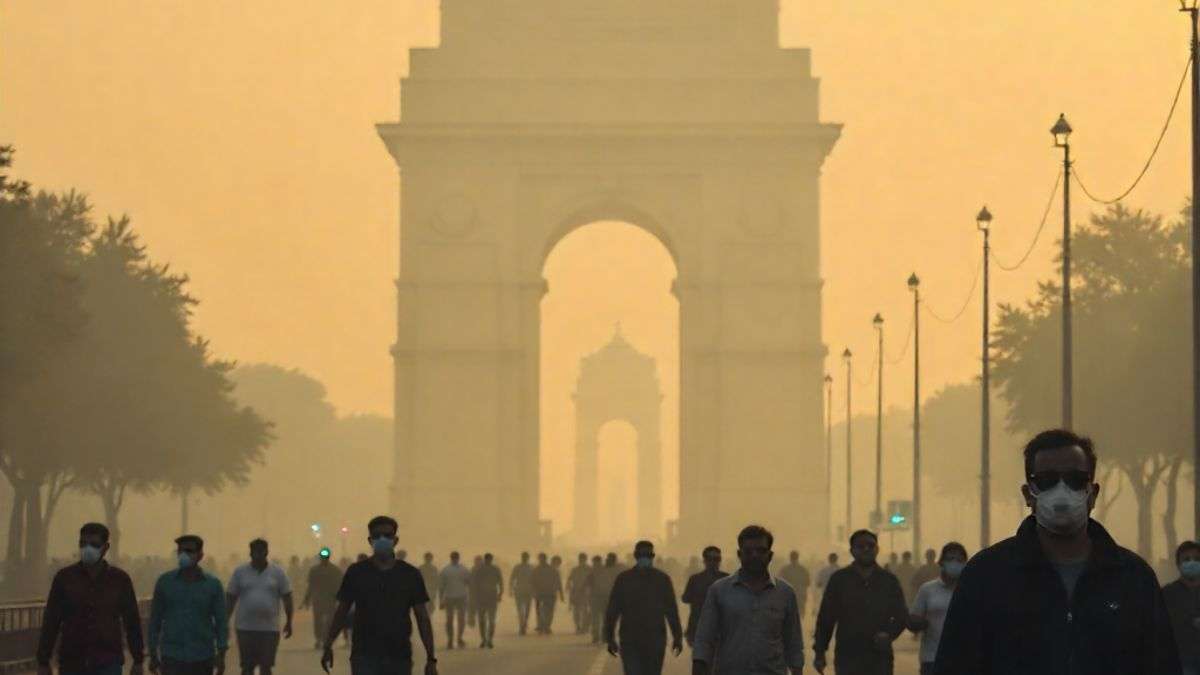
Delhi’s air quality deteriorated sharply on Friday morning as dense smog settled across the capital and adjoining urban districts, pushing pollution levels back into a range that disrupts daily life and economic activity. Monitoring data showed air quality readings edging towards severe thresholds in several localities, underscoring the persistent vulnerability of India’s largest urban cluster to seasonal pollution spikes.
While the citywide average remained within the ‘poor’ classification, multiple neighbourhoods recorded readings beyond the 300 mark, a level associated with respiratory stress and reduced outdoor productivity. Urban health specialists warn that such conditions disproportionately affect senior citizens, children, outdoor workers, and residents in high-density housing, where ventilation options are limited. The return of poor Delhi air quality comes at a time when winter meteorological conditions restrict pollutant dispersion. Low wind speeds and temperature inversions trap emissions close to the ground, amplifying the impact of vehicular exhaust, construction dust, and regional biomass burning. City officials acknowledged that these recurring patterns challenge both short-term response measures and long-term urban planning goals.
Meteorological agencies have indicated the possibility of light rainfall over the coming days, which could provide temporary relief by washing out airborne particulates. However, environmental planners caution that episodic weather interventions do not address structural emission sources. “Rain offers a brief reset, not a solution,” said an urban climate expert, noting that cities must reduce baseline pollution loads to achieve sustained improvement. From an economic perspective, deteriorating air quality has direct and indirect costs. Reduced labour efficiency, increased healthcare spending, and disruptions to logistics and mobility collectively weigh on urban productivity. Real estate analysts also point out that persistent pollution episodes influence housing demand, with buyers increasingly favouring developments offering cleaner indoor environments, green buffers, and proximity to mass transit.
Public infrastructure remains under pressure during such episodes. Schools, transport authorities, and healthcare providers must recalibrate operations as air quality fluctuates. Transport planners argue that accelerating electric mobility adoption, improving last-mile public transport, and enforcing construction-site compliance are essential to reduce exposure during peak pollution months.
The current episode reinforces the urgency of integrated air-quality governance across the National Capital Region. Experts emphasise that city-specific action plans must align with regional coordination, particularly on transport emissions and industrial activity beyond municipal boundaries.
Without this alignment, local gains risk being offset by cross-border pollution flows.
As Delhi braces for the remainder of the winter season, policymakers face a familiar test: whether short-term advisories can evolve into durable reforms. Strengthening clean energy transitions, expanding urban green cover, and embedding air-quality resilience into housing and transport planning will be central to protecting public health and sustaining economic momentum in one of India’s most critical urban regions.
Delhi Smog Conditions Strain Health Systems