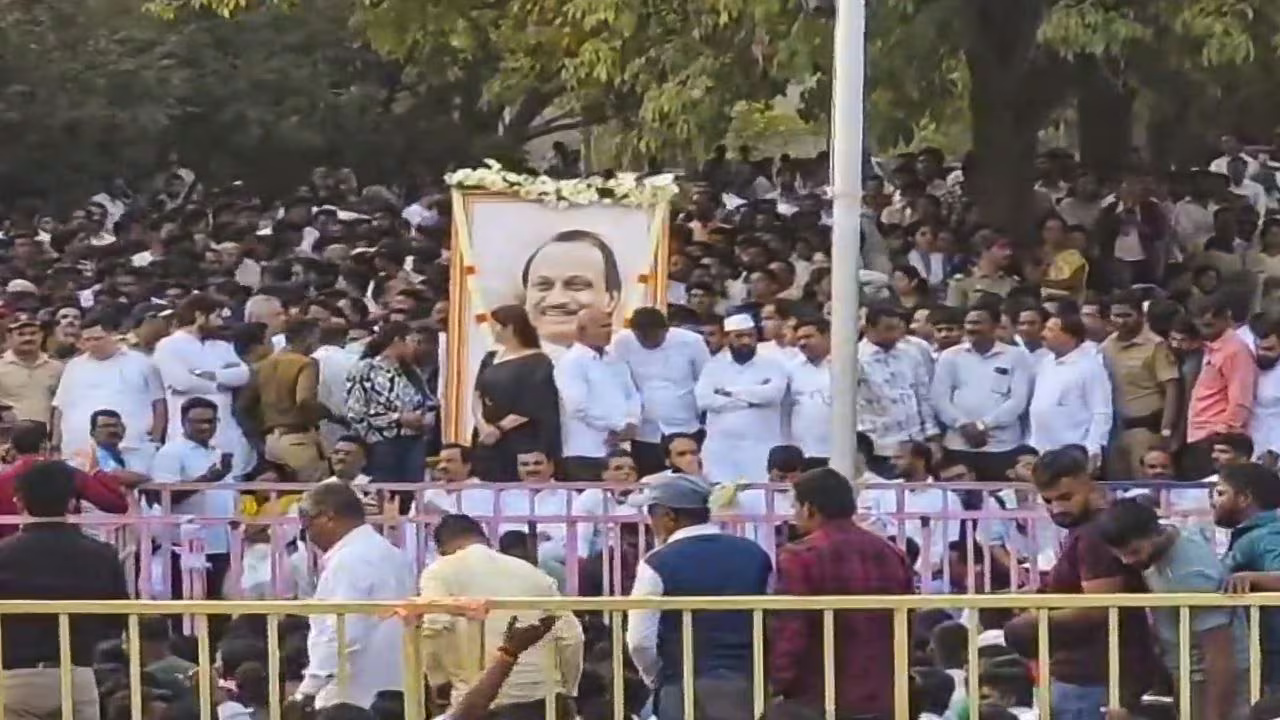
Baramati witnessed an unprecedented public gathering on Thursday as thousands assembled to pay their final respects to a senior state leader who died in a chartered aircraft crash earlier this week. The funeral marked not only a moment of collective mourning but also underscored the deep civic and developmental imprint the leader left on Maharashtra’s political and urban landscape.
Residents from across western Maharashtra arrived in Baramati from early morning, converging near the family village and public institutions associated with the leader’s decades-long public life. The scale of the turnout prompted large-scale traffic diversions, crowd management measures, and heightened security, coordinated by district authorities to ensure public safety and continuity of essential services. Senior figures from the Union government and the state administration attended the last rites, reflecting the national political significance of the leader’s role in shaping infrastructure policy, rural development frameworks, and cooperative-led economic growth. Officials present described the gathering as one of the largest public funerals witnessed in the region in recent years.
The mortal remains were transported from a government medical facility to the funeral venue under police escort, with civic agencies managing sanitation, water supply, and emergency response arrangements. Urban planners noted that the event offered a real-time stress test for Baramati’s public infrastructure, highlighting both its strengths and the urgent need for resilient crowd-management planning in mid-sized cities. The aircraft accident that claimed the leader’s life, along with four others including flight crew and security personnel, has triggered a multi-agency investigation. An accidental death report has been registered locally and will be transferred to the state’s specialised crime investigation wing, following established legal procedure. Parallelly, the national aircraft accident investigation authority has assumed technical oversight of the crash inquiry under civil aviation protocols.
Officials involved in the probe indicated that documentation related to aircraft maintenance, crew certification, and air traffic coordination will be examined alongside digital records such as radar data and communication logs. Findings from the investigation are expected to inform future aviation safety norms, particularly for chartered flights serving regional airports. Beyond the tragedy, urban policy experts observed that the leader’s legacy is closely tied to investments in irrigation networks, road connectivity, educational institutions, and cooperative housing models—many of which continue to influence development planning across Maharashtra. The scale of public response, they noted, reflects how infrastructure-led governance can forge long-term social trust when aligned with local needs.
As Baramati returns to routine civic operations, authorities are expected to review emergency preparedness, aviation safety coordination, and public space management lessons emerging from both the accident and the mass gathering. For rapidly growing regional cities, the episode reinforces the importance of resilient infrastructure systems capable of responding to both crisis and collective public emotion.
Baramati Witnesses Huge Public Turnout At Ajit Pawar Last Rites