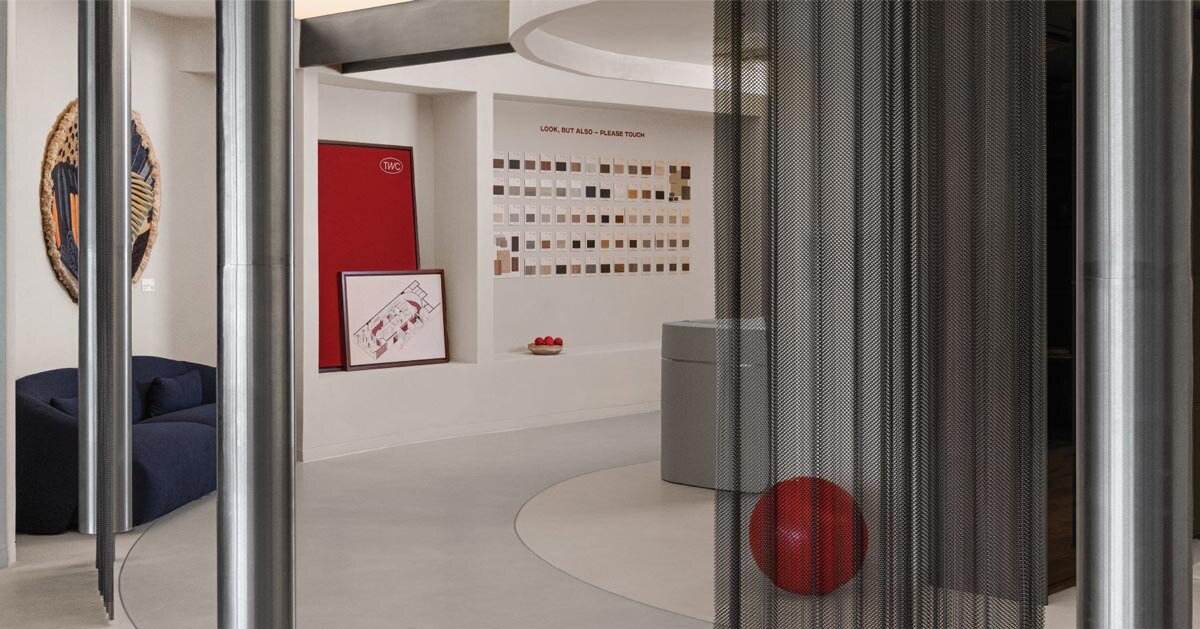
A newly completed showroom in South Delhi is drawing attention within architecture and real estate circles for how it reframes retail as an immersive spatial journey rather than a conventional display environment. Designed by Studio Dot and located in the Okhla industrial district, the project reflects shifting priorities in India’s urban commercial spaces, where experience, adaptability, and material performance are increasingly shaping built outcomes.
The showroom emerges at a time when physical retail formats across Indian cities are being re-evaluated. As digital platforms absorb transactional functions, on-ground spaces are evolving into environments for interaction, learning, and material demonstration. Urban development specialists say this transition is particularly evident in construction and infrastructure-linked showrooms, which now operate as hybrid zones connecting design professionals, suppliers, and end users.Studio Dot’s design is organised around a continuous internal loop that allows visitors to move freely without prescribed entry or exit points. This circular circulation eliminates linear retail hierarchies, encouraging intuitive movement and extended engagement. Urban planners note that such layouts support inclusive, people-first design by reducing congestion, improving spatial legibility, and accommodating diverse user behaviours.
Material expression is central to the project’s architectural language. Exposed concrete surfaces, visible steel elements, and restrained finishes prioritise structural clarity over decorative layering. Industry experts observe that this approach aligns with a broader shift in commercial architecture towards durability and resource efficiency, especially as developers face rising construction costs and increasing scrutiny of embodied carbon. By minimising secondary finishes, interiors can achieve longer lifespans with lower maintenance demands.The project also reflects a wider transformation underway in Okhla and similar industrial precincts across Indian cities. Once dominated by manufacturing and storage uses, these areas are increasingly accommodating studios, experience centres, and creative workplaces. Real estate analysts suggest that such adaptive reuse contributes to more balanced urban growth by activating existing infrastructure rather than pushing development into peripheral greenfield zones.
Lighting within the showroom has been calibrated to emphasise surface texture and depth, allowing visitors to understand how materials respond under varied conditions. For professionals involved in housing, infrastructure, and urban redevelopment, this experiential clarity supports better specification and decision-making.
Looking ahead, projects like this highlight how architectural practice is responding to economic, environmental, and urban pressures simultaneously. As cities seek lower-impact construction methods and more meaningful public-facing spaces, experiential commercial interiors may become an important testing ground for resilient, adaptable urban design.