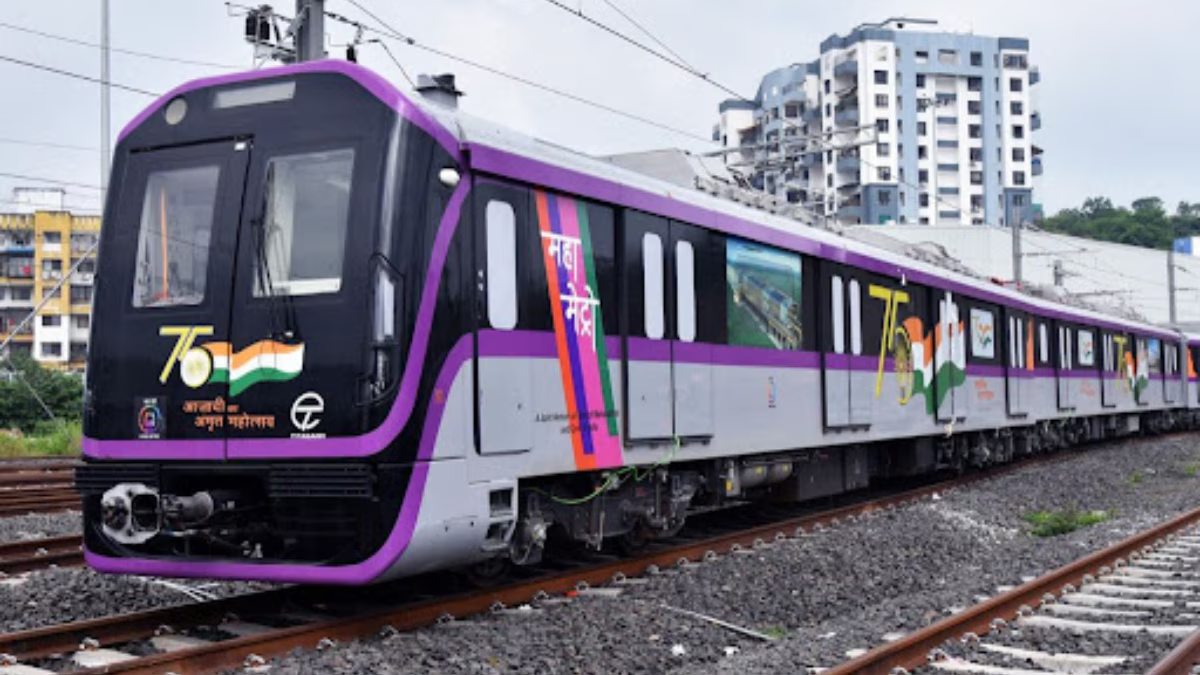
Pune’s long-planned east–west metro corridor has triggered a renewed debate on how large infrastructure projects should be integrated into dense urban corridors, as civic leaders and planners raise concerns over its proposed alignment along Sinhgad Road. The issue highlights a broader challenge facing fast-growing Indian cities: delivering mass transit without undermining road safety, structural resilience, or daily mobility. At the centre of the discussion is the proposal to construct an elevated metro line above the Sinhgad Road flyover, a critical arterial route connecting residential clusters in the city’s south-west with employment hubs in the east. A senior elected representative has formally urged the Pune Municipal Corporation to examine alternative alignments along the riverbed or adjoining canal road, arguing that this could significantly reduce construction disruption and long-term urban stress.
According to municipal documents reviewed by this publication, the current design would require multiple structural interventions on the existing flyover to accommodate metro pillars. Urban engineers caution that such retrofitting often leads to prolonged traffic bottlenecks, increased maintenance costs, and potential structural fatigue particularly on corridors already operating beyond designed capacity. The Sinhgad Road stretch carries a mix of private vehicles, buses, pedestrians, and freight traffic, making it one of Pune’s most congested zones during peak hours. Transport planners note that construction-related lane reductions on such corridors can ripple across neighbouring areas, affecting commute times, fuel consumption, and air quality. From a climate and liveability standpoint, these impacts run counter to the city’s broader mobility and emissions-reduction goals.
The metro corridor, approved after completion of the flyover, is expected to play a strategic role in linking peripheral growth zones with established commercial districts. Real estate analysts say its alignment will influence land values, redevelopment patterns, and transit-oriented development potential for decades. A route positioned away from the main carriageway could preserve road capacity while opening up opportunities for greener, multimodal public spaces along waterways or service corridors. Urban design experts also point to the visual and spatial consequences of stacking infrastructure layers in already dense neighbourhoods. Elevated viaducts over narrow roads can reduce daylight, restrict pedestrian movement, and complicate future upgrades. In contrast, canal-side or river-edge alignments, if carefully planned, offer scope for integrated cycling paths, service roads, and climate-resilient public realms.
Municipal officials indicate that alignment reviews remain technically possible at this stage, though they require coordination with state and central agencies. As Pune expands, such decisions are increasingly seen as tests of institutional capacity to balance speed of execution with long-term urban value. For residents and businesses along the corridor, the outcome will shape not just commute times, but the quality and resilience of the city’s built environment. The debate underscores a growing recognition that metro projects must serve mobility goals while reinforcing, rather than straining, the urban fabric they traverse.