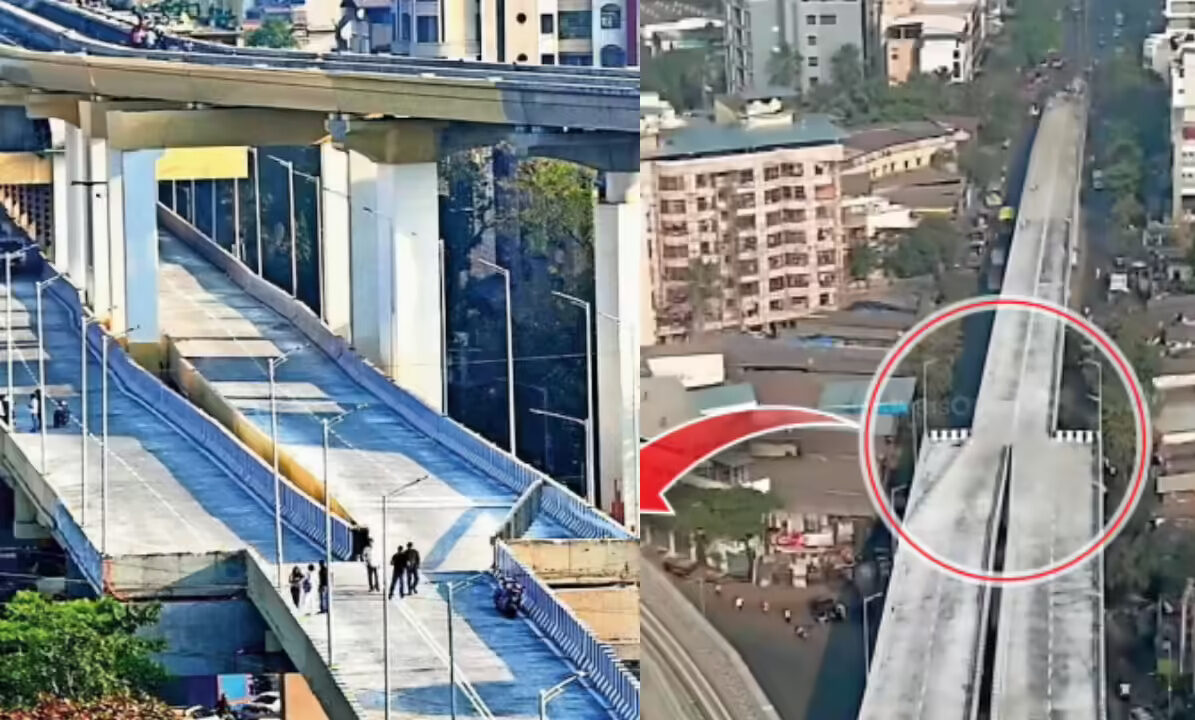
A newly opened flyover in Mira-Bhayander on Mumbai’s northern edge has come under public and professional scrutiny after commuters flagged a sudden reduction from four traffic lanes to two, raising concerns around road safety and congestion management. The structure, part of the Metro Line 9 double-decker corridor, has reignited debate on how transport infrastructure is being integrated into fast-growing suburban urban environments.
The controversy centres on a 1.5-kilometre stretch near a key hospital junction in Bhayander East, where motorists encounter an abrupt lane drop while approaching the flyover. Images and videos circulating online prompted questions about whether the design could increase accident risk, particularly during peak hours when traffic volumes are high and mixed vehicle movement is common. In response, the Mumbai Metropolitan Region Development Authority stated that the configuration reflects engineering constraints rather than a design lapse. Officials said the lane arrangement was determined by limited right-of-way availability and future expansion plans, noting that the current structure carries two operational lanes in one direction while reserving space for additional lanes to be developed in a later phase, subject to inter-agency approvals and railway coordination.
Urban transport experts, however, point out that lane transitions are among the most sensitive elements of road design, especially in dense metropolitan regions. Sudden reductions without extended taper lengths, speed-calming measures, and visual continuity can increase conflict points between vehicles. They argue that while future-proofing infrastructure is necessary, present-day safety and traffic behaviour must remain the primary design drivers. The flyover is part of a larger double-decker viaduct that combines metro rail infrastructure with road traffic, a model increasingly used in Mumbai’s constrained urban corridors. Other segments of the corridor have already been opened to traffic, and authorities maintain that the project is intended to improve traffic dispersal and reduce surface-level congestion once fully completed.
Officials said multiple safety measures, including advance signage, crash barriers, and rumble strips, are being incorporated, with inputs from traffic enforcement agencies before full commissioning. They also indicated that on-ground modifications could be considered after traffic patterns stabilise and operational data is reviewed. From an urban planning perspective, the episode highlights the challenges of delivering large-scale infrastructure in built-up suburbs where land acquisition, municipal coordination, and climate resilience requirements intersect. As Mira-Bhayander continues to urbanise rapidly, transport infrastructure is expected to absorb rising commuter demand while remaining inclusive, safe, and adaptable to future growth.
Civic planners note that transparent communication around design intent and phased development is critical to maintaining public trust. With road safety and sustainable mobility now central to metropolitan policy, projects like this are likely to face closer scrutiny — not only for what they promise in the future, but for how they perform for citizens today.
MMRDA Flyover Design Draws Mira Bhayander Scrutiny