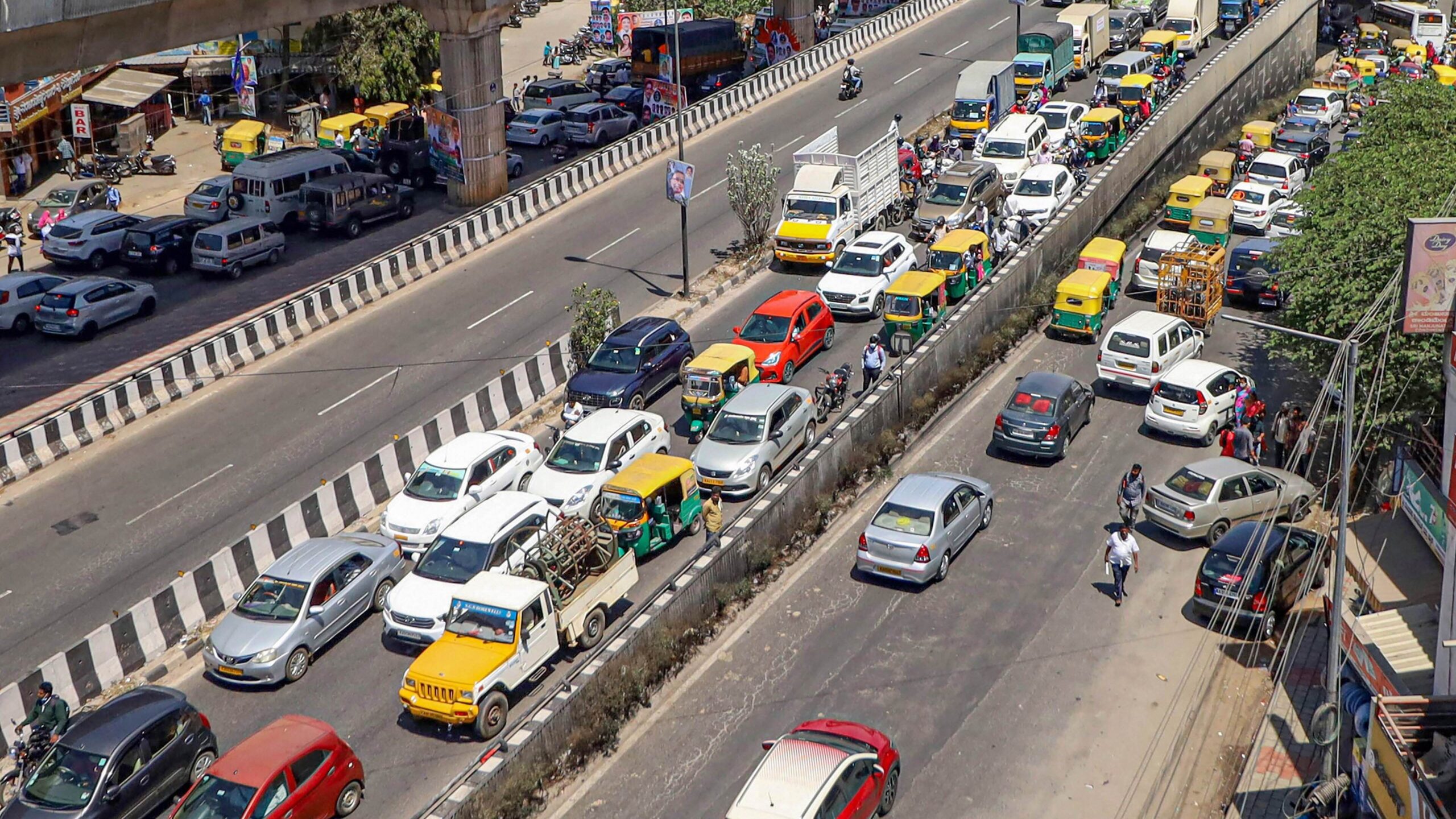
Bengaluru’s road network came under visible stress on Monday as the city returned to full working mode after a long holiday break, triggering widespread congestion across key arterial corridors. From industrial belts in the north to central transit hubs, extended delays disrupted office commutes, logistics movement and emergency access highlighting the fragile balance between travel demand and urban capacity in India’s technology capital. Traffic slowed sharply across multiple junctions during peak morning hours, with vehicle queues stretching well beyond usual weekday patterns.
Commuters navigating northern and central Bengaluru reported prolonged waits at major intersections, while feeder roads leading to employment clusters experienced spillover congestion. Urban mobility analysts say the scale of disruption reflects pent-up travel demand combining with routine weekday volumes, rather than any single incident or closure. The episode underscores how Bengaluru traffic congestion is increasingly shaped by behavioural patterns as much as infrastructure gaps. Holiday-driven outmigration followed by near-simultaneous returns places pressure on roads that already operate close to saturation. With private vehicles accounting for a significant share of daily trips, even marginal increases in volume can trigger cascading delays across the network. Public transport nodes were also affected, particularly in areas where bus terminals, metro interchanges and informal drop-off points converge. Slow-moving traffic around these hubs disrupted last-mile connectivity, extending commute times for workers reliant on multi-modal travel.
Urban planners note that such bottlenecks carry economic costs beyond individual inconvenience, including lost productivity, fuel wastage and increased local air pollution. The impact on emergency response drew particular concern. Urban safety experts warn that prolonged gridlock compromises ambulance movement and response times, especially in dense central districts. This raises questions about whether current traffic management protocols are equipped to prioritise emergency corridors during peak congestion events. From a broader urban development perspective, Monday’s disruption reflects structural challenges facing fast-growing cities. Bengaluru’s employment geography has expanded faster than its transport capacity, while residential growth continues along peripheral corridors with limited mass transit coverage. As offices gradually reinstate in-person attendance, weekday traffic volumes are expected to remain elevated.
Officials familiar with traffic operations point to the need for more dynamic demand management, including staggered office timings, improved real-time signalling and stronger incentives for public and shared transport use. Urban economists add that sustained investment in metro expansion, bus priority lanes and walkable commercial districts will be critical to reducing car dependency over the medium term. As Bengaluru positions itself as a climate-resilient and economically competitive city, episodes of severe congestion serve as reminders that mobility planning must keep pace with growth. Without coordinated action linking land use, transport and work patterns, post-holiday traffic surges may become a recurring feature rather than an exception.