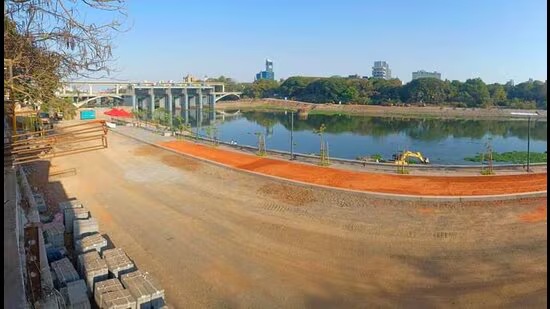
Pune Riverfront Development Tests Public Urban Space
Pune is preparing to open a long-awaited section of its river-edge public realm, with the civic administration set to allow limited public access to a newly completed stretch along the Mula–Mutha in mid-February. The move marks the first tangible delivery under the Pune Riverfront Development programme and signals a shift in how the city approaches its neglected river corridors.
The initial opening covers a 1.5-kilometre promenade near the river confluence area, scheduled to coincide with the municipal body’s foundation celebrations. Access will be regulated during morning and evening hours, primarily for walking and cycling. Urban planners view the decision as a cautious but significant step in testing how citizens engage with reclaimed riverfront space in a dense and traffic-heavy city. The broader Pune Riverfront Development plan spans approximately 44 kilometres within municipal limits, positioning it among the country’s more ambitious urban river initiatives. The first phase concentrates on a 3.7-kilometre segment linking key central neighbourhoods, where officials indicate that most structural and landscaping work has been completed. Parallel construction is underway on longer downstream and upstream sections, with future phases expected to introduce public amenities, shaded walkways, and themed civic zones.
For Pune, the project carries implications beyond recreation. Urban economists point out that riverfront access can improve neighbourhood liveability, stabilise adjacent property values, and reduce pressure on overused public gardens. However, they caution that long-term gains depend on maintenance standards, flood resilience, and equitable access rather than visual upgrades alone. Environmental considerations remain central to public scrutiny. The rivers have historically functioned as informal drains for untreated waste, and past clean-up efforts have struggled with enforcement and upstream pollution. Civic officials have highlighted ecological restoration measures, including increased tree cover and controlled embankments, but independent experts stress that river health will ultimately depend on sewage interception and consistent water quality monitoring.
The administration has indicated that around five kilometres of continuous riverfront could be completed by the end of the current financial year, with a formal inauguration planned later once elected representatives are in place. Until then, the limited opening is being treated as a live pilot to assess crowd management, safety, and environmental impact. As Indian cities compete to attract investment and talent through improved quality of life, projects like the Pune Riverfront Development are increasingly seen as urban infrastructure rather than beautification. The coming months will reveal whether Pune’s experiment can balance public access, ecological responsibility, and long-term economic value or whether it risks becoming another constrained civic asset in a rapidly expanding metropolis.