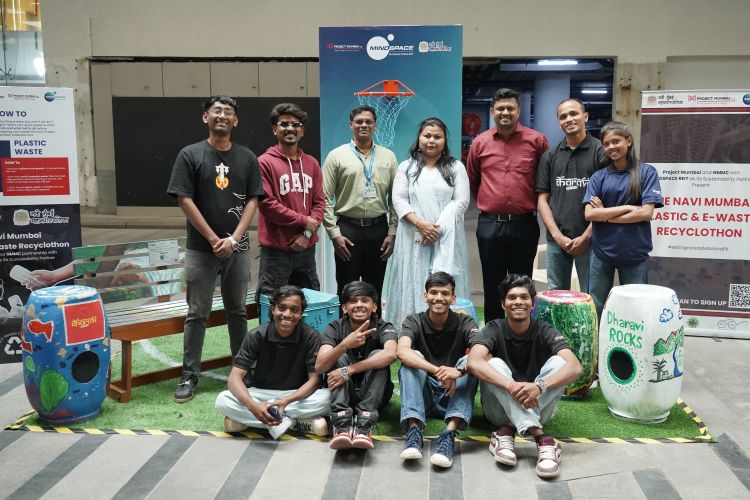
Navi Mumbai Business Parks Lead Plastic Recyclothon Initiative
A major waste‑reduction effort has taken root within one of the city’s largest commercial ecosystems, with Mindspace Business Parks REIT integrating workplace communities into a broader plastic recycling campaign that aims to support circular urban development across Navi Mumbai. The initiative embeds corporate participation within a city‑wide Plastic Recyclothon, linking daily habits to measurable civic outcomes and advancing collaborative approaches to reduce plastic pollution while generating community assets.
Over the next month, Mindspace Business Parks REIT is driving a gamified plastic collection challenge at its Airoli East and West campuses, engaging nearly 100,000 professionals who work in these commercial hubs. The activation is part of Navi Mumbai Municipal Corporation’s (NMMC) broader Recyclothon, conducted in partnership with urban civics organisation Project Mumbai and supported by structured workplace participation. Plastic collected by employees and tenants will be sent to authorised recyclers and then repurposed into benches and other civic assets for municipal schools — a visible manifestation of circular waste practices that connect corporate campuses to the broader urban community. Urban planners highlight this convergence of corporate campuses and municipal sustainability goals as a template for integrating environmental stewardship into daily professional life. By framing recycling through interactive installations and behaviour‑change incentives, the programme seeks to make responsible waste management habitual for knowledge‑economy workers — a demographic that often drives cultural norms in dense metropolitan regions. This approach aligns with emerging urban strategies that position business districts as active agents in local environmental goals, rather than passive stakeholders.
Mindspace REIT’s involvement builds on its ongoing environmental, social and governance (ESG) commitments. Beyond this campaign, the REIT’s waste management practices include stringent controls on single‑use plastics across its properties and integrated waste streams that divert organic material and construction debris from landfill. Such corporate waste frameworks contribute to broader emissions and resource‑use reduction efforts that are increasingly expected by investors and regulators alike, especially in high‑growth regions like Navi Mumbai. Economists and sustainability experts say corporate participation in civic waste efforts can amplify municipal capacity, especially as cities like Navi Mumbai grapple with high population growth and waste‑management challenges. Encouraging corporate ecosystems, educational institutions and resident associations to co‑ordinate waste diversion not only reduces landfill dependency but also complements infrastructure planning for climate resilience and public health.
Crucially, the plastic drive embodies circular economy principles — reduce, reuse, recycle — by transforming discarded materials into community infrastructure. This resonates with city planners’ broader objective to create low‑waste urban systems, where materials remain in productive use and local deficits in public amenities are addressed through repurposed outputs rather than new raw resource consumption. But scaling such models beyond corporate campuses requires conditions that encourage sustained participation: aligning collection systems with local recycling capacity, continuous public engagement, and transparent tracking of environmental benefits. Urban development experts stress the importance of creating feedback loops that show participants how their contributions tangibly reduce waste and support civic outcomes.
As the Recyclothon unfolds, the Navi Mumbai case offers a scalable example of how workplace engagement, municipal governance and community organisations can collaborate to address entrenched sustainability challenges, positioning the metropolitan region as a leader in integrated, inclusive, and zero‑waste urban growth.