


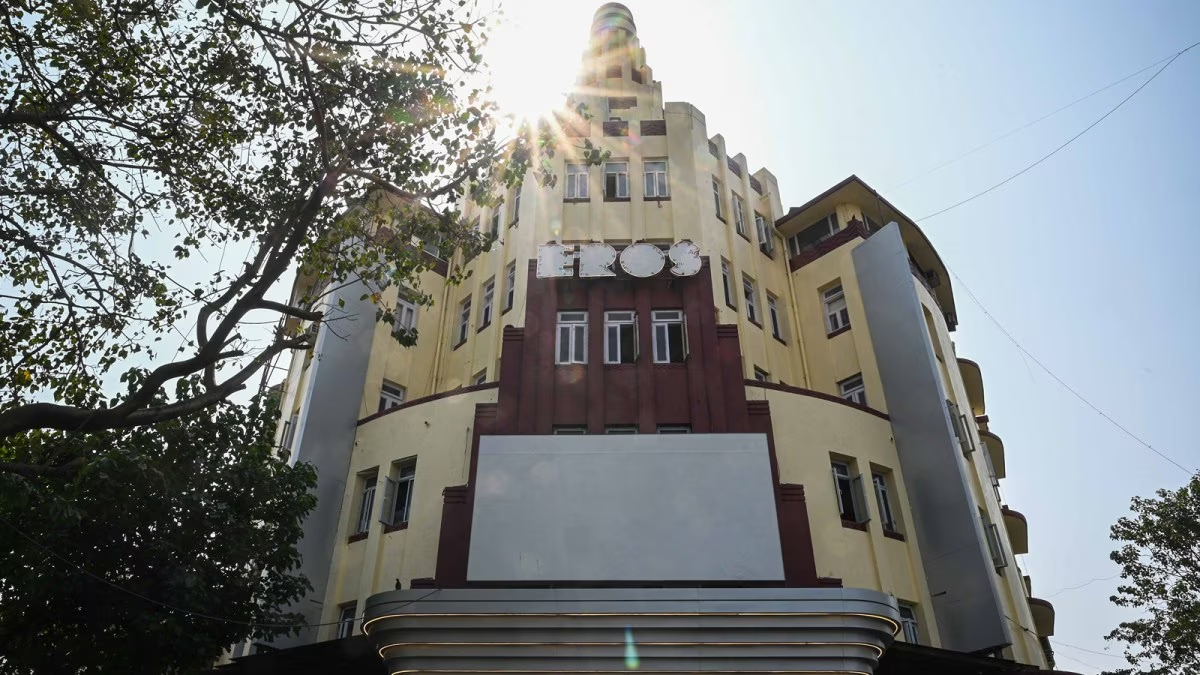
A landmark cinema property facing Mumbai’s busiest transit hub has entered a new phase of stewardship, marking a rare instance where private capital intersects with civic conservation. The 140-year-old Capitol Cinema building, situated opposite Chhatrapati Shivaji Maharaj Terminus, will undergo repairs and upgrades under strict heritage regulations, reinforcing the city’s cautious approach to preserving its historic core amid relentless redevelopment pressure.
Publicly registered lease documents indicate that a retail-focused real estate platform under a large Mumbai-based conglomerate has acquired the leaseholding entity that controls the property. The transaction does not alter land ownership, which remains with the municipal authority, but transfers operational responsibility for the building’s upkeep and compliance. For urban planners, the development underscores how heritage assets are increasingly being managed through corporate custodianship rather than demolition-led redevelopment. The civic body renewed the lease for a ten-year period beginning mid-2025, subject to explicit conditions. Land use remains limited to cinema, retail and residential functions, effectively ruling out commercial intensification or vertical expansion. Officials familiar with the process say the renewal was contingent on binding commitments to restore structural integrity while retaining architectural character, particularly given the building’s visibility within Mumbai’s most sensitive heritage precinct. Urban conservation experts note that the site’s classification under Mumbai’s heritage regulations places it among structures of significant local importance. Any repair work will require prior approvals, detailed material specifications and ongoing monitoring. “This is not adaptive reuse in the commercial sense,” said a heritage architect involved in similar projects. “It is custodial intervention aimed at prolonging the life of a public-facing historic asset.”
The Capitol Cinema precinct holds symbolic value beyond architecture. Developed during the early decades of organised cinema in Bombay, the building once served as a social anchor for the colonial-era business district. Its survival, planners argue, contributes to urban continuity in a city where cultural memory is often displaced by real estate cycles. From a market perspective, the transaction reflects a growing segmentation in Mumbai’s property sector. While large developers aggressively pursue transit-oriented high-density projects elsewhere, heritage zones demand patient capital, long-term returns and regulatory compliance. Analysts say such assets increasingly attract institutional owners seeking stability and reputational value rather than rapid monetisation. The restoration also aligns with broader sustainability goals shaping Mumbai’s urban policy. Extending the life of existing structures reduces construction waste, embodied carbon and infrastructure strain an approach increasingly favoured in climate-resilient city planning.
As approvals progress, attention will remain on execution. For citizens, the outcome will signal whether Mumbai can protect its historic public spaces while accommodating private investment without compromising heritage, access or urban equity.
Also Read: Pune Plans Underground Roads To Ease Congestion
Mumbai Heritage Cinema Enters Restoration Phase
